Video transcript
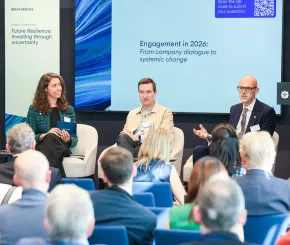
Speakers
Gemma Gooch – Head of Charities Distribution, Rathbones
David Coombs – Head of Multi-Asset Investments, Rathbones
Bev Shah – Co-Chief Executive, City Hive
Mona Shah – Head of Investments, Single Family Office
Vicky Hickey – Joint Chief Executive, Wiltshire & Swindon Community Foundation
Transcript
Introducing the panel discussion
Gemma: We’re now turning to what is within a charity’s control: the quality of its decision-making when external pressures hit.
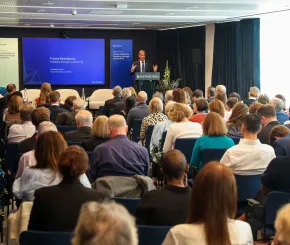
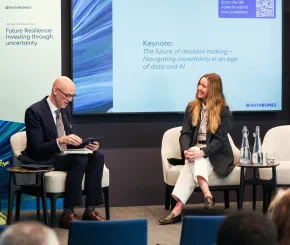
For the next session, we’re moving to the boardroom. We would like to welcome David Coombs, Head of Multi-Asset Investments at Rathbones and co-manager of Rathbones’ two charity multi-asset funds, alongside a panel of leading experts and practitioners. David, welcome to the stage.
David: Thank you, and good afternoon.
Let’s begin with culture. People sometimes talk about culture as though it is a bit soft. However, when I meet the chief executives and chief financial officers of companies, I see culture as one of the biggest risks to a business.
I’m going to share an example of poor culture and explain how it affected the way I think about risk. Before that, I have a few questions on Slido that I would like you to answer.
The first is: what factor is most important when assessing an investment manager? It isn’t a trick question.
That’s very interesting. I’m surprised, but pleasantly surprised. I don’t think we would receive that answer from all our client groups. It also sets up our panel brilliantly, so thank you.
Let me test you again. Which investment manager model do you believe presents the greatest level of risk? There have been some high-profile examples that you may be thinking about, but I don’t want to influence the audience.
How poor culture contributed to the collapse of Barings
David: I promised you a secret, which is a big promise.
Back in 1995, before most of you were born, I was working at Barings. I was a junior investment manager in Guernsey, in a private banking operation that was a separate part of the Barings organisation.
We had a treasury department and held many client deposits, including money belonging to charities. I managed the Barings charity. Because we were a private bank, those cash deposits were placed with 20 large international banks each night. This kept them off our own balance sheet and was intended to protect them from any poor activity elsewhere in the organisation, such as in Singapore.
It was all going well until the head of treasury in London telephoned the head of treasury in Guernsey, whom I’ll call Chris. He said, in a brilliantly British way, “We’ve got a bit of a problem in Singapore. There’s a hole in the bank balance. Can you get all those deposits back from the 20 institutions and send them to us?”
Chris said, “Absolutely,” and did it.
Was Chris simply foolish? Perhaps. But the more important question is what this tells us about the culture at Barings at the time.
Barings was a very traditional, blue-blooded bank. It had traders in Singapore trading the bank’s entire balance sheet and allowed them to sign off their own audits.
There was a rogue trader, but the wider risk was cultural. It was a hierarchical bank in which nobody challenged anybody else. If your boss told you to jump off a cliff, you jumped. That is what Chris did.
If he had said no, the Guernsey operation would not have gone into bankruptcy. Guernsey did not have a bankruptcy regime at the time, so we traded illegally for three weeks, with the local regulator’s permission, to keep the operation afloat and prevent clients’ money from being put at risk.
Chris’s decision to say yes to his boss, because he was too frightened to say no, had a lasting effect on how I think about risk and analyse companies.
Risk can arise from complacency, poor culture and bullying, and it can happen anywhere. When assessing an asset manager, trustees need to understand whether its people are prepared to challenge decisions rather than simply following a leader over the cliff.
Meet the panellists
David: I’m now going to join the panel and explore some of these points. Each panellist brings a different perspective. Rather than introduce them myself, I’ll ask them to introduce themselves, starting with Bev.
Bev: David knows me well enough to know I can talk for England, so I’ll keep it short.
I’m Bev Shah, Co-Chief Executive of City Hive. We are the architects and operators of the ACT corporate culture standard for investment companies.
Before setting up City Hive and launching the standard, I spent several decades in the investment industry analysing investment managers and asset managers as a fund researcher. I know the industry well, and I believe corporate culture sits at the heart of investment decision-making.
David: Mona.
Mona: Hi, everybody. I began my career here 20 years ago. Since then, I’ve worked in family offices, on the institutional side and with sovereign wealth funds. I’m now back in the family office world, where I probably belong.
I also spend a significant amount of time on the investment committee for the endowment at Jesus College, Oxford, where we have a highly ambitious net zero target to meet alongside our investment objectives. I also work with Bev on culture and governance.
David: And Vicky.
Vicky: Hi, everyone. I’m Vicky Hickey, Joint Chief Executive of Wiltshire & Swindon Community Foundation.
We are the oldest community foundation in the UK and Europe and are now 51 years old. Community foundations are place-based funders. Wiltshire and Swindon is my place, and it is a place I will always champion.
We provide grants to local groups and individuals. We also work with philanthropists, charitable trusts and companies that want to give within their local area.
David: In the interests of full transparency, I’m a trustee of Wiltshire & Swindon Community Foundation. I also worked with Mona at Rathbones many years ago, and Bev and I have known each other for a long time.
Bev is chair of City Hive’s strategic council, and I also sit on that council. Given my experiences, culture is unsurprisingly important to me. We need challenge within the organisations with which we work.
What organisational culture means in practice
David: Bev, let’s start by bringing this to life. What is organisational culture? What does it mean in practice, what does it look like and why should this audience care about it?
Bev: This isn’t simply about HR policies or people learning about the structure of an organisation.
When you invest with an asset manager, what are you buying? You’re buying decision-making. You’re buying people’s skills.
The investment management industry doesn’t manufacture anything, although I would like to think we make money occasionally. What we do is package people’s decision-making skills.
Corporate culture provides the environment in which those people make decisions about your money and your beneficiaries’ money. It also affects your own money, because I presume that most people here have some form of pension or investment.
Culture also tells you how an organisation is likely to steward its clients’ assets. During a downturn, you want to know that it will put clients’ assets first rather than prioritising its own interests.
I worked in asset management during 2007 and 2008. Some firms cared deeply about protecting their beneficiaries, while others were primarily concerned about protecting their own ecosystem. That is why corporate culture matters to everyone in this room.
David: In my Barings example, Chris was worried about his boss rather than his clients.
You described culture as nebulous. It can be difficult for an outsider to assess. I know Rathbones’ culture and hope that I help to shape it. But if I’m talking to the chief executive of a large listed company, I may hear a lot of marketing language and corporate straplines.
What are the signs of a healthy culture? Conversely, what indicates an unhealthy culture?
Bev: When you assess a company, you don’t look only at its spreadsheet and financial figures. Those figures, like past performance, are backward-looking. You’re also trying to assess what management is doing with the company and its products.
Assessing corporate culture in the investment industry is still at a relatively early stage. That is why we created a framework to help people translate and assess it.
At this point, one of the most important questions is whether the organisation is transparent. Is the asset manager willing to show clients who it really is, or will it simply repeat the marketing language?
Almost every asset manager’s website uses the same words: “We are unique. We have integrity. We are client-centric.”
Those may be genuine values, but firms need to provide evidence. They should be able to explain how those values are demonstrated in practice.
Culture, governance and long-term performance
David: Mona, from your perspective as an investment committee member, can you give us an example of where organisational culture has affected decision-making or governance?
Mona: Governance is sometimes seen as separate from long-term investment performance. I categorically disagree with that.
Charities are the original long-term investors. When a charity appoints an investment manager, it does so for the long term. However, it is extremely difficult to predict which manager or asset class will perform best.
What we do know is that there will be bumps in the road. Culture, accountability and decision-making provide signals about what may happen when those bumps occur.
It’s important to consider who oversees whom and whether everyone is aligned with the longer-term objectives. That includes the investment manager, the chief investment officer and the risk department. How do they interact?
I have attended meetings where those people barely appeared to know one another. Sometimes they did not even know who to message on Teams to find the meeting room.
Transparency is another practical indicator. When an unforced error or unforeseen event affects a portfolio, can you go back and see the analyst’s original research? How comprehensive and transparent is the reporting?
These are useful indicators of what is happening within an organisation. We need to recognise the relationship between culture, accountability, governance, decision-making and, critically, performance.
David: You mentioned proof points. People not knowing one another in a meeting is a clear example because it undermines claims about how interconnected the organisation is.
What other proof points can trustees use to test what they are being told?
Mona: One good exercise for every trustee is to draw an organisational chart showing every person with whom they interact at the investment manager.
Who executes the trades? Who is the day-to-day contact? Who determines asset allocation? Who leads each asset class? Who reports to whom, and how is each person incentivised? Is remuneration based on assets under management, performance or something else?
Ideally, bring as many of those people into a room as possible. Observe whether there is a leader-and-follower dynamic. Is the organisation hierarchical or relatively flat? Do people speak a common language and demonstrate shared values, or does it feel as though they come from completely different organisations?
Aligning an investment manager with a charity’s values
David: Vicky, you’re coming from a slightly different perspective as a chief executive.
You have employees, donors and trustees, all of whom may hold different views. Some trustees may be strongly focused on environmental issues, while others may be comfortable holding fossil-fuel investments. Staff also have their own values.
When selecting an investment manager, what are you looking for?
Vicky: We have a strong culture within our organisation. My fellow Joint Chief Executive, Fiona, and I have worked hard to build it over the past six years. I hope that culture extends to our trustees and that they understand it clearly.
When we recently conducted an investment tender, we added questions to the request for proposal about values and alignment with our organisational values. We had never done that before.
Previously, we might simply have asked the investment professionals on our board to handle the request for proposal. This time, there were important questions that we wanted to include ourselves.
We are an accredited Living Wage Employer, and that is very important to us. We therefore asked potential managers whether they were also Living Wage Employers.
Some firms said, “Yes, we are accredited.” I checked, and they were.
One firm said, “All our employees are paid above the Living Wage.” That wasn’t the question we had asked. I checked, and the firm was not accredited.
That immediately made me wonder what else it might not be telling us. Although I’m an accountant by training, some of the financial information in an investment proposal can still be extremely complex. If a firm says that it has done something when it hasn’t really done it, that is a red flag.
We ask all our suppliers whether they are Living Wage Employers. If that value matters to us, we want to see it reflected in our investment managers too.
David: You took part in the tender and interviewed all the managers. When you were trying to assess their values, what were you looking for? Did their marketing claims about integrity and client focus stand up to scrutiny?
Vicky: We were looking for openness, honesty and transparency because those are qualities we value within our organisation.
The initial questions revealed some useful information. We considered the composition of boards and looked at diversity.
We have only 18 employees, but we report the diversity of our team and trustees on our website because diversity of thought and experience matters to us. We therefore looked for similar evidence from investment managers.
We asked one firm about its diversity reporting, and it replied, “We report what we are legally required to report.” That was another red flag.
We are not required to publish our own information, but we do so because it is important to us. We want our investment managers to reflect that commitment.
Being open about difficult investment trade-offs
Mona: Despite the volume of information now available, openness has not necessarily increased.
For charities, the way a portfolio is constructed and how its investment policy relates to its charitable purpose can create tensions.
For example, some of the mandates I work on have clear restrictions relating to fossil fuels. Although exposure to major oil companies might be presented as a way of hedging inflation, we cannot take that approach.
When an investment manager is uncomfortable discussing the tension between risk, return and sustainability criteria, that causes concern.
I want difficult issues to be discussed. Investment managers naturally want to say yes during a tender because they want to win the business. The more difficult questions show whether that openness is genuine.
Bev: Culture should not be treated as a separate or peripheral issue. It is part of the portfolio construction process and part of diversification.
A portfolio may contain thousands of individual stocks and bonds across asset classes and currencies. If one company fails, often because of problems with culture and governance, diversification may limit the overall effect.
However, an investor might use only 20 asset managers. If something goes wrong at one of those firms, the consequences could be significant. Culture is therefore a risk mitigator.
Trustees should diversify the types of firm with which they invest and ensure that they understand each organisation. You are entering into a partnership with an organisation that will manage your beneficiaries’ money.
Would you invest your own money with it? Would you invest your children’s or grandchildren’s money with it? That is a question of governance and fiduciary responsibility.
When something goes wrong, you need to know whether the organisation has appropriate mechanisms for accountability and decision-making.
This is much broader than HR policies or diversity alone. It is about whether you want to partner with that organisation as part of your portfolio construction.
When people discuss resilience in investment portfolios, they should also consider resilience within the companies that manage those assets. Culture should be embedded in ongoing portfolio oversight, not treated as an occasional item under any other business.
Using the ACT Standard to assess culture
David: Culture and governance require more work to assess than numbers on a spreadsheet. Trustees may need to meet five or six people within an organisation, which takes time.
Is there a systematic approach that can help trustees address this?
Bev: Yes: the ACT Standard for corporate culture.
We created the standard to support anyone investing with a company that manages investments.
After decades in the industry, I realised that its biggest gap was that we didn’t examine ourselves. We are very good at holding other industries to account. We analyse the management of companies in sectors such as infrastructure and technology, but we devote less attention to the investment management industry itself, despite it looking after assets for people around the world.
Stakeholders need access to material, non-financial information about those firms.
The framework helps trustees understand what their asset manager stands for. It does not create a large amount of additional work because the initial work has already been done, and trustees are not expected to be experts in every data point.
Many people across the industry can look at the same information and ask questions from different perspectives. That provides greater accountability and reassurance.
An ACT signatory mark indicates that a company is prepared to be transparent. Trustees can then examine its reporting and use it to develop questions.
Every report is different, so the responses help you understand the organisation’s intent. The standard is free, it has been tested and it is overseen by practitioners. We created it to address a risk gap in the industry and help prevent another situation like the collapse of the Woodford funds.
Turning disclosed information into better questions
David: Mona, you are involved in the governance of the framework. What evidence gives you confidence that a firm is walking the walk rather than simply talking the talk?
Mona: It is difficult to replace face-to-face contact and communication.
The ACT Standard enables many people to examine the data, but I encourage trustees to look at that information themselves, take it to their investment manager and ask questions about the responses.
That process can help build a stronger partnership. The word “partnership” is underused in this context.
The relationship between a long-term charity investor and its investment manager can last longer than a marriage, so it needs to operate as a genuine partnership.
An effective board contains people with different skills. Someone with a valuable specialist skill may know less about governance. Conversely, a person who knows a great deal about governance may be over-boarded and sit on too many boards, increasing the risk that something will be missed.
The charity toolkit and ACT Standard provide a framework through which the whole board can build its knowledge, regardless of individual members’ backgrounds. Knowledge is then less likely to reside with only one or two people.
That supports partnership with the investment manager and partnership among board members.
Helping every trustee take responsibility
David: Vicky, how can trustee boards balance reliance on experts with the need for every trustee to take ownership of their responsibilities?
Vicky: It is difficult. You often see the same issue with finance. A board may have a finance committee or treasurer, and everybody else says that a particular decision belonged to that individual.
But every trustee remains responsible.
Resources such as the ACT Standard are extremely useful. Every trustee should also read and understand the Charity Commission’s CC14 guidance on investing charity money.
Organisations can make that guidance more meaningful by holding a dedicated session rather than simply telling trustees to read it.
We have begun conducting deep dives during our board meetings. We spend 20 minutes concentrating on a single subject and discussing it properly.
This also comes back to culture. In our board meetings, I would hope that any trustee feels able to say, “I don’t know what that means,” or “I don’t understand.”
Creating an environment in which people can admit that they do not know something is important. They will almost certainly not be the only person in the room who is unsure.
Information needs to be accessible and easy to understand. Investment managers should also be invited to speak to the full board.
One of our investment managers is attending our next board meeting. We intend to do that more often. Previously, those conversations were reserved for the investment committee.
It is about building confidence. Board members bring particular skills, but they remain collectively responsible for the whole organisation.
David: You also sit on the investment committee for four community foundations. Do you think being so closely involved is a good use of your role as a chief executive? Not all chief executives take that approach.
Vicky: At Wiltshire & Swindon Community Foundation, we have the benefit of a joint chief executive structure. My background is in finance, so I naturally have an interest in investments.
However, it is important for chief executives to have that knowledge, just as it is for trustees. Otherwise, the organisation becomes reliant on one or two people again.
It is also important to bring staff on that journey. We’re going to hold an investment deep dive for our team because our grants team wants to understand where the money used to fund local groups comes from.
Communication with employees and donors is important too.
Extending stronger governance across the industry
David: We have discussed the ACT Standard and its charity toolkit. The toolkit is free and is open to trustees and boards. It provides a structure for analysing risks that are non-financial and harder to identify.
Bev, why did City Hive decide that charities needed a toolkit of this kind?
Bev: Charities were not the first stakeholder group we considered, but we always knew they would be among the groups we wanted to support.
When we launched the ACT Framework and Standard four years ago, we focused initially on connecting directly with fund buyers and helping investors incorporate cultural information into their decisions.
The framework began with 10 asset managers that committed to it. We now have 44 signatories and nearly 200 asset managers reporting to some degree.
That momentum matters because, when clients ask for this information, it becomes part of the investment decision rather than a final question asked after the decision has effectively been made. It can form part of longlist selection rather than being left until final operational due diligence.
We want stronger governance across the entire investment industry, from regulated institutions to retail investors. It does not matter whether the investor is a charity or pension fund.
Better governance among the firms managing those assets will help build trust among future investors and contribute to a more robust financial system.
The free toolkit explains who the framework is for, what it is, why it matters and where trustees can find further resources. It is written in accessible language rather than technical industry terminology.
It also explains which parts of Charity Commission guidance the framework can help trustees evidence.
Additional resources are available through our website and by contacting us. They are intended to help trustees explore the disclosed data in greater depth.
We previously launched a toolkit for investment trust boards and plan to extend the approach to US closed-end funds. Asset managers operate globally, so there is no reason to treat this as only a UK initiative.
We’re also producing toolkits for pension funds, authorised corporate director boards and managed portfolio services.
The objective is to give different groups access to shared information that supports their governance.
The framework will evolve. Its purpose is not simply to ask firms the questions they can already answer today. It is to help signatories become comfortable sharing more meaningful information over time, allowing investors to observe change and progress.
Making cultural assessment part of ongoing oversight
David: Vicky, when you look at this type of framework, can you see how it could help your trustees?
Vicky: Yes. I wish it had been available six months earlier when we carried out our tender.
It helps level the playing field by enabling trustees and operational staff with different levels of investment experience to investigate asset managers on a more consistent basis.
The important point is not only whether a firm is a signatory or how it answers the initial questions. Trustees should also look at what action the process has prompted. That can reveal a great deal about the organisation.
Trustees should not wait until the next tender to use the framework. It should become part of ongoing portfolio oversight.
You also want unpolished answers. It can be reassuring to hear an organisation say, “We haven’t got this right yet, but we’re working on it.”
If every answer suggests that everything is perfect, that can itself be a warning sign.
Closing remarks
David: I’m receiving the signal to finish.
Thank you. I hope you found the session useful. Please look at the framework if it is relevant to your organisation. Although it is free, it has real value.
Thank you to Bev, Mona and Vicky for sharing your time and helping us navigate this important subject.







_0.jpg?changed=1790591353)
.jpg?changed=1790581581)