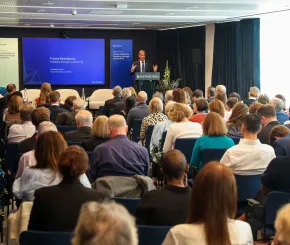
Video transcript
Speakers
- Gemma Gooch – Head of Charities Distribution, Rathbones Group
- Laura Hobbs – Senior Investment Director, Rathbones Greenbank
- Matt Crossman – Stewardship Director, Rathbones Group
- Alex Robinson – Chief Programme Officer, WRAP
Introducing engagement and systemic change
Gemma: Welcome back. I hope you have had the chance to speak to our Rathbones colleagues and each other about today’s experience.
We have looked at resilience from three angles this afternoon: markets and geopolitics, culture, and governance. Each of those is, in a sense, defensive, addressing how you respond to what the world sends your way.
The next session turns that around slightly. As a charity investor, you are not only exposed to long-term risks such as climate change, inequality and poor corporate behaviour. You also own a piece of the companies that are creating them. That gives you a voice, and engagement is about what happens when you choose to use it.
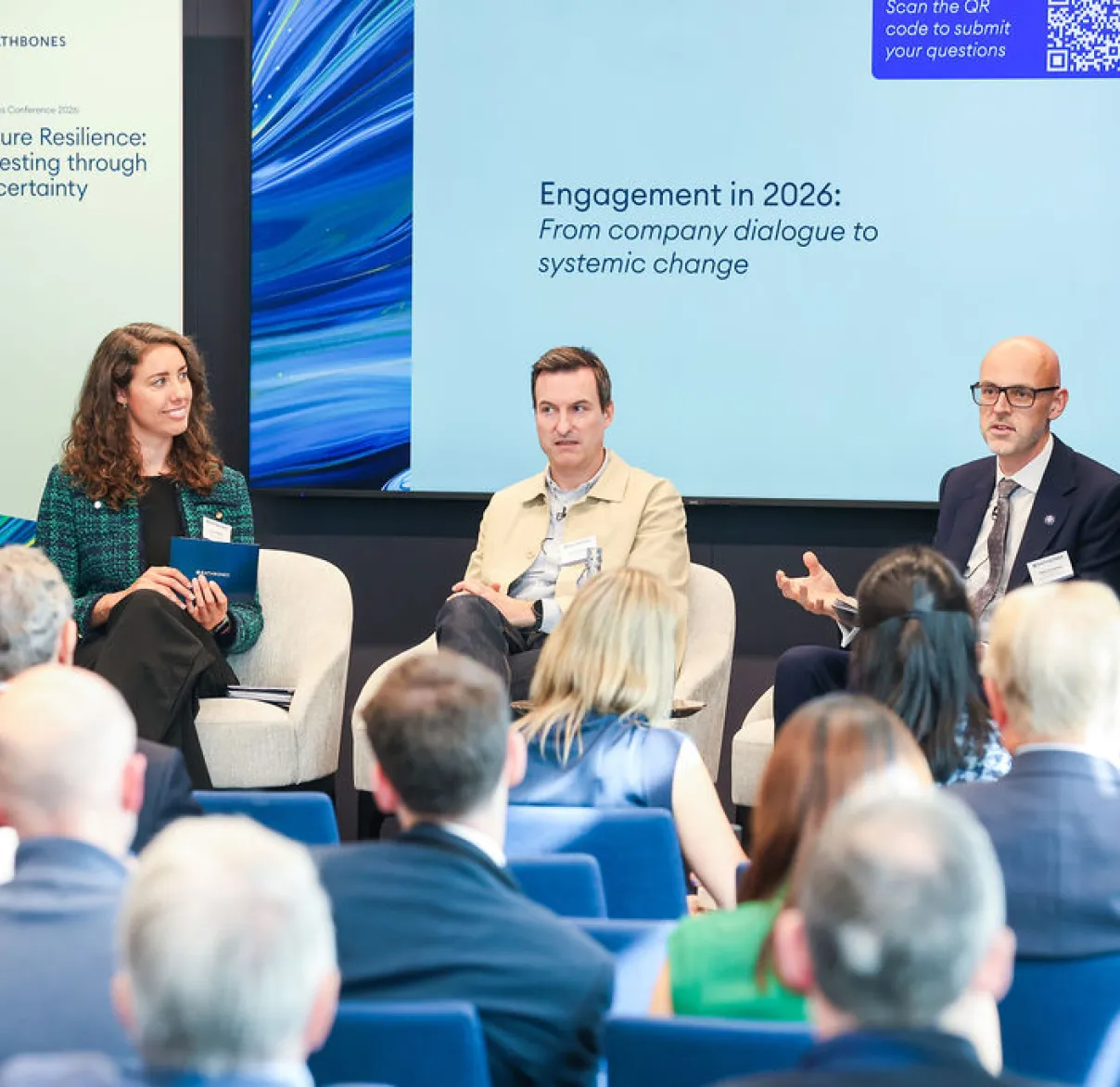
Our next fireside chat is entitled ‘Engagement in 2026: From company dialogue to systemic change’. I would like to welcome my colleagues Laura and Matt, as well as Alex Robinson, to the stage.
Laura: Thank you, Gemma. I am Laura Hobbs, Senior Investment Director at Rathbones Greenbank, and I am delighted to chair this session on systemic change.
Before I introduce our panel, I want to consider what we mean by systemic change and set the scene. Climate change, resource use, nature loss and human rights are major issues facing society. We know they are important because we all want to live in a cleaner, safer and happier world.
However, I am speaking to an audience of finance professionals, CFOs and charity finance trustees, so let us put some numbers around this from an economic perspective.
A World Economic Forum paper published in 2023 put the cost of damage caused by climate change and extreme weather events at $16 million per hour. Nature loss costs $318 billion annually across eight sectors alone. Modern slavery is estimated by the UK government to cost the UK economy £60 billion annually, equivalent to 2% of UK GDP.
These are significant challenges. None can be solved by a single company acting within its own four walls, or by a single investor acting alone. They are systemic issues because they extend across sectors, supply chains and entire economies.
I am joined by two excellent panellists. Matt Crossman is Stewardship Director at Rathbones Group. He has worked at Rathbones for more than 20 years and leads our ESG and stewardship programmes. He is also a specialist in supply-chain and human-rights issues.
Alex Robinson is Chief Programme Officer at WRAP, an environmental action NGO focused on transforming the world’s broken systems. Alex designs and delivers WRAP’s global programmes for change. He joined WRAP from Hubbub, a behavioural-change charity where he was CEO when it was named Charity of the Year at the 2023 Charity Times Awards.
Before entering the charity sector, Alex worked in the music industry and led international campaigns. He assures me he is the only person in the world to have worked with NatWest and Snoop Dogg in the same year.
Alex has applied what he learnt about collaboration across industries, bringing together businesses, governments, policymakers and philanthropy to support positive environmental change.
Let us begin. For many trustees, stewardship probably means their investment manager talking to companies across the table. Is that still an accurate picture of stewardship in 2026?
How stewardship has evolved
Matt: It is a very good question. I should add briefly to my biography that I am also a charity trustee. I have been one since I was 24, when I was persuaded to join a board. It has been valuable to experience both sides of the conversation.
Stewardship has certainly evolved beyond simply talking directly to company representatives. Rathbones has 15 professionals in its Responsible Investment Centre of Excellence, around 12 of whom are involved in meaningful dialogue with a company, issuer or policymaker.
The word ‘stewardship’ has medieval origins. It brings to mind someone looking after another person’s estate on their behalf. There is continuity between that idea and the modern concept of stewardship. As investment managers, we hold your assets in trust, while you are, in turn, looking after the interests of your beneficiaries and other stakeholders.
Engagement therefore comes with a sense of fiduciary responsibility. The modern definition we use is the responsible allocation, management and oversight of capital to create long-term value. That can take many different forms.
Traditionally, stewardship might have meant attending an annual general meeting and asking a difficult question. That has been a fruitful way for the third sector to engage with companies. Publishing reports and conducting research can also be effective.
However, as the investment world has become more aware of responsible investment and ESG considerations, stewardship has increasingly involved joining forces with like-minded investors to address systemic issues. It includes engagement with policymakers, regulators, trade associations and whole industries. It can also involve speaking to the government of the day to help change the rules of the game.
Dialogue remains essential. It should be purposeful and intentional, with a defined goal and timeframe. However, changing the rules of the game is also an important part of engagement and stewardship in 2026.
Why systemic problems require collective action
Laura: Alex, from WRAP’s perspective, why are some of our biggest sustainability challenges impossible to solve through individual organisations acting alone?
Alex: I think about the Tesla fast chargers that you see beside motorways. Electrification is one of our most important tasks in tackling climate change, and the transition to electric vehicles is a major part of that.
One of the toughest challenges is charging cars on long-distance journeys. People are accustomed to refuelling petrol cars quickly. Tesla addressed that challenge by creating a fast-charging network. However, whether because of an engineering mindset or the logic of the market, it initially created infrastructure that only Tesla drivers could use. It has since opened the network to some other vehicles, but imagine a world with separate chargers for Kia, Ford and Toyota. It would be absurd.
A single organisation can solve an incredibly complex challenge, but it can still produce a solution that makes the wider system worse.
I am also considering this issue in relation to the English water system. No river in England is classified as being in good overall health by the Environment Agency. When you look at a river catchment, there are three predominant risks: too much water, not enough water or water that is too polluted.
There are also many different inputs. Farms make decisions about fertiliser use and nutrient run-off. Factories withdraw water. Towns and cities affect the catchment, as do communities that use the river or live alongside it.
You cannot move a river catchment, its cities or its farms. Yet we depend on those catchments for our food supply and many other needs. When considering how to build a resilient water system, it makes little sense to ask what a single institution can do. Collective problems require collective action.
Laura: How do you encourage competing organisations to work together on these issues?
Alex: We create what we call pre-competitive spaces. We are not arguing that organisations should not compete. They should compete on a level playing field that still allows progress on the issues we care about.
For example, I recently attended the Textiles Pact Advisory Group. This brings together organisations from across the textiles system to identify ways of reducing the system’s impact. It includes brands such as Primark and Next, marketplaces such as eBay, charities including Oxfam and the Salvation Army, recyclers, and other parts of the value chain.
Together, they can gather and share evidence about what is required to build a successful pre-loved clothing solution. That evidence helps everyone involved move more quickly, rather than attempting to solve the same problem independently. Once the information has been shared, the organisations can compete to deliver the best solution.
WRAP is not a lobbying organisation, so participants trust us to take an evidence-based approach. We are also close to government, which helps organisations understand forthcoming policy and gives them an opportunity to influence its development.
Collective and pre-competitive action is also about momentum. It is difficult to initiate, but once the right people are in the room, other organisations do not want to be left out.
Investor tools and collaborative influence
Laura: Matt, from an investor’s perspective, what tools and levers can be used to support similar collective action?
Matt: It is difficult, but it is important. While Alex was speaking, I was thinking about work my team has done over the past 18 months to reconcile the energy transition with the realities of the mining industry.
The transition we are advocating, and the net-zero goals reflected in many portfolios, will require a vast quantity of materials to be extracted from the ground. The mining industry may need to deliver three times as much lithium annually as it has produced previously, and lithium is only one of the critical minerals involved.
We therefore need to balance the demands of the energy transition with the objectives of a just transition and meaningful community engagement.
Rathbones has been involved in the Consolidated Mining Standard Initiative. The mining industry currently has several different definitions of what constitutes a good mine. Companies report against different standards, making accountability difficult and preventing investors from comparing companies effectively.
The initiative brings together civil society, NGOs, standards bodies and investors to develop a unified standard for responsible mining. My team has contributed to consultations and spoken to the companies involved, encouraging them to set a high bar.
We also participate in larger industry collaborations. Rathbones joined the UN-supported Principles for Responsible Investment in 2009. It now brings together thousands of investment firms from around the world around six principles. Through its collaboration platform, investors can share work and coordinate activity.
We also participate in investor networks focused on particular issues, including the Institutional Investors Group on Climate Change.
Our starting point is that we can only go so far alone. If one investor is concerned about an issue, others are likely to share that concern. The challenge is to create a framework in which investors can establish shared goals and work together with companies.
Regulation is making some forms of collaboration more difficult, particularly where questions arise about investors ‘acting in concert’. Rathbones is also a member of the Investor Forum. If we have concerns about a major FTSE 100 company, we can raise them with the forum. It asks its other members whether they share those concerns. If there is sufficient common interest, it brings those views together and conducts the engagement on members’ behalf.
This has not been a static area. It has evolved and deepened considerably over recent years.
The connection between environmental and social risks
Laura: Are systemic risks such as climate change and human rights more interconnected than investors have traditionally recognised?
Matt: Yes, and sometimes in surprising ways. The principal source of the connection is the globalised, highly interconnected world in which we live.
Climate risk is systemic, but in some respects it is easier to understand than social risk. We can quantify the effect of carbon emissions and map them using observable science. Companies report emissions data, and investors can calculate an implied temperature rise.
Social risk is no less material, but it is harder to measure. The fact that it is difficult does not make it less important.
Global disruption and sociopolitical upheaval expose weaknesses in systems, creating conditions in which labour exploitation can thrive. When conflict began in Ukraine, some of the first people to target those fleeing the war were human traffickers. They knew that vulnerable people would be displaced.
That is a stark example, but exploitation thrives wherever disruption reveals a lack of resilience. As the effects of climate change increase, so will the opportunities for human-rights abuses. Investors must therefore avoid focusing only on the ‘easy’ issues for which data is readily available. They must also engage with the harder social issues that can ultimately affect the value of the companies in which they invest.
Alex: For a long time, we have treated environmental and social issues as separate. That separation is deeply problematic.
It is rooted in a view of nature as a resource for humanity that can be controlled and exploited. That approach is not working. We are discovering that we have been sawing off the branch on which we are sitting.
The conceptual separation has led us to create separate environmental and social NGOs, distinct groups of funders, and different reporting and governance structures. We have built systems that treat environmental and social concerns as though they were unrelated.
In recent years, I have seen a significant shift towards bringing those streams together. The food system makes the need for that particularly clear. Food brings health, culture, the environment and economics together on a single plate. These issues are difficult to separate, and we need to continue treating their risks and opportunities holistically.
Measuring engagement and escalating action
Laura: Does engagement really work? At what point does dialogue stop being productive, and what do you do when progress is not being made?
Matt: We need to move away from the perception that corporate engagement is simply tea and biscuits with a company’s chair.
If you aim at nothing, you will achieve it. Effective engagement starts with a clear understanding of what you want to accomplish, over what timeframe and using which tools.
Each year, our engagement action plan examines the market and identifies the most significant threats, risks and areas of concern affecting portfolio companies and the health of the wider economy. We then assess our skills, influence and opportunities before setting goals for particular companies and industry bodies.
Investors must hold themselves accountable for engagement. They must also be willing to intensify and escalate their actions when basic dialogue is not producing results.
Ideally, engagement is based on enlightened self-interest and mutual benefit, and we can generally establish that relationship with companies. However, changes in corporate culture or differences in time horizons can prevent progress through regular meetings.
At that point, shareholders have other powers. These can be exercised at annual general meetings, which are an important mechanism for holding major companies publicly accountable.
We vote actively and have a clear voting policy that integrates social and environmental considerations alongside core governance factors. We also attend AGMs to meet management, raise concerns and escalate issues.
The final step on the escalation staircase is to conclude that the relationship is no longer working. That is when divestment comes into consideration, although I would argue that it should be the last step.
This is not necessarily a linear process. A change in company culture can allow an investor to return to an earlier stage and make progress through dialogue. Negotiation is both an art and a science. As someone once told me, ‘Negotiation is the art of letting the other person have it your way.’
From public commitments to practical change
Laura: Alex, without naming and shaming companies, what distinguishes organisations that merely sign up to an ambitious programme from those that genuinely want to make changes?
Alex: There are two questions. First, are organisations signing commitments in good faith? Secondly, does signing a commitment itself drive action?
Most organisations sign in good faith, although that is not always the case. Large companies often value the press release and publicity associated with joining an initiative. Even when they fully intend to follow through, there may still be a public-relations element, and that is not necessarily a problem.
Where follow-through is limited, the people responsible for signing the commitment, such as members of a sustainability team, may be strongly committed but have relatively little power within the wider organisation.
Making a public commitment is powerful because publicly stating a goal increases the likelihood that an organisation will pursue it.
In my previous role at Hubbub, I worked with Virgin Media O2 on a project addressing electronic waste and digital exclusion, bringing environmental and social risks together. The company had published a clear sustainability commitment with specific measures to be achieved over several years.
That public commitment shaped our monthly meetings and quarterly reporting. Some goals were exceeded, while others remained a long way from being achieved. Missing a target did not necessarily mean that the company was not trying. Sometimes conditions are unfavourable or the original assessment of what is possible proves inaccurate.
The company continued to report publicly against those goals. A public commitment can be a galvanising force, but it is not a guarantee of success.
Matt: Alex’s comments remind me of situations in which investors have helped empower a company’s sustainability function.
One UK utility company has phased coal out of its generation portfolio and invested significantly in the just transition. When it closed coal plants, it supported local communities and provided retraining. Around a third of its staff are former fossil-fuel employees now working in gas and low-carbon generation.
The company had an excellent sustainability team that used engagement to strengthen its internal position. I would ask whether it would help if I attended the AGM and raised a particular issue. The team might suggest a project that would benefit from being discussed publicly because this gave it legitimacy and helped unlock a budget.
That sense of partnership can be extremely powerful, and investors can play an important part in it.
The retreat from public ESG commitments
Laura: An audience member has asked whether companies have substantially retreated from public ESG commitments. Is this a long-term trend, or is it the result of political developments in the United States?
Matt: It depends where you are looking. In the United States, the beginning of the second Trump administration made it more difficult for companies to make forward-looking commitments publicly. The Department of Government Efficiency and opposition to diversity, equity and inclusion created a highly charged environment. Many organisations retreated publicly.
However, we did not see the same level of retreat in private. Many initiatives were rebranded but remained functionally unchanged, which was encouraging.
There were also regional differences. Companies on the West Coast, East Coast and in strongly Democratic areas such as California did not retreat to the same extent.
These issues move in cycles. Catherine Howarth of ShareAction has described the recent period as a ‘sustainability recession’. The positive thing about recessions is that they end.
The underlying trends have not disappeared. Environmental and social issues may be described as non-financial, but they materially affect our world, investments and lives.
However, some of the language may need to change. Public support for climate action remains high, but support for the term ‘net zero’ has fallen because it has become politically toxic and has been amplified negatively through social-media algorithms.
I would describe this as a recession because the underlying factors have not changed. Fundamentally, people still want the just, clean and fair world that Laura described at the beginning.
Alex: I agree, although I would not predict how long the recession will last. I have not proved especially good at predicting politics over the past decade.
There has been a retreat in public commitments. However, behind the scenes, corporate sustainability has undergone a significant professionalisation over the past five years.
Some of the activity is less visible than it was previously, and there is less public engagement. Organisations are keeping their heads below the parapet for understandable reasons.
At the same time, there is greater demand for compliance and data. European Union policy continues to affect large UK companies that trade in the EU. A considerable amount of work is preparing companies for the future and making sustainability functions more powerful and effective than they were during the previous decade. I take some hope from that.
How voluntary action supports regulation
Laura: Where does voluntary action reach its limit, making policy intervention necessary to address systemic issues?
Alex: I would gently reject the framing of voluntary action and policy intervention as opposing forces.
Voluntary action is sometimes used by companies to fend off pending legislation. However, it can also be a necessary precursor to legislation and a stage that helps policymakers design better rules.
It is difficult to devise effective policy when you do not understand how a system will respond to an intervention. Much of WRAP’s work on plastics and packaging over the past decade has involved voluntary action by supermarkets, manufacturers and recyclers.
Recent government measures, including simpler recycling systems and the forthcoming deposit return scheme, build on years of data, testing, pilots and reports. That work created an enabling environment for better policy, as well as a well-informed group of professionals and civil servants capable of implementing it.
I see voluntary action and legislation as complementary. WRAP’s role is to create voluntary action that normalises change. That normalisation might ultimately occur through legislation, revised standards or changes in business practices and culture. To some extent, the mechanism matters less than achieving the change.
Emerging systemic risks
Laura: Looking ahead over the next five years, what issue is currently under the radar but could become a major focus?
Matt: I will give one technical answer and one that is perhaps more accessible.
I am often surprised by how little institutional investors discuss accounting standards and sustainability. This should be central to our work, but it has proved difficult to build campaigns around it.
I am particularly interested in how companies report climate risk in their accounts. Some companies still claim to be aligned with the Paris Agreement despite making major changes to their portfolios that suggest otherwise.
I hope the role of the finance sector and financial regulation will receive greater attention. This could include involvement from the Financial Conduct Authority and more rigorous stress testing of the risks disclosed in financial statements.
The second issue is antimicrobial resistance. Modern healthcare relies heavily on effective antibiotics. We often take them for granted, whether they are prescribed after surgery or childbirth to prevent infection.
The supply of effective antibiotics is diminishing, while they continue to be misused in agricultural supply chains and elsewhere. Advances in areas such as artificial intelligence and medicine will be undermined if we do not have an effective programme to address antimicrobial resistance.
I became involved in this issue through a Rathbones charity client working in the area. Rathbones now engages on antimicrobial resistance as another example of systemic risk.
Laura: Alex, what is your answer?
Alex: This is not an issue WRAP works on directly, but I think it is diet.
There is a reluctance in this country to acknowledge that we cannot meet our climate goals while maintaining our current diets, particularly the amount of meat and dairy we consume and the associated environmental impact.
It is a deeply unpopular discussion in some quarters, but I think it will rise up the agenda in strange and unpredictable ways over the coming years.
Closing remarks
Laura: Thank you. We have highlighted many different risks and explored the different ways in which investors, businesses, NGOs and policymakers need to work together to address them.
The positive conclusion I take from the discussion is that this collaboration is happening. Whether it is happening quickly enough remains an open question.
From a charity trustee’s perspective, it is important to continue challenging your investment manager on the issues that matter to your organisation and to ensure those issues are being raised on your behalf.
Thank you, Matt and Alex.







_0.jpg?changed=1790591353)
.jpg?changed=1790581581)