




As AI drives rapid growth in data centres, rising demand for energy, water and land is creating new environmental and social challenges. We explore the pressures facing hyperscalers as they expand capacity, and how investors can encourage lower-carbon, water-efficient development that remains consistent with companies’ climate commitments.
Article last updated 27 November 2026.
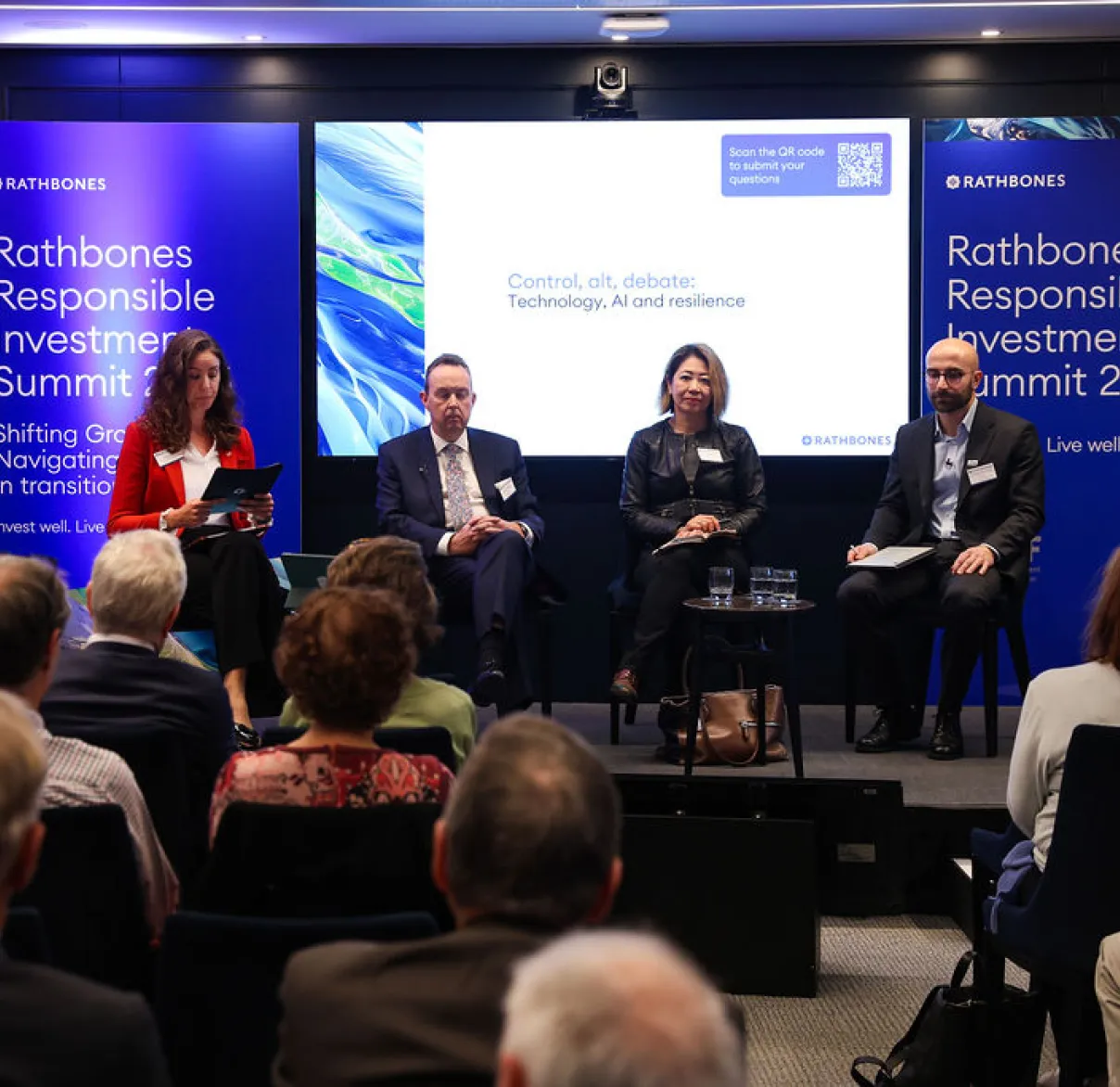
Drawing on a debate at the Rathbones Responsible Investment Summit 2026, this article explores what the rapid development of AI could mean for investors, companies and society, including the opportunities it creates and the social, environmental and governance risks that need to be managed. It reflects the discussion at the Summit and is intended to inform, not to provide investment advice or a recommendation.
Can AI make us more resilient?
Technology has transformed society, improving access to information, advancing healthcare, supporting scientific research and increasing productivity. Artificial intelligence promises to accelerate many of these changes, with applications ranging from drug discovery and climate research to data analysis and more efficient business processes.
But as AI becomes more deeply embedded in companies, markets and everyday life, an important question is emerging: does technological progress make society more resilient, or does it create new vulnerabilities?
The answer is unlikely to be straightforward. AI has significant potential to help solve complex problems, but how it is developed, governed and deployed will determine whether those benefits outweigh the risks.
Laura Hobbs, Senior Investment Director – Charities, Rathbones Greenbank, chaired the session and speakers included Simon Lapthorne, Senior Research Analyst at Rathbones, Dr Christine Chow, Member of the Advisory Board and Senior Director of Embera Partners, a consultancy that advises companies and investors on navigating financial markets and corporate governance, and Toby Sparwasser-Soroka, Senior Responsible Investment Manager for Principles for Responsible Investment (PRI), a global organisation that works with investors to promote responsible investment and incorporate environmental, social and governance considerations into investment decisions.
How AI is developed, governed and deployed will determine whether its benefits outweigh the risks.
Greater resilience, but new vulnerabilities
Historically, technological progress has improved productivity and living standards. Could AI continue that pattern?
Its ability to analyse vast quantities of information could support climate research, accelerate the development of new materials and medicines and help optimise areas such as agriculture and energy use. Yet technological change can also expose weaknesses elsewhere in society.
Automation may increase economic output, but it may also impact jobs. AI systems can often reproduce bias, generate inaccurate information, and create new cybersecurity vulnerabilities. And as organisations become more reliant on digital infrastructure, technology itself can become a potential source of disruption.
Our speakers noted that the challenge is not necessarily to decide whether AI is ‘good’ or ‘bad’, but to understand where its benefits and risks lie, and whether companies and society are sufficiently prepared for both.
Who benefits from the AI boom?
One concern is that the first wave of benefits has been highly concentrated.
So far, much of the investment value created by AI has been concentrated in a relatively small number of companies building the infrastructure behind it, yet the benefits for companies actually deploying these tools across their operations are less clear-cut.
Over time, AI could raise productivity across functions such as marketing, accounting, sales, IT and HR. However, if competitors have access to similar tools, those advantages may quickly become standard across an industry rather than providing a lasting competitive advantage. Investors therefore need to distinguish between enthusiasm for the technology itself and the value of individual businesses exposed to it.
Expectations also matter. A company may genuinely benefit from AI but still represent an unattractive investment if those benefits are already reflected in its valuation. Conversely, some companies perceived as vulnerable to AI disruption could be undervalued if the market expects that disruption to happen more quickly than it ultimately does.
Investors need to distinguish between enthusiasm for the technology itself and the value of individual businesses exposed to it.
The human side of technological change
The economic benefits of AI may not be distributed equally.
Technology can increase productivity without automatically translating into higher wages or greater job security. Workers may therefore find themselves in a difficult position: using AI might increase their productivity today while simultaneously accelerating changes that could reshape or remove their roles in future.
This creates risks for businesses too. Employees worried about keeping pace may begin using unapproved AI tools to perform their jobs. This can leave companies with systems, code or processes created using technology that has not been properly reviewed or monitored. So-called ‘orphan AI’, where tools or agents continue operating without clear ownership or oversight, illustrates how seemingly individual decisions can create wider governance, security and operational risks.
There is also an international dimension. Much of the world’s advanced computing capacity is concentrated in a small number of countries, while some lower-income economies and workforces are particularly exposed to disruption from automation. AI could therefore reinforce inequalities both within and between countries unless its benefits are shared more widely.
Governance must keep pace
For companies, AI does not eliminate traditional governance responsibilities. If an organisation integrates third-party AI into its products, services or customer interactions, it cannot simply outsource responsibility for the consequences. Boards remain accountable for understanding how technology affects the business and for ensuring that appropriate oversight is in place.
One point of discussion was whether boards need dedicated AI committees, or whether AI can be effectively incorporated into existing governance structures.
Companies should understand where AI is being used and which systems operate in live environments that involve real users and information, rather than in an experimental, safe practice space. They should consider what could go wrong, who is accountable and how outcomes are tested and monitored.
Our speakers agreed that cybersecurity, data privacy, and AI governance are increasingly interconnected and need to be considered together rather than in separate organisational silos.
What should responsible investors ask?
AI governance is rapidly becoming an important stewardship issue. Investors can ask companies whether boards have clear oversight, whether there are inventories of the AI models they are using, and whether organisations have processes for monitoring outputs, reliability, and accountability.
An important distinction is between AI developers, which build models, and deployers, which use them. Much public attention has focused on developers, but deployers may offer a broader area for investor engagement, as AI is increasingly integrated into companies across almost every industry. Responsible procurement and vendor due diligence, where background checks are run on AI companies before the software is bought or used, could therefore become significant stewardship tools. Companies buying AI services can ask suppliers how models are governed and tested, potentially creating pressure for better standards throughout the technology value chain.
There is also an opportunity to learn from the evolution of climate-related investment. Rather than allowing numerous competing AI governance frameworks to develop independently, greater coordination among investors, companies, policymakers, and other stakeholders could help establish approaches that are both useful and usable in a collaborative manner.
There is an opportunity to learn from the evolution of climate-related investment.
The environmental cost of AI
AI also has an important physical footprint. Rapid investment in data centres is increasing demand for electricity, grid capacity, land and infrastructure. Water use and cooling have also attracted scrutiny, although technologies such as closed-loop cooling systems, in which a sealed network of pipes or ducts continuously reuses the same liquid or air to carry heat away from hot equipment, may help alleviate some of the pressures.
The scale of anticipated data-centre expansion means energy availability itself could become a constraint on AI growth. This creates a complex relationship between two major transformations discussed throughout the Rathbones Responsible Investment Summit: electrificationand artificial intelligence. AI may help optimise energy systems and accelerate technological development, but the infrastructure supporting it will itself require substantial amounts of reliable power.
Investors consequently need to consider not simply whether AI creates opportunities, but also where the energy and resources required to deliver them will come from.
Finding a balance between fear and opportunity
One of the strongest themes from the debate was the danger of approaching AI with either excessive optimism or excessive fear.
Moving too slowly risks missing innovations that can improve productivity, healthcare, scientific research, and society’s ability to confront environmental challenges. Moving too quickly without appropriate oversight could introduce vulnerabilities that businesses do not yet fully understand.
For investors, the response requires balance. AI should be considered across environmental, social, and governance dimensions, as well as through the fundamentals of investment analysis: what are the opportunities, what are the risks, how well are they being managed, and what expectations are already reflected in valuations?
The key takeaway from the session was that while technology may ultimately make businesses and societies more resilient, greater technological capability does not automatically mean greater resilience. The real test in the years to come will be whether governance, infrastructure and institutions can develop quickly enough to keep humans firmly in control.


_0.jpg?changed=1793194960)