



We’re living longer but healthy life expectancy isn’t keeping up
Article last updated 7 May 2026.
|
Quick take
|
Picture yourself sipping a glass of aged Scotch after a light meal, and reading this piece as your faithful feline friend purrs on your lap and a box of Green & Black’s chocolates rests on the coffee table at your side. If you don’t have to imagine this – because it’s what you’re doing anyway – you may well be an older consumer, part of a bulging demographic that’s highly interesting for the consumer staples sector.
Ageing populations, characterised by rising life expectancy and declining fertility rates, have profound implications – supporting demand for some products and services, but reducing it for others.
Some markets face challenges because of ageing
Lower fertility reduces demand for infant formula and nappies, weakening long‑term growth prospects for companies with heavy exposure to these ‘early‑life categories’.
More broadly, food consumption falls with age. The average 70‑year‑old consumes around 20% fewer calories than the average 26‑year‑old. In ageing societies, this will limit total calorie growth, even if the population is growing.
Impulse‑driven food products are also under increasing pressure. Sugary snacks are already hit by rising health awareness, regulatory scrutiny, and GLP-1 weight loss drugs. On top of this, older people are less likely to eat these snacks, even if their spending remains resilient on premium and seasonal chocolate (much of the latter doubtless destined for their grandchildren).
Overall, alcohol consumption also faces demographic headwinds. But although older consumers drink less, they drink better. That’s good for sales of premium spirits and wine. Meanwhile, spending on most beauty products subsides markedly beyond 65. But hair colouring is a notable exception.
Some markets will benefit from ageing populations
The consumer health market is likely to benefit from this trend. That should in turn increase spending on over-the-counter (non-prescription) treatments for chronic symptoms and medical nutrition products that respond to particular health conditions. Older people also need more vitamins, minerals and supplements (VMS) because of deterioration in their metabolism and ability to absorb nutrients.
Within food and beverages, rather than reaching for a quick sugary snack in a busy working day, older consumers are often more likely to reach for a coffee – and they have the time to make a cup of real coffee. This will support the otherwise mature coffee market.
Ageing, low‑fertility societies are lonelier societies. Pets increasingly meet the need for companionship, so older people are likelier to have them. This factor could drive growth in spending on pet food – and particularly the premium end of the market, which older people often favour.
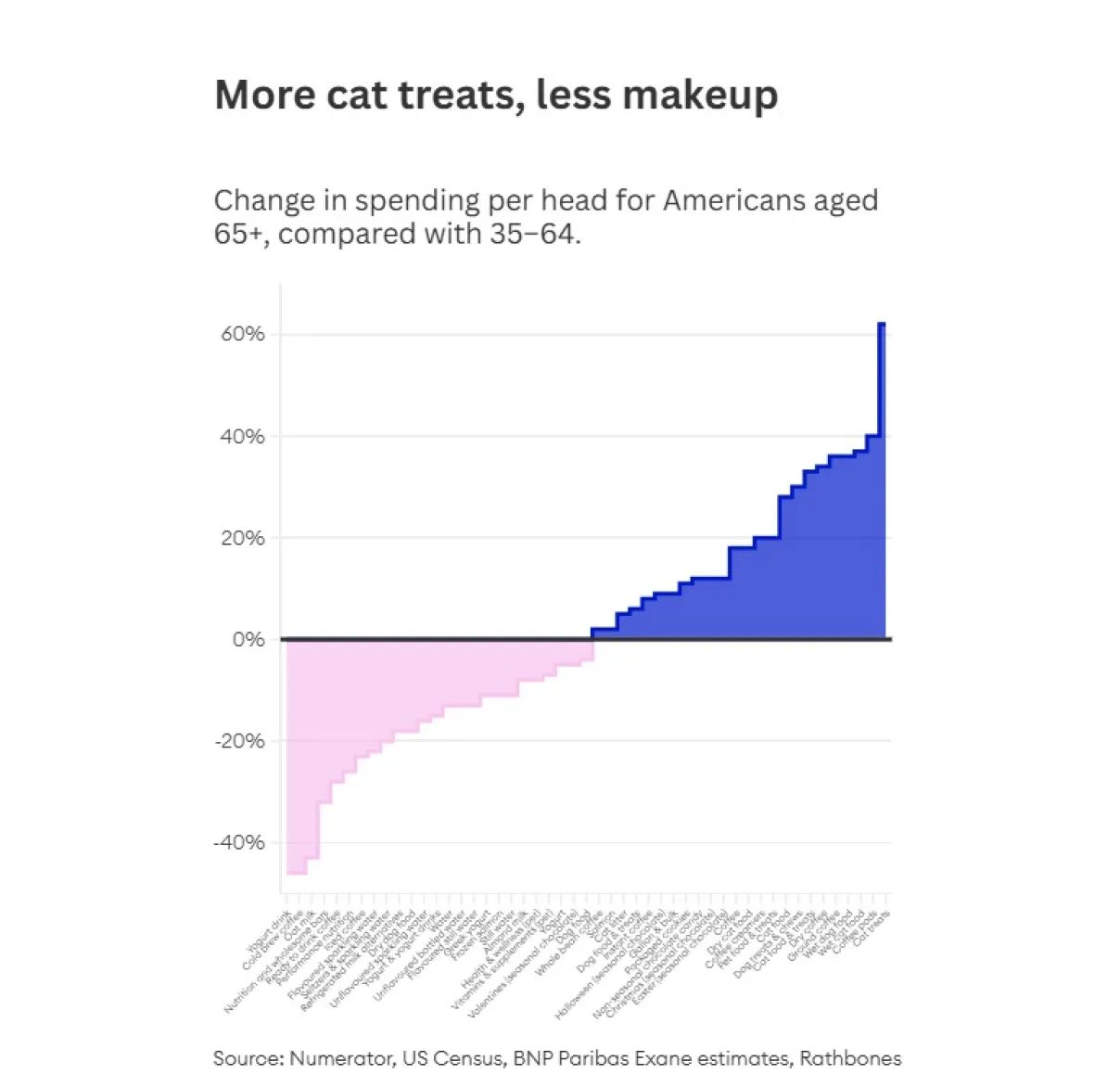
Older people buy more ground coffee and cat treats, but less makeup and sun cream.
Change in spending per head for Americans aged 65+, compared with 35–64.
Companies that could win out from an ageing world
Looking at individual companies, market leaders in consumer health include two UK businesses: Haleon, a consumer health specialist, and Reckitt Benckiser, which is more diversified but is big in this sector.
Switzerland’s Nestlé is also well-aligned with the ageing trend: it has strong businesses in coffee, medical nutrition, VMS, and pet care.
Defensiveness and dispersion
Consumer staples is quite defensive relative to other stock sectors, as demand is more stable rather than being buffeted by the economic cycle.
Ageing makes this sector more defensive still. This is partly because more of the consumption is non‑discretionary and habitual. For example, you can’t stop buying food for your pet and, if at all possible, vitamins for yourself. It’s also because older people’s income is steadier.
Despite the sector’s overall steadiness, consumer staples stocks will see greater dispersion of market performance than before: the demographic changes mean some market segments will do particularly badly, some particularly well. That makes active management – good, old-fashioned stock-picking – all the more important.