





As AI drives rapid growth in data centres, rising demand for energy, water and land is creating new environmental and social challenges. We explore the pressures facing hyperscalers as they expand capacity, and how investors can encourage lower-carbon, water-efficient development that remains consistent with companies’ climate commitments.
Article last updated 27 November 2026.
What it takes to navigate a world in transition
The language of responsible investment has changed considerably over the past two decades. Corporate social responsibility gave way to sustainability and ESG, and today another term is increasingly coming to the fore: resilience.
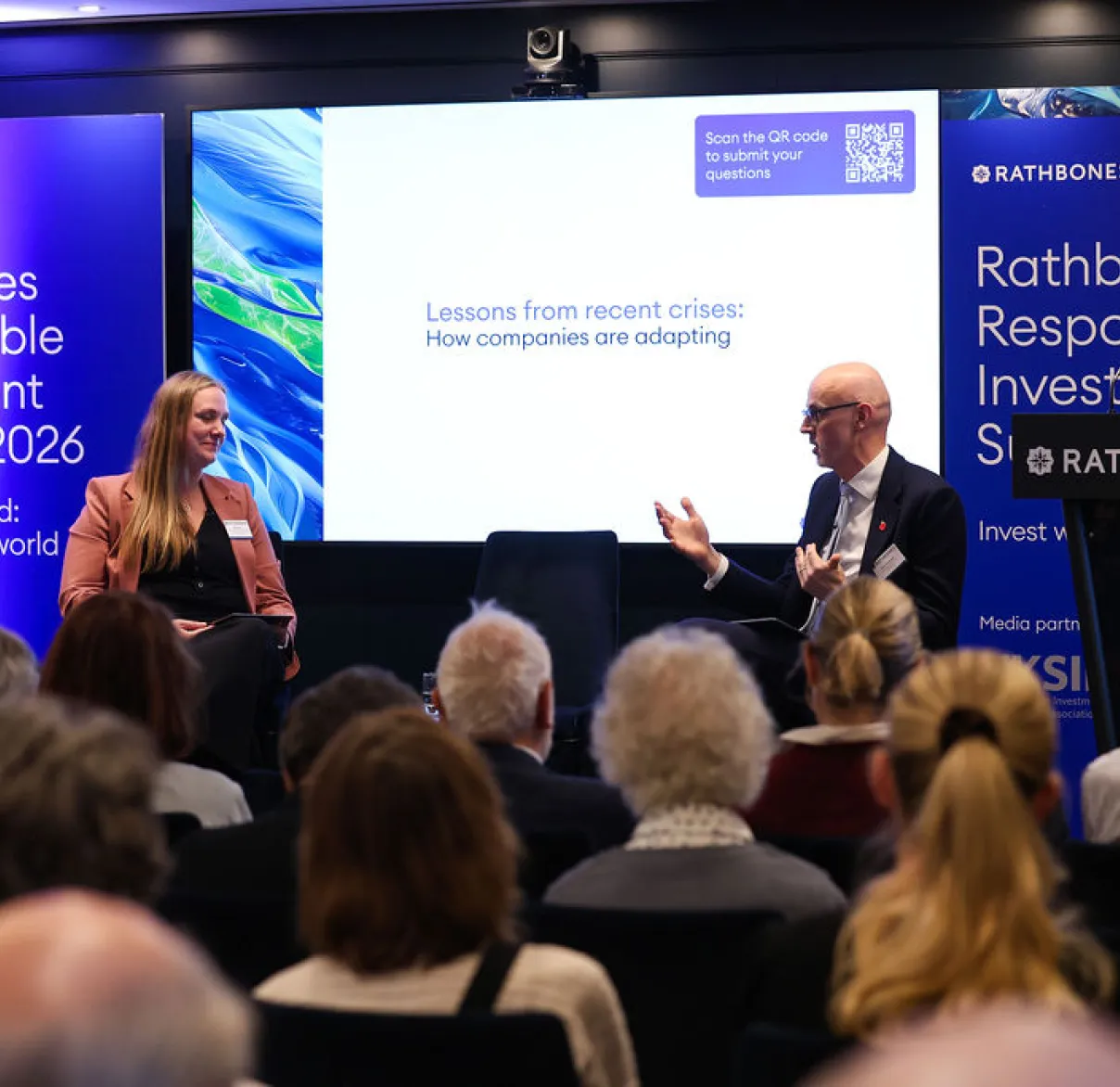
For Kate Elliot, Head of Rathbones’ Responsible Centre of Excellence and Matt Crossman, Rathbones’ Stewardship Director, that evolution is about much more than terminology. It reflects a growing recognition that environmental, social, economic and geopolitical challenges are increasingly interconnected, and that businesses and investors need to be prepared for a world in which disruption may be the norm rather than the exception.
What does resilience mean for investors?
Matt offered a straightforward definition of resilience: the ability to predict, plan for and recover from unexpected shocks. The final element is particularly important. It is impossible to anticipate every disruption; therefore, resilience is not simply about preventing things from going wrong. It is also about how quickly businesses can adapt and recover when they do.
That ability has become more important as the operating environment has grown increasingly unpredictable. The global financial crisis, Brexit, the Covid-19 pandemic, conflict and geopolitical instability have challenged many assumptions about how the global economy functions. As a result, companies have needed to reconsider everything from manufacturing and sourcing to energy security and supply chains.
One example is the move away from highly concentrated, ‘just-in-time’ supply chains. This is a supply chain strategy where materials and goods arrive as close to when they are needed as possible to avoid excess stock or storage costs. While strategies such as these helped businesses maximise efficiency in a relatively stable environment, repeated disruptions have exposed their vulnerabilities. Some companies are now deliberately introducing alternative sources for critical components to ensure a single factory, supplier or region cannot bring production to a halt.
But this can create a difficult balancing act. Too much redundancy can make businesses less efficient, while too little can leave them dangerously exposed.
Resilience is not simply about preventing things from going wrong. It is also about how quickly businesses can adapt and recover when they do.
Understanding interconnected risks
A central theme of Kate and Matt’s discussion was that many risks traditionally considered separately can no longer be viewed in isolation.
A cyber-attack, for example, might begin as a technology risk but could quickly become a food-security or healthcare issue if it disrupts refrigeration and cold-chain infrastructure, as demonstrated recently in attacks on shop freezers across Europe. Similarly, disruption to a major trade route, such as the Strait of Hormuz in February of 2026, can simultaneously affect energy prices, supply chains, inflation, and geopolitical stability. These sorts of disruptions demonstrate how climate, nature, human rights, energy security, technology, and geopolitics increasingly overlap in a rapidly changing world.
This can create difficult trade-offs for both businesses and investors. For example, protecting workers from rising heat stress could require additional cooling, which may subsequently increase energy use. Diversifying a supply chain could improve resilience but introduce new environmental or human rights risks elsewhere.
For Kate, the objective should not be to search for a company with no negative impacts. Instead, she believes responsible investment means understanding all the impacts as best we can, and asking whether they are being managed, mitigated and minimised as far as reasonably possible.
From company risk to systemic risk
This interconnectedness is also changing the role investors can play.
Some risks cannot simply be diversified away. Climate change, inequality, human rights issues, and failures across global supply chains can affect entire markets and economies. Matt, therefore, argued that responsible investors increasingly need to consider systemic risks that can affect entire markets or economies, rather than individual companies alone.
Considering systemic risk changes the role of stewardship. Traditional engagement often focused on encouraging a company to improve its own practices. But if the economic or regulatory environment prevents a company from making the change investors are seeking, engaging with that company alone may achieve little. The question then becomes not simply how investors can push a company within the existing boundaries of what is economically possible but, more importantly, whether they can help shift those boundaries through engagement with policymakers and the wider market.
Policy engagement therefore best sits alongside corporate engagement, particularly where effective action requires a level playing field across an industry. Matt highlighted work on human rights due diligence as an example of investors collaborating with other organisations to advocate for stronger standards. It demonstrates how responsible investment can extend beyond conversations with individual companies towards addressing some of the underlying conditions influencing corporate behaviour.
Some risks cannot simply be diversified away.
Engagement with consequences
Where engagement does focus on individual companies, Kate and Matt stressed that it needs to have a clear purpose and intentional outcome, and, where necessary, consequences.
Investors already have a range of approaches available to them. These include private dialogue with company management, voting at annual general meetings, speaking publicly at AGMs and filing or supporting shareholder resolutions. Escalation matters when initial discussions fail to deliver progress. You can find out more about Rathbones’ approach to engagement here.
But successful stewardship often requires patience. Kate noted that some of the most meaningful outcomes occur when an issue investors have consistently raised over several years eventually becomes embedded in the company’s strategy. At that point, responsible business practices become more resilient themselves. Rather than depending on the language a company uses publicly at any particular moment, eventually, the language becomes part of how the organisation actually operates.
Matt pointed to engagement with SSE, the Scottish energy company, as an example of that long-term approach. Over several years, investors engaged progressively as the company moved away from coal and expanded its focus on renewables and electricity networks. In 2020, SSE launched its ‘Just Transition Strategy ’. The investor objective was not to demand an overnight transformation, but to encourage the next achievable step while working with people inside the organisation who could help move the strategy forward. The example demonstrates the long-term nature of stewardship; engagement progress is considered separately from the broader assessment of a company’s investment merits.
Some of the most meaningful outcomes occur when an issue investors have consistently raised over several years eventually becomes embedded in the company’s strategy.
Small disruptions can have enormous consequences
Another lesson for investors is that the scale of a disruption does not necessarily indicate the scale of its consequences.
Matt used the problems encountered by Boeing’s 787 Dreamliner as an example. A problem involving lithium-ion batteries contributed to the grounding of an entire fleet and revealed the vulnerability created by a complicated international supply chain. The component involved was small compared with an aircraft’s wings or engines, but its failure had consequences across production, delivery and reputation.
For investors, examples like this underline the importance of looking beyond obvious headline risks. Understanding where critical dependencies sit within a business can be just as important as identifying its largest operations.
Resilience requires adaptability
There is no single model for effective responsible investment.
Kate stressed the importance of choosing the right approach for the problem. Sometimes collaboration with other investors will be most effective. In other circumstances, direct engagement with a company or policymaker may achieve more.
The same principle applies to the balance between local and global action. While stronger local systems can improve resilience within individual communities, international frameworks can provide common objectives and help coordinate change at scale. Both have important roles to play.
This pragmatic approach also matters as established frameworks evolve. The UN Sustainable Development Goals run to 2030, but Kate and Matt argued that the social and environmental challenges behind them will persist regardless of what framework or terminology follows. Examples like this demonstrate that a label matters less than continued action.
Certainty in an uncertain world
To conclude the discussion, Kate and Matt looked ahead and returned to one of the simplest requirements for greater resilience: certainty.
Businesses making long-term investments need a stable policy environment in which they can plan with confidence, and constantly changing requirements or political priorities can often make that harder.
Matt argued the case for smarter policies that encourage progressive improvements over time and which can survive political cycles. Kate added to this, noting that sometimes the most helpful change is simply not to change direction again.
In a world defined by uncertainty, resilience is not about predicting every crisis. It is about building companies, portfolios and systems capable of responding when disruption inevitably arrives. For responsible investors, that means looking beyond individual risks, recognising the connections between them and, where possible, using stewardship, investment and policy engagement to help create businesses and systems that are better prepared for whatever comes next.


_0.jpg?changed=1793194960)