





As AI drives rapid growth in data centres, rising demand for energy, water and land is creating new environmental and social challenges. We explore the pressures facing hyperscalers as they expand capacity, and how investors can encourage lower-carbon, water-efficient development that remains consistent with companies’ climate commitments.
Article last updated 27 November 2026.
From transition to transformation: the next chapter for responsible investment
After a difficult few years for responsible and sustainable investment, there are now some signs that the direction of travel could be beginning to shift.
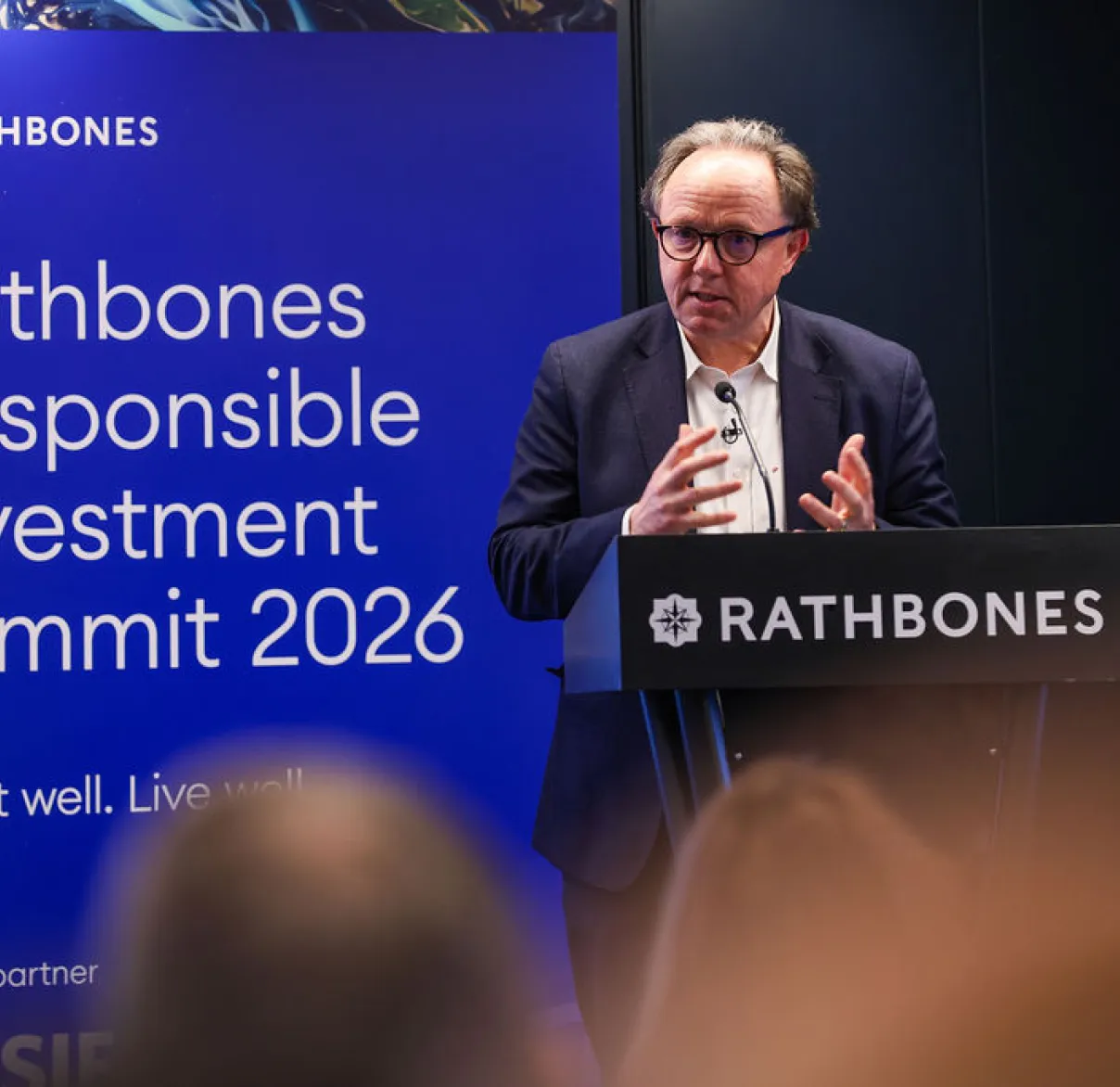
Nick Robins, Senior Director, Finance at the World Resources Institute, and keynote speaker at the Rathbones Responsible Investment Summit 2026, believes we have reached an important turning point. The challenge now, he said, is not simply to manage a gradual transition towards a more sustainable economy, but to respond to a much broader transformation already taking place across economies, industries and the financial system.
A new era for sustainable finance
Nick took us on a journey back before looking forward and described the decade from around 2012 to 2022 as the first major generation of sustainable finance and responsible investment.
During this period, much of the focus was on achieving an orderly transition. Policymakers, businesses and investors sought to establish the policies, technologies and sources of capital that could support the move towards a lower-carbon economy.
But the environment has changed significantly since. Russia’s invasion of Ukraine, rising interest rates and political pushback against some aspects of the sustainability agenda have all contributed to a much less predictable landscape. Nick argued that we have consequently moved from an era of transition to one of transformation.
Industries are facing fundamental changes to their business models and competitive environments. At the same time, the geographical centre of the clean economy is shifting. While Europe and the UK were among the early centres of sustainable finance, Nick pointed to the increasingly important role Asia, and particularly China, is playing.
Clean economy investment has increased substantially since 2010, rising from around USD$243 billion in 2010 to roughly USD$2.2 trillion annually in 2025–2026, according to the International Energy Agency (IEA), but Nick cautioned that the rate of growth has slowed precisely when greater investment is needed.
He also introduced a broader question about who benefits. The transition cannot simply be about replacing one technology with another. Nick stressed the importance of a ‘just transition', the principle that a move toward a green, low-carbon economy should be fair, inclusive, and as equitable as possible for all workers, communities, and social groups. In other words, the transformation ahead should be as much about people as it is technology.
The transformation ahead should be as much about people as it is technology.
The growing importance of resilience
Nick stressed that financing a clean economy is only one half of the climate challenge. The other is responding to the physical consequences of a changing climate, which we are already seeing globally. Nick highlighted what he described as a notable gap between the amount of money flowing into renewable technologies and the significantly smaller funds directed towards adaptation and resilience.
For investors, this raises important questions. If some effects of climate change can no longer be avoided, how can investment help businesses, infrastructure and communities become more resilient?
Nick brought that challenge closer to home through the example of Tenbury Wells, a town in Worcestershire that has experienced repeated flooding.
As insurers reassess the risks associated with flooding and other extreme weather events, some businesses and households can find it increasingly difficult to secure affordable cover. The consequences can extend far beyond insurance. Businesses can struggle to operate, property can become more difficult to finance, and communities can ultimately become less economically viable.
For Nick, examples such as this highlight why climate resilience needs to become a much more tangible part of discussions about finance and investment. Investing in the clean economy remains essential. But so too is investing in the infrastructure and adaptation required to help communities cope with the impacts of climate change that are already emerging.
Financing a clean economy is only one half of the climate challenge. The other is responding to the physical consequences of a changing climate.
A transition bigger than climate
Nick also put today’s energy transition into a broader historical perspective. 2026 is the 70th anniversary of Britain’s transition away from fossil fuels, and it didn’t start with climate. The Clean Air Act of 1956 followed the deadly smog four years earlier, while the oil shocks of the 1970s highlighted the economic and security risks associated with dependence on imported energy. Acid rain provided another environmental impetus for change in the 1980s, before climate policy became increasingly significant, particularly in our century.
The lesson, Nick suggested, is that the energy transition has always been driven by multiple forces. Climate change is critical, but so are public health, energy security, affordability, technological development and economic competitiveness. It’s important to take a systemic view combining all of these if we are to end our dependence on fossil fuels.
That broader perspective could prove particularly important today. Geopolitical tensions, slow economic growth, artificial intelligence, higher borrowing costs, and growing public debt all interact with efforts to decarbonise economies. Rather than viewing climate in isolation, Nick argued for making the connections between these challenges.
Rather than viewing climate in isolation, we need to make the connections between the challenges shaping the transition.
How should responsible investors respond?
Responsible investment can feel under pressure, for example through the ESG backlash, the political and public pushback against environmental and social governance. To illustrate the response he believes is needed, Nick turned to a memorable analogy: how to survive a shark attack. The lessons for responsible investment are clear: don’t panic, maintain eye contact, fight back, don’t swim alone and keep fighting.
Behind the humour was a serious set of principles for responsible investment:
01 Don’t panic
Recognise the opportunities that accompany the transition, as well as the challenges. The growth of electrification and its potential to make clean power increasingly affordable could create opportunities for businesses and investors, while a greater focus on adaptation could help make resilience more tangible.
02 Maintain eye contact
Remain clear about investment principles and values, even when the political or economic environment becomes more difficult. Nick here emphasised the value of continued engagement between investors, companies and policymakers, alongside clear transition plans showing how organisations can cut their carbon emissions and adapt their business for a low-carbon economy.
He also highlighted the importance of courage. Challenging circumstances can make it harder for organisations and individuals to maintain their commitments, but collective support can give leaders greater confidence to act.
03 Fight back
Explore practical financial reforms that can accelerate investment. Nick highlighted the need to channel more capital towards UK businesses developing technologies for the transition, address the higher costs some green projects face when raising finance, and find better ways to reflect the environmental costs of fossil fuels in financial markets.
But perhaps Nick’s most important message was contained in the fourth principle:
04 Don’t swim alone
The scale of the transformation means investors cannot deliver it in isolation. Collective investor initiatives remain important, but Nick argued that collaboration needs to extend beyond the investment industry.
Investors should think about the people ultimately affected by their decisions: beneficiaries, families, workers, businesses, and communities dealing with the consequences of flooding, such as those living in places like Tenbury Wells.
Demonstrating how the transition can improve lives, create employment, and strengthen communities could also help reinforce public support for change, rather than viewing the transition as damage control. Nick contrasted the familiar idea of a ‘coalition of the willing’ with a more action-orientated concept: a ‘coalition of the doing’.
For responsible investors, that provides a useful description of what the next phase may require. Nick argued that while ambition and commitments still matter, they increasingly need to be accompanied by tangible investment, collaboration and action. This will be important in 2027 when the UK takes over the presidency of the Group of 20 (G20), the intergovernmental forum comprising 19 sovereign countries, the European Union (EU), and the African Union (AU).
Nick’s final message was therefore one of determination rather than pessimism:
The challenges are substantial, and the transformation is unlikely to be orderly. But investors can still influence its direction. The priority now is to keep investing, keep engaging, keep collaborating and, above all, keep fighting.
Nick Robins, World Resources Institute

_0.jpg?changed=1793194960)