





What is a trust and who does what? A plain-English guide to how settlors, trustees, and beneficiaries work together, and why the trust document matters.
Article last updated 23 November 2026.
|
Quick take • Last week was difficult for investors: the S&P fell 8.6%. |
Last week was difficult for investors. The speed and scale of the moves were disorientating, particularly after a year already marked by geopolitical shocks, a powerfull AI-led rally and sharp changes in market leadership: which stocks are doing better and which are doing worse.
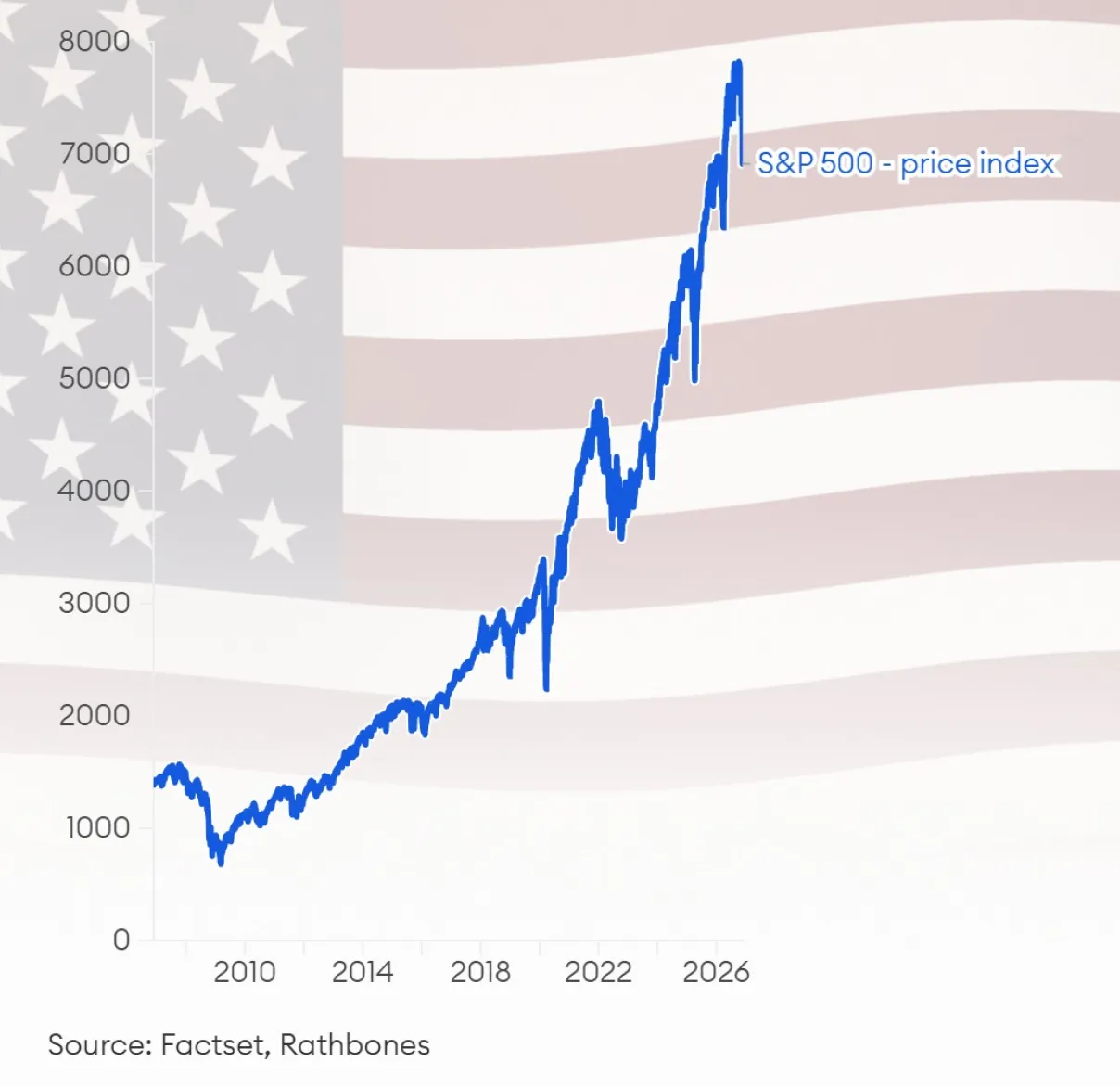
The S&P 500 fell 8.6% over the week, leaving it 11.6% below its 6 October peak. It was the index’s worst week since the tariff-related sell-off in April 2025. The index has fallen for seven consecutive sessions and measures of investor anxiety have risen sharply.
Periods of extreme volatility compress time. Daily market movements suddenly feel disproportionately important and the temptation to react becomes much stronger. That is precisely when it’s important to stay calm, stick to our long-term strategy and established investment principles, and follow our views of the macroeconomic fundamentals and valuation discipline as our compass – while remaining alert and nimble enough to act when required.
These moves are unusual, but perhaps not as rare as they feel. The past 20 years have seen seven weeks – including this one – in which the S&P 500 fell by as much as it did last week, or more. The other six occurred twice during the Global Financial Crisis in 2008, three times during the initial pandemic shock in 2020, and once in April 2025. That comes to roughly once every three years, although inevitably these episodes have clustered around periods of exceptional stress.
Correction or something more serious?
Our central judgement remains that we’re seeing a correction – a one-time change in stock prices, rather than a long and sustained fall – and a change in market leadership, not the beginning of a deep and prolonged bear market.
The past 20 years have seen several price falls that equal or exceed last week's
But we’re not complacent: there are important reasons for caution. Before the sell-off, this was not a cheap market. Even after the fall, valuations remain demanding in parts of the US market, particularly where prices today depend heavily on assumptions of future corporate revenue growth. Valuations for US stocks and, looking globally, the stocks of several industries, remain high by historical standards.
Much of the recent decline appears to reflect a widening in risk premia rather than a comparable deterioration in expected growth or earnings. In other words, investors will pay less for stocks than before because they think the risk of holding them has gone up. But the technical backdrop – the picture for short-term traders, who make decisions by looking at patterns in data on asset prices – has clearly worsened. Momentum is negative: in simple terms, because the market has fallen, that can create a vicious circle, where this may sour investors on the market, making stocks fall still more. Liquidity is becoming less supportive: investors may sell out of stocks to raise money to cover losses in their portfolios elsewhere, further exacerbating price declines. Moreover, risk appetite has deteriorated and financial conditions have tightened from the easier levels seen earlier in the year.
At the same time, the market has moved into a ‘show me’ phase on AI, with investors demanding clearer evidence that extraordinary levels of capital spending will ultimately generate adequate returns.
But on the positive side, economic data has held up and corporate earnings remain strong. Importantly, earnings expectations haven’t yet undergone the broad downward revisions normally associated with a prolonged bear market.
History provides some useful perspective, although no two episodes are the same.
In the final quarter of 2018, the S&P 500 came close to falling 20% as monetary policy tightened and investors became increasingly concerned about slowing growth.Markets subsequently recovered strongly as policy expectations changed.
In March 2020, the S&P 500 fell by around a third in little more than a month as the global economy shut down. That was a genuine bear market, but an extraordinary monetary and fiscal response helped produce an equally extraordinary recovery.
The 2000-02 bear market was different again. Excessive valuations, particularly in technology, were followed by a prolonged deterioration in earnings expectations and a much deeper reassessment of the returns investors could expect from the companies that had previously led the market.
It’s too early to know which past fall, if any, will prove the better analogy. For now, however, the evidence doesn’t suggest the beginning of a 2000-style prolonged bear market.
Why has the selling been so severe?
The initial catalyst was concern about the AI investment cycle: the scale of data-centre capital spending, the cost of financing it, the pace at which companies could actually make money from the new capacity, and uncertainty over which businesses will ultimately reap the financial benefits of AI.
Near-term demand and earnings remain strong, but it’s hard to see the picture for capital spending and profitability several years ahead. The “buy everything AI” phase appears to have passed. And investors’ heavy buying into the AI story has amplified the move.
As sentiment turned, investors reduced risk, crowded positions unwound, and some investors sold into a falling market. Technology was among the most heavily sold areas, while rising volatility forced sales by some investors whose strategies were fuelled by high levels of debt.
Once investors need to sell rather than simply choosing to, liquidity becomes the primary consideration. The assets that can be sold most easily are often sold first, irrespective of long-term quality.
That helps explain why prices can move further and faster than the underlying news appears to justify.
The weakness has subsequently broadened beyond technology. We’re watching this carefully, but note that company earnings, credit conditions, and economic activity have so far held up considerably better than equity prices.
This may therefore prove to be not simply a correction in the overall market, but also a change in market leadership. Future returns may become less dependent on a narrow group of highly valued growth companies and broaden towards a wider range of sectors, styles, and regions.
The key risk: if markets begin to damage the fundamentals
The most important risk is not simply that markets have fallen. It’s the risk that market weakness starts to create the economic deterioration investors currently fear.
Lower asset prices and higher volatility can tighten financial conditions. That can reduce confidence, increase the cost of the capital companies need to build their businesses, and make companies defer investment and hiring. Households may become more cautious about spending. Banks and credit investors may become less willing to lend.
If those effects become sufficiently broad and persistent, weaker markets can eventually produce weaker growth and earnings.
We’re monitoring that feedback loop closely. In particular, we’re watching
• Earnings revisions and company guidance on earnings
• Employment and hiring intentions
• Investment and capital spending plans
• Corporate credit spreads and funding conditions
• Bank lending standards and credit availability
• Business and consumer confidence
If several of these indicators deteriorate significantly at the same time, we’d be prepared to take more risk out of portfolios. Our willingness to remain invested isn’t unconditional.
But there’s a potential stabilising mechanism.
Falling markets, lower commodity prices, and weaker inflation expectations could eventually make investors expect the US Federal Reserve to stop raising rates.
That could boost stocks, as investors price in the fact that businesses have to pay less to fund expansion and their customers will have to pay less on their mortgages and other debts.
That’s a possible catalyst, not our immediate forecast.
And it would need to be supported by inflation and employment data that gave the US central bank room to cease raising rates.
Perspective: the path has felt worse than the destination
There’s a useful Rip Van Winkle perspective.
Imagine an investor who went to sleep at the start of the year and woke up today. They’d have missed the geopolitical shock, the AI-led surge, the abrupt rotation between sectors, and the recent sell-off.
Looking only at the start and end points, however, the outcome would appear much less dramatic.
The S&P 500 is up a little on the beginning of the year. Most balanced diversified portfolios are also still modestly ahead, too. That’s disappointing, after significant gains earlier in the year. But it’s very different from the experience of a deep bear market.
Individual outcomes will, of course, differ according to risk level, currency, holdings and timing, so this shouldn’t be treated as an estimate of any particular client portfolio. But the broader point is simply that the journey has felt considerably more dramatic than the end-to-end return for the year so far.
That doesn’t make the volatility irrelevant. But it does help put the last few days into perspective. It’s another reason not to allow short-term market movements to overwhelm a long-term investment strategy.
Diversification is doing its job
This episode reinforces our view that portfolios shouldn’t depend on a single market narrative.
• Cash provides stability and the ammunition to buy into markets.
• High-quality government and investment-grade bonds can provide income and protection if growth weakens and interest rate expectations fall.
• Diversifying strategies reduce dependence on the direction of equity markets.
• Broader equity exposure across different investment styles, sectors, and regions reduces reliance on narrow growth, based just on tech stocks.
Diversification won’t prevent portfolios from falling during a severe risk-off period. Its purpose is to make portfolios less dependent on any single outcome and better able to withstand uncertainty without forcing poorly timed decisions.
These protections can sometimes appear unnecessary when markets are rising strongly. Their value becomes much clearer when conditions change.
Price is not the same as value
Periods of indiscriminate or liquidity-driven selling can create a gap between the price of an investment and its underlying economic value.
We’re not trying to call the bottom. Bottoms are normally obvious only with hindsight, and attempting to identify the exact turning point can encourage unnecessary trading and excessive confidence.
Instead, we’re looking closely, company by company, at high-quality businesses we already know and like, asking whether their prices have moved further than their long-term value.
Our focus is on companies with:
• Strong balance sheets
• Durable cash generation
• Defensible competitive positions
• Sensible capital allocation
• Resilient long-term earnings
• Valuations that provide adequate compensation for uncertainty
The task is to distinguish a change in price from a change in a stock’s correct value.
Forced selling can create genuine opportunities for investors able to take a longer view. Our response is therefore not to make a binary call on technology, AI, or the market as a whole, but to look company by company for situations where price has moved significantly further than fundamental value – whether higher or lower.
Where the long-term investment case remains intact and valuations increasingly compensate us for the risks, we will be prepared to rebalance selectively.
Our conclusion
For now, our approach is straightforward. Stay diversified, retain appropriate protection, remain nimble, and resist the temptation either to panic or to try to call the exact bottom.
Volatility is part of investing. The right response is neither complacency nor capitulation – selling out of the market – but disciplined judgement, careful monitoring, and a willingness to act as the evidence changes.