



  • Wealth Management
  • Asset Management
  • Wealth Management
  • Asset Management
Location
  • United Kingdom
    Language
  • Jersey
    Language
  • Guernsey
    Language
  • US
    Language
  • MyRathbones login
  • Financial Planning login
  • Donor Advised Fund login
Home
  • Who we help
    Who we help

    We help a wide range of clients invest well so that they can focus on what matters.

    Who we help
    • Individuals and families

      Focusing on you and your individual goals.

    • Financial advisers

      Working with you, for your clients.

    • Professional partners

      We work with lawyers, accountants and other professionals.

  • Our services
    Services

    See our wide range of services tailored for your needs.

    Our services
    • Investment Management

      Looking for someone to create an investment portfolio for you?

  • About us
    About us

    A leading UK wealth manager with roots dating back to 1742.

    About us
    • Careers

      Learn more about what it’s like to work at Rathbones, and search our current vacancies.

    • Corporate governance

      Learn more about our Board, Executive Committee and our approach to corporate governance.

    • Media centre

      Read the latest news from Rathbones Group.

    • MyRathbones – Our digital platform

      Our secure online portal and app, designed to give clients a clear view of their investments with us.

    • Our purpose

      Our driving purpose is to help more people invest well, so they can live well.

    • Responsible business

      We believe in doing the right thing for our clients and for others too.

  • Insights
    Insights

    Read the latest news and market commentary from our specialists.

    Insights
    • Investing

      Read about the key investment themes affecting global markets.

    • Responsible investing

      Explore our articles, reports and events on investing responsibly.

    • Webinars

      Timely insights, real conversations. Watch live or catch up anytime.

  • Contacts
    Contacts

    Whether you have a question about our services, or need to talk someone specific, we can help.

    Contacts
    • Our offices

      Find your local Rathbones office. We have 21 across the UK and Channel Islands.

    • Our people

      Find the contact details for your Rathbones team by searching our people’s directory.

    • Let's talk

      Our team will be in touch to help you book a no obligation consultation with an adviser.

    • Our media contacts

      Access the contact details for our media team.

    • Other contacts

      Need to contact us about something else? Here you'll find all the options.

Let's talk

SearchStax standalone input

Investment Insights Q4 2023: AI industrial revolution?

18 December 2023

Major new technologies often result in investors over-extrapolating: think of radio stocks in the 1920s, or internet stocks in the late 90s. Or even the dominance of miners and oil producers in 2010 as globalisation — which is technological in a sense — was touted as never-ending. The history of artificial intelligence (AI) is filled with predictions that now seem absurd: pioneering computer scientist Herbert Simon said that by 1985 a computer would be as capable as the human brain.

Rathbones Investment Management
  1. Home
  2. Guernsey
  3. Knowledge and Insight
  4. Investment Insights Q4 2023: AI industrial revolution?

Article last updated 25 November 2025.


Comparing AI with biological brains isn’t a bad way to think about it — after all both AI and brains are based on neural networks. Ajeya Cotra of Open Philanthropy wrote a well-respected paper in 2020 that found ChatGPT-2, the state-of-the-art generative AI at the time, was equivalent to a honey bee’s brain and it would take until 2050 before AI was as likely as not to be as powerful as a human’s. But progress has been rapid and GPT-4, which is part-owned by Microsoft, is now approximately as powerful as a squirrel’s brain and her estimate of likely human-brain equivalence has been updated to the late-2030s.  

That may seem scary or it may seem tremendously exciting. Our advice: get to know it now. Play about with ChatGPT or Bard or Claude. Ask them to write an essay on a topic you know something about: you’ll probably give it a B — better than what most people could achieve, but many could do a lot better. Although not in just a few seconds, of course.  


Productivity gains

Some scientists think the large language models on which these AIs are based are never going to threaten the capacity humans have for abstract reasoning — they’re essentially predictive text engines, after all. But perhaps that’s not necessary to unleash tremendous productivity gains. B-grade work delivered in a few seconds is good enough for many of the tasks many occupations require, freeing valuable labour time for activities with greater added value. Some studies have found significant productivity gains from generative AI in certain professions already (such as customer support centres and software coders), especially among less experienced staff. But to revolutionise economic growth wholesale it needs to be adopted and more universally adapted to. This is where there is considerable uncertainty.

The ‘great invention’ interpretation of economic history has lost academic currency since the millennium. Rather than single inventions, we should think of productivity cycles as being driven by clusters of complementary technologies and their ability to diffuse via many people across many industries, learning from each other and making incremental improvements. Because of the lags involved in adopting and adapting to new processes, it takes time before output growth accelerates.

The steam engine is a good example of how these things can take time. Newcomen’s Dudley Castle Machine of 1712 did nothing for industry. It took until James Watt’s 1774 invention of the separate condenser for that to change, but its take-up was slow outside of mining. The development of high-pressure steam engines in the first two decades of the 19th century did not expand steam use by much. Steam’s peak contribution to economic growth arrived with the further advances in high-pressure technology and with the arrival of compounding (extracting steam energy in multiple stages rather than just one) in the 1840s and 50s. Even then it needed to be combined with other important technological breakthroughs, such as the steel-hulled ship, to truly transform the world.

It took four decades from the opening of the first power station for electricity to have a significant effect on productivity. Its peak contribution to growth came when Dupont and other industrial innovators found ways to deliver electrical power to each workbench rather than the whole factory at once, enabling incredible efficiencies. The benefits came from the adaptation not the adoption. Computers did little to raise productivity growth in the decade before the internet came along, and even then the spike in productivity growth was disappointingly short-lived. It was over by the time most internet companies had figured out a way to really monetise the thing.

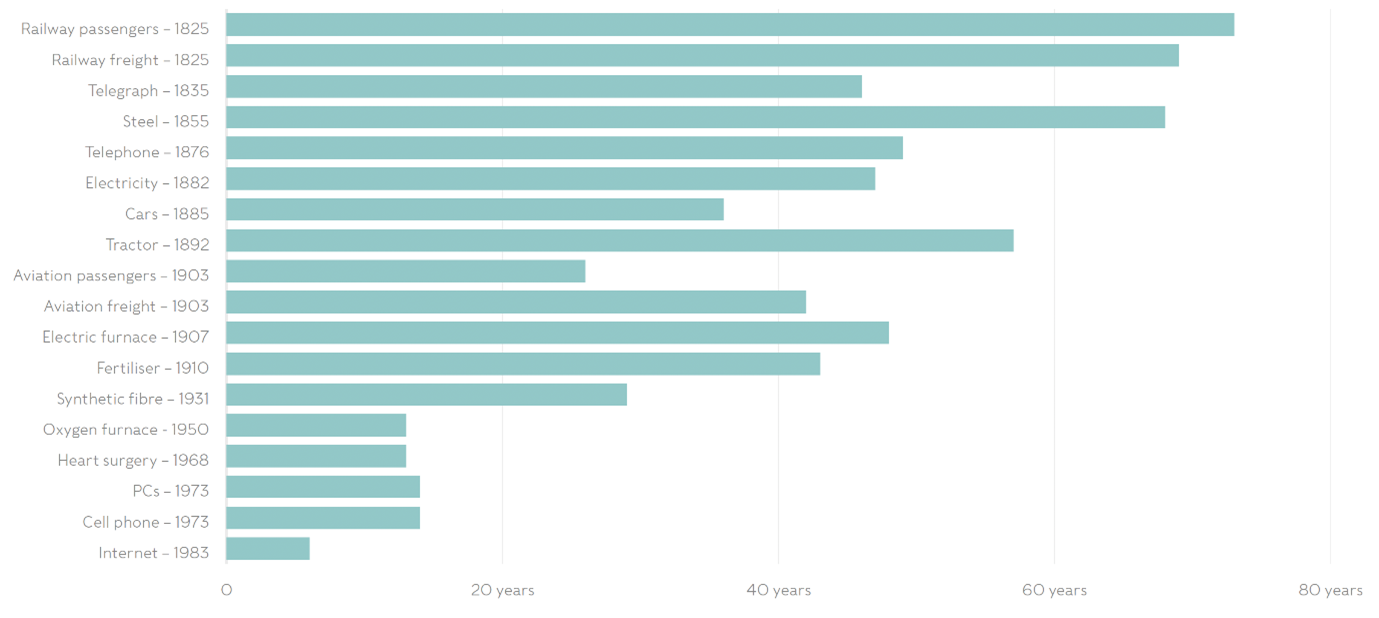
New technology timescales

The adoption timescales for new technologies are getting shorter — but not necessarily the adaption times.

Source: Diego Comin and Martí Mestieri (2018) “If Technology Has Arrived Everywhere, Why Has Income Diverged?” American Economic Journal. 

Bar chart of technology adoption times, showing older inventions took decades, while modern ones spread in under 20 years.


The average time to widespread adoption of new technologies seems to be getting shorter. But are we getting better at adapting? This is less clear. Are ideas able to diffuse well? There’s good evidence they are not, which is a concern because there’s also evidence that if innovation is concentrated in too few firms or industries the economy is trapped in a low-growth scenario. Productivity booms tend to follow periods of supernormal investment spending. MIT scholars found that for each dollar of capital invested in computers, firms tend to make $10 of complementary investments to change business processes, repurpose roles, train staff and so on. But will today’s higher interest rates, high levels of indebtedness, and high uncertainty around inflation constrain the necessary investment spend? We’re optimistic, but there are arguments both ways. 

In short, generative AI could conceivably boost GDP growth by 1-2% a year, but no one knows if that will begin next year, in 10 years, or further out. Economic history cautions us against assuming we can adopt and adapt immediately. Mark our words, this technology has got a better chance than anything we’ve seen in a long while, but investors need to keep a level head and diversify across the suppliers, adopters and adapters of generative AI at this relatively early stage. 

Find out more about our views on the future of AI in our previous Insights publication or by speaking to your investment manager. 

 
VIEW PDF VERSION

Individuals and families

Individuals and families come to Rathbones for the care, diligence and intelligence they receive from their dedicated wealth management team. Begin your own investment story with Rathbones.

Let's talk
Man and woman laughing on a vespa
  1. Home
  2. Guernsey
  3. Knowledge and Insight
  4. Investment Insights Q4 2023: AI industrial revolution?

How can we help you

In Rathbones, our clients find a trusted partner that can help guide their long-term wealth plans with reassurance, through all life stages, generation after generation. We offer you a total wealth solution, from planning to investing — our approach focuses on your wealth in its entirety.


For us every client relationship starts with trust and every investment starts with a client story. We listen to understand your priorities and aspirations to create a wealth plan and investment strategy that’s as individual as you are. You and your family can determine your level of involvement in defining your investment strategy and management — whether you prefer a dedicated Rathbones investment professional to manage the portfolio on your behalf or keep direct control of your investment decisions.

Download our brochure

Investing, growing and preserving your wealth

If you are looking for help growing your investments, our services could be right for you:


Managed
Investing in the ready-made and globally diversified portfolio that’s suitable for you. This service is typically for clients with at least £250,000 to invest.


Bespoke
A bespoke investment strategy and portfolio built and managed for you by a dedicated Rathbones investment manager. This service is typically for clients with at least £500,000 to invest.

Let's talk
two women eating in an outdoor cafe

Global perspective. Individuals focus.

The way we invest is shaped around you. To help deliver to your long-term objectives, we insist on a direct relationship with your dedicated investment manager.


We build our investments around a structure that combines clear guidance with genuine flexibility. It allows us to anticipate future needs and respond in the moment to both opportunities and challenges. 
The value of your investments and the income from them may go down as well as up, and you could get back less than you invested.

Learn about our investment approach
Group of volunteers shaking hands

Responsible investing

We offer individually tailored portfolios that reflects your client's values. We use the extensive experience of our in-house team and Greenbank which is our specialist ethical, sustainable and impact investment team formed in 1997. 

Find out more

Learn more about our services

Investment management

Looking for someone to create an investment portfolio for you?

Find out more

Greenbank sustainable investing

Looking for investments that align with your values? See our sustainable investment options.

Visit Greenbank

Asset management

Are you looking to invest in a fund? See our full range.

Visit Asset Management

Investment Insights

A picture of drones flying over a tree

3 mins

7 August 2026

Drone defence and AI cyber risk: Investment Insights August 2026

Our thought-provoking monthly analysis of markets, economies, and investment opportunities and risks in particular sectors

Drone defence and AI cyber risk: Investment Insights August 2026
A twisting reel of film

3 mins

7 July 2026

Investment Insights July 2026: Stalled house prices, reshaped media, and resilient assets

Our thought-provoking monthly analysis of markets, economies, and investment opportunities and risks in particular sectors

Investment Insights July 2026: Stalled house prices, reshaped media, and resilient assets
Large red rocks reflecting in water

3 mins

8 June 2026

Investment Insights June 2026: Ageing, AI, and new investment fault lines

Our monthly look at investments, economies, and markets

Investment Insights June 2026: Ageing, AI, and new investment fault lines
Image of cat on lap

3 mins

7 May 2026

Investment Insights summary: May 2026

Our monthly look at what’s driving global markets

Investment Insights summary: May 2026

Sign up for insights

Subscribe for Rathbones news, insights, and upcoming events delivered directly to your inbox.

I’ve read Rathbones’ Privacy Policy, which explains how my personal information is used, and understand that I can always unsubscribe at any time.

GA Consent trigger

Ready to start a conversation?

Make a plan with one of our experts

Your investment journey starts today
Let's talk
Rathbones Logo
  • Important information
    • Important information
    • Financial Services Compensation Scheme
    • Complaints and the Financial Ombudsman Service
    • Privacy policy
    • Accessibility
    • Cookies
    • Update cookie preferences
  • Important information 2
    • Fraud: Reporting and preventing it
    • Interest rates
    • Climate reporting
    • Corporate governance
    • Modern Slavery Statement
    • Sitemap
    • Website status and updates
Address

Rathbones Group Plc
30 Gresham Street
London
EC2V 7QN

© 2026 Rathbones Group Plc
Incorporated and registered in England and Wales.
Registered number 01000403

Follow us
  • Facebook
  • Instagram
  • LinkedIn
  • X
  • Youtube

The value of your investments and the income from them may go down as well as up, and you could get back less than you invested.