








  • Wealth Management
  • Asset Management
  • Wealth Management
  • Asset Management
Location
  • United Kingdom
    Language
  • Jersey
    Language
  • Guernsey
    Language
  • US
    Language
  • MyRathbones login
  • Financial Planning login
  • Donor Advised Fund login
Home
  • Who we help
    Who we help

    We help a wide range of clients invest well so that they can focus on what matters.

    Who we help
    • Individuals and families

      Focusing on you and your individual goals.

    • Financial advisers

      Working with you, for your clients.

    • Professional partners

      We work with lawyers, accountants and other professionals.

  • Our services
    Services

    See our wide range of services tailored for your needs.

    Our services
    • Investment Management

      Looking for someone to create an investment portfolio for you?

  • About us
    About us

    A leading UK wealth manager with roots dating back to 1742.

    About us
    • Careers

      Learn more about what it’s like to work at Rathbones, and search our current vacancies.

    • Corporate governance

      Learn more about our Board, Executive Committee and our approach to corporate governance.

    • Media centre

      Read the latest news from Rathbones Group.

    • MyRathbones – Our digital platform

      Our secure online portal and app, designed to give clients a clear view of their investments with us.

    • Our purpose

      Our driving purpose is to help more people invest well, so they can live well.

    • Responsible business

      We believe in doing the right thing for our clients and for others too.

  • Insights
    Insights

    Read the latest news and market commentary from our specialists.

    Insights
    • Investing

      Read about the key investment themes affecting global markets.

    • Responsible investing

      Explore our articles, reports and events on investing responsibly.

    • Webinars

      Timely insights, real conversations. Watch live or catch up anytime.

  • Contacts
    Contacts

    Whether you have a question about our services, or need to talk someone specific, we can help.

    Contacts
    • Our offices

      Find your local Rathbones office. We have 21 across the UK and Channel Islands.

    • Our people

      Find the contact details for your Rathbones team by searching our people’s directory.

    • Let's talk

      Our team will be in touch to help you book a no obligation consultation with an adviser.

    • Our media contacts

      Access the contact details for our media team.

    • Other contacts

      Need to contact us about something else? Here you'll find all the options.

Let's talk

SearchStax standalone input

Weekly Digest: A gilt-edged warning

19 May 2026

As speculation rises that a left-winger could replace Keir Starmer, UK gilt yields have risen to levels last seen before the financial crisis, bringing renewed focus to inflation, public finances and borrowing costs. Equity markets continue to be supported by earnings growth and AI investment, even as higher yields play a more visible role.


By John Wyn-Evans, Head of Market Analysis
  1. Home
  2. Guernsey
  3. Knowledge and Insight
  4. Weekly Digest: A gilt-edged warning

Article last updated 24 June 2026.

Quick take

•    Higher gilt yields underline the challenges facing government finances and future policy decisions.
•    Strong corporate earnings have so far absorbed the impact of higher interest rates, helping markets look through short‑term pressures.
•    Patience and balance remain central to long‑term investment outcomes.


Even those with no great interest in investment matters will have noticed the headlines over the last week concerning the travails of the UK’s government bond market. You’ll likely be aware that bond yields have reached their highest level since 2008. And that the country’s finances are in a worse state than in the aftermath of 2022’s ‘mini-Budget’ during Liz Truss’s short premiership.

A gilt with a 30-year maturity currently trades with a redemption yield – the annual return if held till maturity – of 5.8%. The last time it did so was back in May 1998. The more commonly quoted 10-year gilt yield, currently 5.14%, was last this high in 2007, just before the Global Financial Crisis (GFC).
Since the GFC led to the first use of quantitative easing by the Bank of England to buy government bonds, you could say that we’ve completed a nineteen-year round-trip. That journey took us to a yield low point of 0.07% in August 2020, again thanks to central bank purchases and the fact that the bank base rate was 0.1%. To put that into context, a yield of 0.07% meant that it would take 1,420 years to earn back your capital through interest payments!

And the country’s finances relative to 2022? In some ways, not markedly different. The debt-to-GDP ratio is similar, at around 94%. However, higher interest payments on the outstanding debt will create an increasing burden as gilts issued in the last nineteen years mature and have to be refinanced at higher rates. At least the government is aware   this and has been at pains to rebuild some fiscal headroom by increasing taxes. But, of course, that has weighed on economic growth. 


A trend shift

Unlike today, bond yields were trending downwards in both 1998 and 2007. The 10-year yield had peaked at over 16% in 1980 and then again at close to 13% in 1990 in the face of high inflation. It’s difficult to overemphasize the positive influence of falling bond yields on the equity bull market that ran from 1980 to 2000. Bond yields constitute the discount rate used by investors to value future streams of earnings. The figure they come up with is called ‘net present value’. A lower yield leads, arithmetically, to a higher net present value for those earnings. That two-decade period saw balanced portfolio investors reap substantial gains from both equities and bonds, while inflation trended lower thanks to factors such as productivity growth and increasing globalisation. 

However, bond yields can get too low for comfort. Very low yields can also signal insufficient growth or the risk of tipping into Japan-style deflation. If prices are driven lower by innovation and productivity enhancements, this might be deemed ‘good’ deflation. But insufficient demand meeting oversupply is the bad sort. That was the world that threatened to develop after the technology bust at the turn of the century. It was later reinforced by the 2008 GFC, after which households and governments were more inclined to reduce their debts than to increase spending. 

The first two decades of the century didn’t turn out too badly for investors, especially on a risk-adjusted basis. Central banks’ quantitative easing supported financial assets, and the volatility of balanced portfolios was dampened by the fact that bonds’ and equities’ performance wasn’t positively correlated. To the contrary, when one went up, the other went down. 

That relationship has shifted again since the pandemic. Governments, bowing to populist forces, have been more willing to spend. That tendency has been reinforced by geopolitical events, including the war in Iran. Inflation has kicked into a higher gear. 

Although we endured a painful resetting of valuations in 2022, higher inflation hasn’t hindered equity markets – they hit new all-time highs again last week. So far, the tailwind of strong growth in corporate earnings has proved more powerful than the valuation headwind of a higher discount rate. To some degree, this has been enabled by the incredible level of investment in artificial intelligence (AI), which looks sustainable for the foreseeable future. But we have to consider the possibility that the bond market’s influence proves more potent. After all, the AI-related capex is inflationary in its own right. For example, the latest producer price data in the US showed a 27% year-on-year increase in the cost of electronic components. Much of this can be pinned on the burgeoning demand for memory chips as AI-related demand shifts from training the large language models to using them (a process known as inference). 


A crowded boat 

We could paint this situation more optimistically by saying that the rise in gilt yields isn’t a problem specific to the UK, but you can immediately see the flaw in that line of thought. If bond yields are rising everywhere, that leaves investors with fewer places to hide. And while the UK is paying more than any other G7 country for its debt, the interest bills are rising for the other six too. 

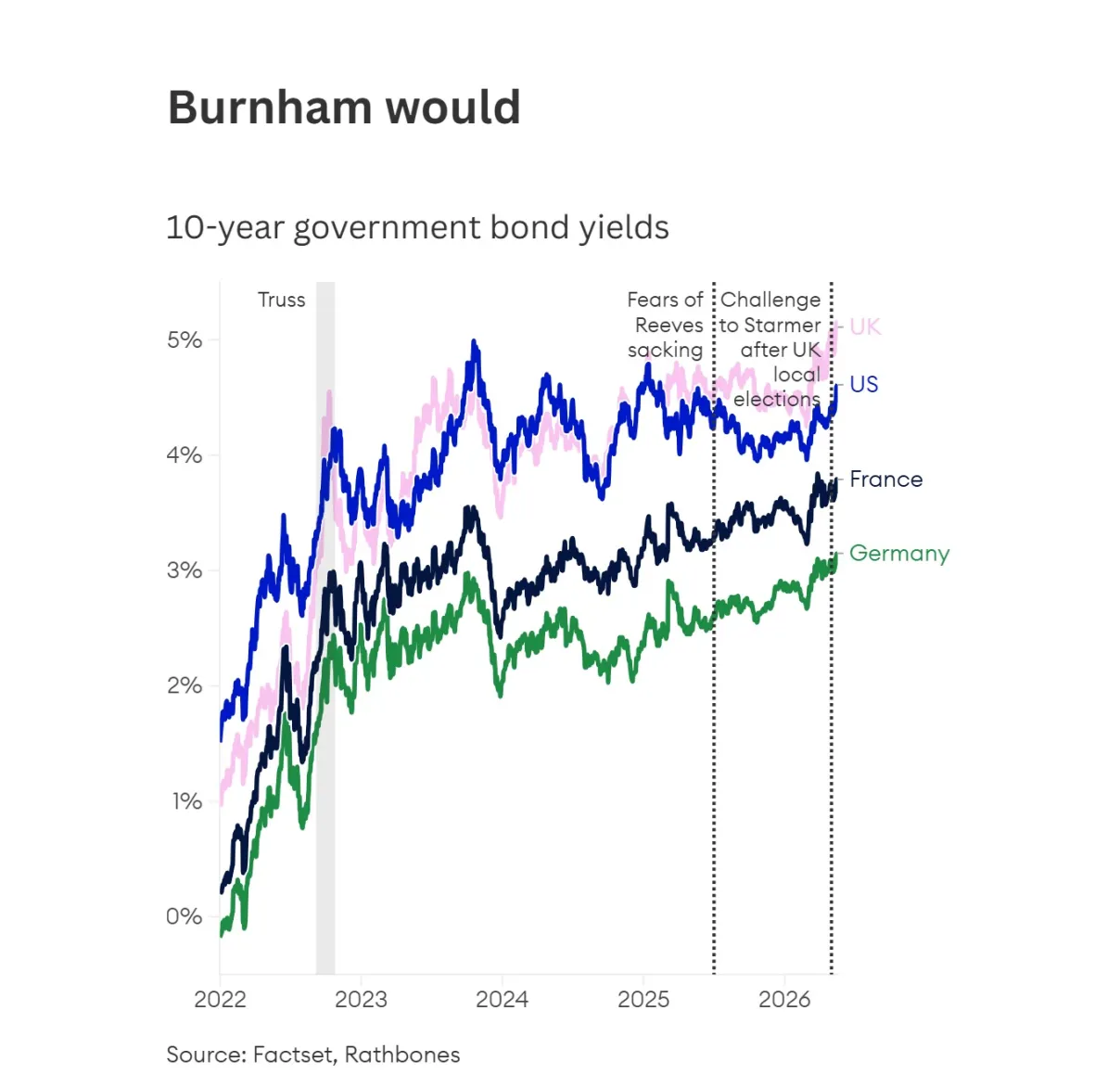
This year, the UK 10-year gilt yield’s climb from 4.47% to 5.14% amounts to an increase of 0.67 percentage points (pp). The average yield increase for the other six G7 members is 0.3pp. Since the Iran war began (and yields had been falling before that), the 10-year gilt yield has increased by 0.91pp against an average 0.60pp for the others (with a relatively tight range from 0.51 to 0.68pp).

So investors must see something in the UK they don’t like. Especially since the UK started with a higher yield, thanks to its history of higher structural inflation and the “moron premium” attached to it since the Truss affair. 

I think you need look no further than the Labour Party and its leadership contest. With betting markets favouring Andy Burnham as the likeliest winner, investors foresee a shift further to the left in policy that will lead to higher debt issuance. This fear could be exacerbated if, for example, increased defence spending is met outside the fiscal rules, an idea floated by Burnham in April (but it will still need to be paid for).

However, Burnham seemed to allay that fear in Monday comments, suggesting that he has been advised not to ignore the influence of the so-called ‘bond vigilantes’. This is the nickname given to investors in government bonds, who have the capacity to limit governments’ ability to resort to large fiscal deficits. That’s because governments know these bond investors will, in response, sell off bonds in fright, forcing up yields.


The balancing act

We’re almost always weighing opposing forces when constructing portfolios. Today, it feels as though those forces are more extreme than usual. There’s the massive potential reward of the buildout and adoption of AI on one side; there’s the threat of further disruption to energy supplies and inflation on the other.

Boring as it might seem not to bet the farm on one or the other extreme outcome, I’d portray that as responsibility amid uncertainty. Diversified portfolios still offer the best means of navigating the world. We certainly won’t be left behind if the AI boom wins out, but neither will we be left empty-handed if inflation and public finances turn out to be a bigger problem. 


UK bond yields have risen particularly fast, on fears that Andy Burnham or another left-wing figure could replace Keir Starmer as premier


 

Individuals and families

Individuals and families come to Rathbones for the care, diligence and intelligence they receive from their dedicated wealth management team. Begin your own investment story with Rathbones.

Let's talk
Man and woman laughing on a vespa
  1. Home
  2. Guernsey
  3. Knowledge and Insight
  4. Weekly Digest: A gilt-edged warning

How can we help you

In Rathbones, our clients find a trusted partner that can help guide their long-term wealth plans with reassurance, through all life stages, generation after generation. We offer you a total wealth solution, from planning to investing — our approach focuses on your wealth in its entirety.


For us every client relationship starts with trust and every investment starts with a client story. We listen to understand your priorities and aspirations to create a wealth plan and investment strategy that’s as individual as you are. You and your family can determine your level of involvement in defining your investment strategy and management — whether you prefer a dedicated Rathbones investment professional to manage the portfolio on your behalf or keep direct control of your investment decisions.

Download our brochure

Investing, growing and preserving your wealth

If you are looking for help growing your investments, our services could be right for you:


Managed
Investing in the ready-made and globally diversified portfolio that’s suitable for you. This service is typically for clients with at least £250,000 to invest.


Bespoke
A bespoke investment strategy and portfolio built and managed for you by a dedicated Rathbones investment manager. This service is typically for clients with at least £500,000 to invest.

Let's talk
two women eating in an outdoor cafe

Global perspective. Individuals focus.

The way we invest is shaped around you. To help deliver to your long-term objectives, we insist on a direct relationship with your dedicated investment manager.


We build our investments around a structure that combines clear guidance with genuine flexibility. It allows us to anticipate future needs and respond in the moment to both opportunities and challenges. 
The value of your investments and the income from them may go down as well as up, and you could get back less than you invested.

Learn about our investment approach
Group of volunteers shaking hands

Responsible investing

We offer individually tailored portfolios that reflects your client's values. We use the extensive experience of our in-house team and Greenbank which is our specialist ethical, sustainable and impact investment team formed in 1997. 

Find out more

Learn more about our services

Investment management

Looking for someone to create an investment portfolio for you?

Find out more

Greenbank sustainable investing

Looking for investments that align with your values? See our sustainable investment options.

Visit Greenbank

Asset management

Are you looking to invest in a fund? See our full range.

Visit Asset Management

Investment Insights

A twisting reel of film

3 mins

7 July 2026

Investment Insights July 2026: Stalled house prices, reshaped media, and resilient assets

Our thought-provoking monthly analysis of markets, economies, and investment opportunities and risks in particular sectors

Investment Insights July 2026: Stalled house prices, reshaped media, and resilient assets
Large red rocks reflecting in water

3 mins

8 June 2026

Investment Insights June 2026: Ageing, AI, and new investment fault lines

Our monthly look at investments, economies, and markets

Investment Insights June 2026: Ageing, AI, and new investment fault lines
Image of cat on lap

3 mins

7 May 2026

Investment Insights summary: May 2026

Our monthly look at what’s driving global markets

Investment Insights summary: May 2026
tanker terminal

3 mins

7 April 2026

Investment Insights summary: April 2026

Our monthly look at what’s driving global markets

Investment Insights summary: April 2026

Sign up for insights

Subscribe for Rathbones news, insights, and upcoming events delivered directly to your inbox.

I’ve read Rathbones’ Privacy Policy, which explains how my personal information is used, and understand that I can always unsubscribe at any time.

GA Consent trigger

Ready to start a conversation?

Make a plan with one of our experts

Your investment journey starts today
Let's talk
Rathbones Logo
  • Important information
    • Important information
    • Financial Services Compensation Scheme
    • Complaints and the Financial Ombudsman Service
    • Privacy policy
    • Accessibility
    • Cookies
    • Update cookie preferences
  • Important information 2
    • Fraud: Reporting and preventing it
    • Interest rates
    • Climate reporting
    • Corporate governance
    • Modern Slavery Statement
    • Sitemap
    • Status of our websites
Address

Rathbones Group Plc
30 Gresham Street
London
EC2V 7QN

© 2026 Rathbones Group Plc
Incorporated and registered in England and Wales.
Registered number 01000403

Follow us
  • Facebook
  • Instagram
  • LinkedIn
  • X
  • Youtube

The value of your investments and the income from them may go down as well as up, and you could get back less than you invested.