




As AI drives rapid data‑centre growth, rising water use is becoming a significant climate and investment risk, pushing companies to look at more efficient cooling and better reporting.

Article last updated 22 June 2026.
|
Quick take
|
Simple rhymes can be surprisingly useful. ‘The cat sat on the mat’ helps early learners grasp letters and grammar. Professional services firms are always acutely aware of the need to maintain the right balance of ‘finders, minders, and grinders’ among their partners to keep the business successful.
Likewise, the investment opportunities presented by ageing populations can be summed up as ‘beds, sheds' – both real estate opportunities – and meds’. Among this trio, ‘meds’ looks set for the strongest growth. Taking the UK as an example, Lord Darzi’s 2024 report on the NHS found that access to healthcare is under severe pressure because of a rising population, significant underfunding, and ineffective allocation of resources: too much money flowing to some parts of the NHS and not enough to others.
The UK’s ageing population will add heavily to this burden. Almost 80% of people who have reached their 75th birthday have at least five long-term health conditions. We believe reform should concentrate on technology investment and preventative healthcare through GP surgeries and other primary care centres. This is better than relying excessively on a reactive system based on hospitals.
This shift is likely to take time, although there were already signs of movement in this direction under former Health Secretary Wes Streeting. As UK governments are pushed towards this approach by necessity, likely beneficiaries include private hospital owners such as LondonMetric, the FTSE 100 property company that leases assets to healthcare provider Ramsay. Primary care centre owners may also benefit, including the real estate investment trust Primary Health Properties, which has more than three-quarters of its rental income backed by the government.
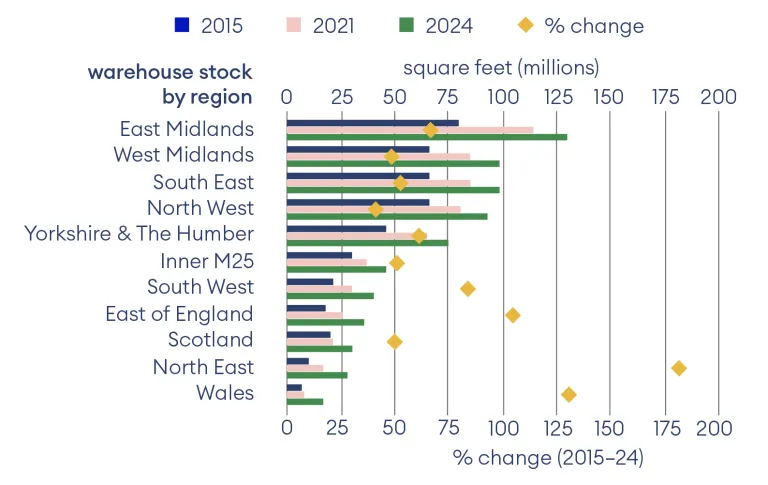
‘Sheds’ is shorthand for warehouses, which benefit from the continued growth of e-commerce (figure 2.1). As older people become less mobile, online shopping becomes increasingly valuable, allowing goods to be delivered directly to their doors.
Sun, sea, and assisted living
‘Beds’ refers to homes. We expect newly retired people to move to places offering the lifestyle they want – typically where there’s sun, sea, and other pleasures nearby. The listed market offers relatively few direct opportunities linked to this trend.
As people age further, many may favour urban living while remaining in their own homes. Later still, assisted living and care homes may become more appropriate. Assisted living is more established in the US but is becoming increasingly common in the UK through businesses such as the privately owned Audley Group.
Among listed companies, firms such as Welltower in the US and Target Healthcare in the UK provide premium private care homes, run by separate landlords.
Offices, by contrast, are likely to remain under pressure. The reason is not primarily because populations are ageing, but because of workforce turnover as older workers retire and younger people fail to replace them in sufficient numbers. Companies may increasingly substitute AI for some retiring workers rather than hiring replacements.
High-quality, environmentally sustainable office space should fare better. But the valuation gap between these buildings and lower-quality offices – already widening in the era of working from home – is likely to widen further.
Gold in the golden triangle
The growth of warehouse space in the UK, particularly inside the ‘golden logistics triangle’ based around Birmingham, Leicester, and Northampton, presents investment opportunities. (Source: Savills Research, Rathbones)