




We look at what the Democrats’ new control of Congress could presage for financial markets.
Article last updated 7 November 2026.
|
Quick take • We think this looks more like a correction than the beginning of a bear market, but we’re watching closely. |
Yesterday, equity markets fell sharply. They were also a reminder of an enduring truth, worth emphasising: volatility is a normal part of long-term investing, even when the economic backdrop remains broadly sound.
The speed of the move is understandably unsettling. But speed and significance are not always the same thing.
Technology has been at the centre of the recent weakness. After an extended period of strong performance, investor positions had become increasingly concentrated in a narrow part of the stock market, pushing up valuations to levels that demanded considerable faith about future earnings. Some of what we are now seeing appears technical: crowded positions are being reduced and successful trades unwound quickly.
By ‘technical’, we mean short-term trading strategies that look at patterns in data, rather than fundamental rethinking about the economy and corporate profits.
That said, there are legitimate questions about the extraordinary amount of investment being made in artificial intelligence and data centres. Political and public scrutiny of the scale, cost, and energy requirements of this investment was already increasing – and will increase still more, now that the Democrats have greater political power (please see this week’s piece on the mid-terms results). That could moderate the pace of spending at the margin.
But this does not, in itself, mean that the fundamental investment case has broken.
Correction, bear market, or change in leadership?
That is the key question.
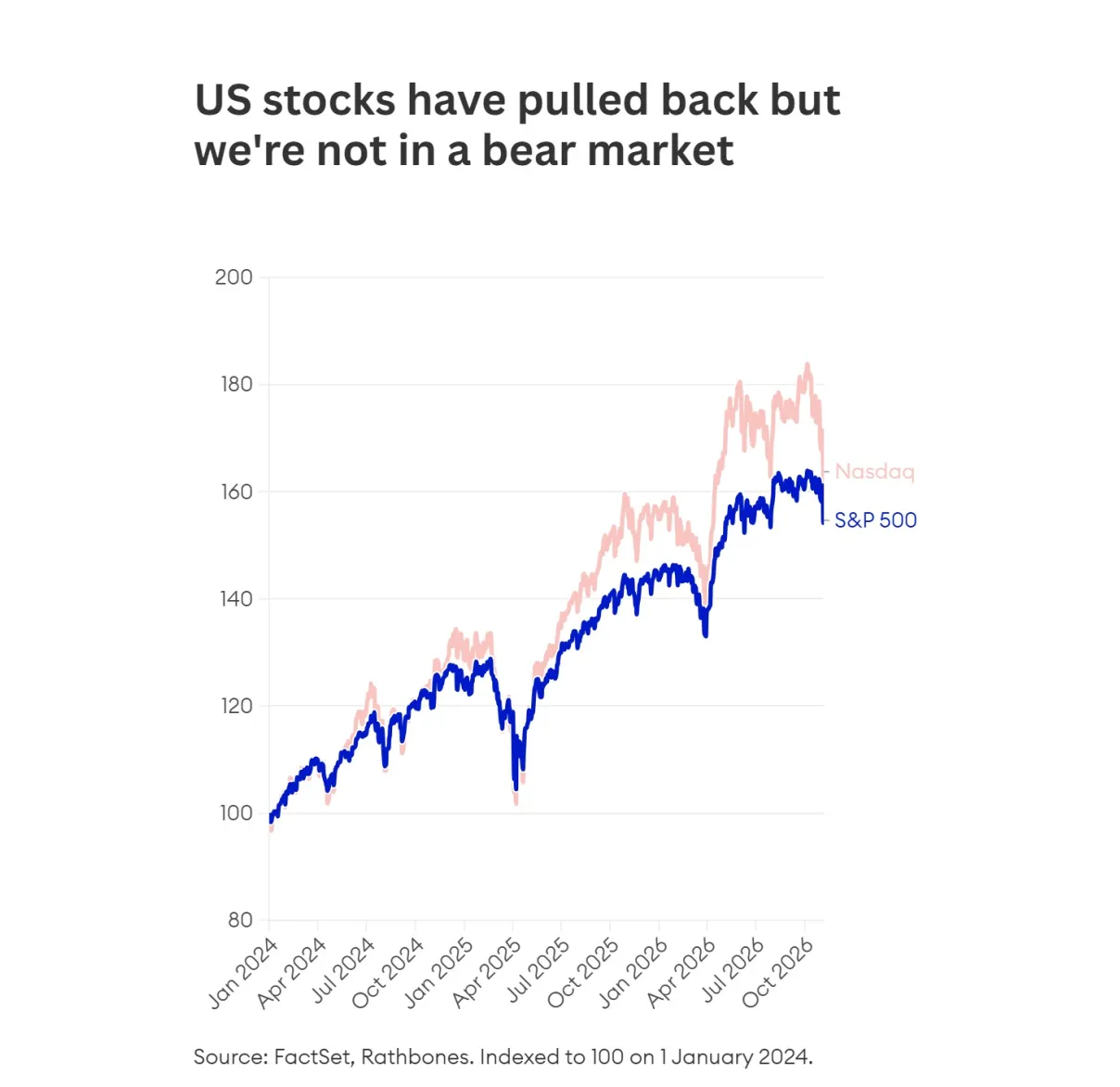
We strongly believe that for now, the evidence points more towards a correction – potentially accompanied by a change in which stocks will perform well – than the beginning of a prolonged bear market. In other words, a pulling back rather than the start of a sustained fall.
Supporting this view, corporate earnings remain resilient, economic activity has held up, and we are not seeing the degree of stress in credit markets that would normally accompany a more serious deterioration.
Lower oil prices, if sustained, should also help – the price of crude oil has fallen this week. They reduce inflationary pressure, support household incomes, and provide some easing in financial conditions, by making it easier for central banks to cut interest rates.
What may be changing is this key question: where do market returns come from?
Markets have become unusually dependent on a relatively narrow group of technology and AI-related companies. A correction in those areas does not necessarily imply that the broader economic or market cycle is ending. It may instead mark the beginning of a period in which leadership moves towards other sectors, styles, and regions.
That distinction is important. A change in market leadership is not the same thing as the end of a bull market.
US stocks have pulled back from highs, but we're not in a bear market
The risk we are watching closely
There is, however, an important risk that we have highlighted before: markets can themselves become part of the fundamental story, in the real economy.
A sufficiently large and persistent fall in asset prices can damage confidence and tighten financial conditions. Companies may postpone investment, households can become more cautious, and lenders less willing to extend credit.
In other words, weaker markets can create a negative feedback loop in which deteriorating sentiment eventually produces weaker fundamentals.
We do not believe we are at that point today. But this concern is one reason why we remain vigilant and, rest assured, poised to act if the evidence changes.
What diversification is designed to do
Periods such as this are precisely why portfolios are diversified.
Diversification cannot prevent portfolios from falling when markets decline sharply. Its purpose is to avoid depending on one asset class, one sector, or one economic outcome.
Importantly, diversified portfolios remain up over the year despite the recent falls.
Government bonds can provide income and protection if growth expectations weaken. Diversifying strategies can behave differently from equities during periods of market stress. And broader equity exposure reduces dependence on the relatively small number of technology companies that have driven a disproportionate share of recent market returns.
Our focus remains, we should note, on quality, diversification, and breadth.
Within fixed income, higher yields provide an opportunity to consider selectively increasing duration – in other words, investing more in longer-dated bonds, which benefit when expectations for economic growth slow. This would give portfolios greater potential protection should economic growth falter.
Within equities, we continue to see merit in broadening exposure beyond the recent technology leaders. That means looking across a wider range of high-quality companies and more attractively valued sectors, including areas of the market that have participated less fully in the recent advance.
This is not about abandoning successful long-term themes such as technology or artificial intelligence. It is about ensuring portfolios are not overly reliant on them.
Volatility can create opportunity
Sharp market movements are uncomfortable, but they can also create opportunities.
When selling becomes driven by professional investors’ positioning, liquidity – their need to raise funds to cover losses elsewhere – and risk reduction rather than changes in the long-term prospects of individual businesses, something interesting happens. Good assets can become available at more attractive prices.
A change in market leadership can create opportunities too. If returns broaden beyond the narrow group of companies that have dominated markets, disciplined investors may find attractive opportunities across a much wider range of quality businesses and sectors.
That is why our response is not simply to become more defensive. We remain ready to protect portfolios if the fundamental environment deteriorates, but equally ready to take advantage of market dislocations, where prices have moved further than fundamentals justify.
We will continue to watch earnings, economic activity, labour markets, credit conditions, and corporate investment closely. If those indicators deteriorate materially, we will respond. If fundamentals remain resilient while markets continue to reprice the value of assets, opportunities are likely to emerge.
For now, the appropriate response is neither complacency nor panic. It is to remain calm, stay diversified, and continue to follow a disciplined long-term investment process.
Watch my new video for more long-term thinking on the issues I've discussed in this piece.