Introduction
Mike Kempster:
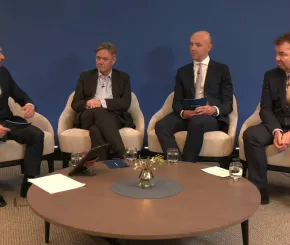
Hello everyone and a very warm welcome. I'm Mike Kempster, head of London and East distribution at Rathbones and I'm delighted to host our second investment insights webinar of the year.
It's been an eventful start to 2026 and investors are understandably looking for clarity from a market perspective. As of the end of Q1 2026, we've seen plenty of volatility, but also a clear reminder that the path is unlikely to be smooth. Risk appetite has held up at times, while day‑to‑day moves have often been driven by headlines, particularly around geopolitics and trade policy.
Over the quarter, the outlook for interest rates and inflation has continued to shape expectations for earnings and valuations, particularly in the areas where the market is pricing and is most demanding. Over the last couple of weeks, we've seen another example of how markets react when news turns for the better. The announcement of a two‑week ceasefire and talks between the US and Iran, another example of Trump always chickens out. His tendency to pull back from the brink was greeted with an instant markup of most financial assets.
I'm joined today by John Wyn‑Evans, our head of market analysis, who will guide us through the forces shaping markets right now and what they could mean for portfolios as we move further into the year. Our aim is to help cut through the noise and bring some clarity to what matters most for advisers and their clients navigating the year ahead.
We'll also have a Q&A session at the end. There's a Q&A tab on the right‑hand side of your screen where you can submit questions at any point and we'll come back to those before the session wraps up.
There's plenty to explore this morning. So, John, let's dive in. Over to you.
Presentation
John Wyn‑Evans:
Thanks very much, Mike, and good morning, everyone.
I'm just going to share my own screen, which will just take a moment to set up. So, give me a second with that.
Obviously, it's been a very exciting period, not necessarily in a good way, since I last spoke to you. But remarkably also, in many respects, we are kind of in a better position than we might have expected to be at this point as well.
So the things that we're going to cover this morning – we're going to look at what I've called “what was all the fuss all about”. We're going to see that in many respects what markets have done over the last few weeks has pretty much taken us back to where we were before the war started. And I don't think necessarily many would have bet on that at the time.
We'll talk about the Iran war and its consequences in some detail. I'm going to come back to the AI story as well, then talk a little bit about markets too. So there's quite a lot to pack in as usual into one of these sessions.
What was all the fuss about?
I'm going to remind you all of one of my favourite characters who I bring out every now and again – the jungle explorer.
This is this mythical investor who disappears off into the jungle for several months at a time on one of his expeditions. He doesn't have any access to the internet and he can't check what his portfolio is doing. Usually, whatever happens in that period, he comes out and he thinks, “Oh, the world is a very quiet place while I was away”, and doesn't really realise what's going on.
Certainly, as a best practice in many respects, I always say the fewer times you actually check the valuation of your portfolio, I'm guessing the less stress you will feel as well. It will appear to be less volatile on that basis.
Let's have a look. These are the data on Monday's close and luckily an awful lot hasn't happened in the last sort of 24 hours or so.
The MSCI World index shows a price return of 4.5 per cent year to date. Now, we're coming towards the end of April. Multiply that by three for an annualised return and it's a pretty decent annualised return, well into double digits. So it's been a good year for returns so far in spite of everything.
Look at the indices below that. The S&P 500 up about 2.5 per cent, the FTSE up 6.7 per cent, MSCI Europe ex‑UK up 3.8 per cent, the Topix index in Japan up over 8 per cent and emerging markets up 13.5 per cent.
Now admittedly quite a lot of that has come from just a few stocks – the memory chip companies in South Korea and the Taiwan Semiconductor Manufacturing Company – which are all part of the AI play. But even so, it's quite a decent performance year to date in spite of everything that we've seen.
And if we look at it from the chart point of view, you can see that the MSCI All Countries World Index was up 4.6 per cent before the end of February. Everything then kicked off at the beginning of March. It fell 9.5 per cent to its lows just before the end of March. And then as the news turned for the better again, there was talk of more reconciliation and it's jumped almost 12 per cent since then, leaving us on that nice little gain for the year.
Bonds and portfolio volatility
Now looking at other asset classes, the bond market just followed the equity market. We've been talking for quite a long time about how in this higher inflation world bonds and equities are more correlated, and so bonds don't necessarily give you that diversification benefit in a portfolio.
You can see the global aggregate bond index was up just over 2 per cent at the end of February, but it fell 3.5 per cent during March before bouncing back. It's only up 0.7 per cent year to date. So the market is concerned about inflationary effects in the long term and also about what this might do for the fiscal health of countries. The bond market has been struggling to find a better bid in this environment.
One thing that has helped us against what was going on in the bond market is that for some time we've been exposing ourselves to less duration in our bond portfolios. I wanted to show you how much more volatility there is in a bond price the longer the duration or maturity you have.
If you look at the UK gilt that expires in March 2028, it was down about 1.7 per cent during March. The 2031 gilt was down almost 3 per cent, the 2036 ten‑year was down almost 5 per cent, and by the time you go out to 2063, that was down about 8 per cent.
This is just a reminder that you can control volatility through managing duration. This works both ways when rates are coming down, but that's not necessarily the case at the moment.
A lot of clients also like to buy low‑coupon gilts because of the tax favourability, as there is no capital gains tax and most of the return comes from price. But with low‑coupon gilts you also expose yourself to more volatility because of longer modified duration.
Portfolio illustration
If we boil all of this down into an illustrative portfolio, using the FTSE Private Balanced Index as a proxy, you can see it was up about 4 per cent at the end of February. It then fell about 5.5 per cent during March and has bounced back almost 6 per cent, taking us pretty much back to the end‑February peak.
It's been an amazing round trip in portfolio performance over that period.
Looking back over history at geopolitical events since 1939, the average outcome is a sell‑off in the first few trading days, maybe up to three weeks, and then quite a decent bounce back. This episode was slightly worse than average in terms of the fall but the recovery was much faster.
Iran, oil and global supply
The bulk of what I want to talk about today is the war in Iran.
The Strait of Hormuz is a fatal choke point. About 20 per cent of the world's oil supply passes through it. While there are some alternative pipelines, they only offset part of that volume. The Red Sea route also introduces additional geopolitical risk due to activity around Yemen.
Oil tanker crossings dropped from between 50 and 80 per day at the beginning of the year to virtually zero by the end of February. There was a brief spike last weekend when Iran said the strait would reopen, but it was quickly shut again.
Oil prices have jumped from around $60 at the start of the year to almost $120 at the peak and are currently trading around $97 per barrel.
This is not just about oil. Many refined products and by‑products are affected: sulphur, propane, butane, helium, fertiliser inputs, liquefied natural gas and jet fuel. These disruptions have broad consequences across agriculture, semiconductors, aviation and food prices.
Inflation outlook
UK CPI data for March showed inflation rising from 3 per cent to 3.3 per cent, with fuel prices up almost 9 per cent. Core inflation dipped slightly, suggesting limited second‑round effects so far.
However, energy price caps are likely to rise again in July. Forecasts from Oxford Economics suggest inflation could peak at between 4 and 4.5 per cent later in the year.
Scenarios
We are considering three scenarios: de‑escalation, muddling through and further escalation.
De‑escalation would see energy transit return close to pre‑conflict levels. Muddling through implies prolonged disruption at reduced volumes, which is where we likely are now. Escalation would mean extended closure of the Strait of Hormuz.
In the escalation scenario, oil prices could rise to around $150 a barrel, keeping central banks constrained and increasing the risk of stagflation.
Portfolio positioning
We have held firm during the conflict, given experience with previous geopolitical events. Short‑duration gilt exposure has helped reduce volatility. We have reduced European equity overweights and increased index‑linked gilts for inflation protection.
AI and markets
AI has come back into focus. Hyperscaler capital expenditure expectations for 2026 have risen from $500 billion to $660 billion in just three months. The gap between hardware and software performance has been striking.
Adoption across businesses is increasing, and demand for computing power continues to exceed capacity.
Earnings and valuations
US equities remain the most expensive at around 21.5 times earnings. Earnings expectations remain strong so far, with first‑quarter growth forecast at around 12 per cent year on year.
Emerging markets are forecast at around 40 per cent earnings growth, driven largely by semiconductor companies. UK earnings growth is forecast at around 16 per cent, boosted by energy and materials.
Politics and risk
UK local elections in May and US mid‑term elections in November could introduce further volatility. Markets are not signalling panic at present, but we expect political developments to remain important.
Conclusion
Uncertainty is ever‑present. Markets tend to overreact in the short term. Equities remain fully valued but earnings growth should support them absent a recession. Inflation is likely to be higher and more volatile in the long term, which informs our portfolio construction.
Thank you very much for your time.
Q&A
Mike Kempster:
Thank you very much, John. Very informative, and I think some really good slides that hopefully advisers can use in client conversations. I think we can all, from time to time, relate to the last one that you showed – not the disclaimer, but yes.
We've got some Q&As. We've got some interesting questions and I think you spoke about the midterm elections and we've had a question in from Nikki. So I'll cover that one off first.
To talk a bit about the US, and I think we covered some parts of that, Nikki's kind of question is: as ever, Trump is the most important man in the world. How are Americans feeling and hurting about the Iran war and the effects on them, for example gas and petrol in the US? Obviously you covered off the midterm elections, so really what's his agenda?
But to dovetail with that as well, we've got a second question which I'll roll into this because I think it is all relevant. The second question is: will Trump ensure that there is a buoyant US equity market ahead of the midterm elections in November?
So what are your thoughts on that?
John Wyn‑Evans:
Yeah, I mean in terms of how the US is feeling at the moment, a lot of it is dependent upon what your politics are.
It feels – I mean we did see some consumer confidence data out in the US ten days ago, which is kind of the lowest it's ever been in terms of the readings, more depressed now apparently than we were during the height of Covid or even the financial crisis for example. But there's no doubt that what we have witnessed is a lot of these sentiment surveys do seem to be skewed quite a lot by politics as well.
If you look at Republicans, they're happier than Democrats. When Biden was president, Democrats were happier than Republicans. So it's quite hard to say.
There also seems to be a lot of tearing in the US economy. Basically if you're in a job, you're okay. If you're out of a job, you feel like it's a recession. And that's definitely the case.
Also, if you own assets – and particularly financial assets rather than property at the moment – and you're in the stock market, a lot of the US has much more embraced equity ownership than UK or European investors. They're having quite a nice ride. The S&P 500 closed at an all‑time high a couple of days ago, so they're probably feeling wealthier at this point, particularly the middle and upper classes.
Certainly, the lower income cohorts are not doing so well and they get hit harder by higher fuel prices. So it depends how it's distributed around the economy. But consumption doesn't seem to be too bad at the moment. We saw some retail sales data earlier this week that beat expectations.
In terms of how this feeds through into politics, there's no doubt people are unhappy with things. There doesn't seem to be huge support for the war. Support is higher amongst core MAGA supporters than elsewhere, but they just don't feel it as much over there.
They do still face global oil pricing to some degree, even though the US is self‑sufficient. Gasoline prices have gone from under $3 a gallon to over $4 on average, closer to $6 in parts of California. So they may vote with their wallets in the end.
But Trump does have time to try to reverse that and maybe do some economic giveaways to keep the economy humming up until November. And I think, given his character, you'd probably bet on that being the case.
Mike Kempster:
Sure. No, thanks John. That's really helpful.
A further question regarding the US, UK and European equity markets – if the war continues, do you see these three markets at further risk of decline?
John Wyn‑Evans:
Yes. I have to be completely honest – a one‑word answer is yes.
The longer it goes on, you move from having higher prices to not being able to get the products themselves. When you start to see shortages of fertiliser, jet fuel, diesel or whatever it might be, that will have a greater impact on the economy.
It also pushes prices up, keeping the price of money higher. That definitely has a negative effect. Normally if the economy weakens, central banks would cut rates, but they won't do that in a high‑inflation environment if they're worried about unanchoring long‑term inflation expectations and second or third round effects.
That’s the worst‑case stagflation scenario.
From a portfolio perspective, that’s one reason why we're neutral at the moment in terms of risk appetite. We would have been tempted to be overweight risk at the end of February, with interest rates potentially coming down and inflation settling, and the AI trade gaining momentum.
But we can't do that now. If you go underweight risk and there's a resolution, markets gap higher and it's hard to chase.
So we're neutral. We maintain a quality bias, balance‑sheet strength, and diversifiers like short‑dated gilts. We're prepared for volatility but not taking a specific bet that things will definitely get worse.
Mike Kempster:
Okay. No, that's fair. Thanks John.
And what's the expectation for the Middle Eastern position settling? Any timescales and any thoughts on how this is being negotiated?
John Wyn‑Evans:
The fact they are still talking is important. What we’ve seen with Trump over the last year or so is escalation to de‑escalate – appearing tough, then pulling back.
We saw this with China last autumn. China pushed back and restricted rare earths. It was ultimately walked back because it wasn’t in either side’s interest.
We have a template for that behaviour. Iran is harder to read. No one is quite sure who is in charge, which doesn’t help. They may tolerate pain longer for ideological reasons.
Iran can’t get its oil out, it needs money, and its population was restive even before this started. There was maybe an expectation in the US administration that this would lead to a rapid regime response, but that hasn't happened.
So it's very difficult to put a timescale on it. The market suggests sooner rather than later, and the collective wisdom of the crowd is at least some pointer.
Closing
Mike Kempster:
Thank you John.
Well, that's all we've got time for today. So thanks so much for joining us and for all your questions.
Finally, if you do have any further questions, please get in touch with your Rathbones business development director or investment manager contact.
We hope you leave today with a clear view of what's moving markets and what that could mean for portfolios in the months ahead.
Thank you again, John. And on behalf of Rathbones, I'm Mike Kempster. Let's work with you to stay focused, proactive, and continue to deliver confidence in a changing landscape so that our clients can invest well and live well.
Thank you.