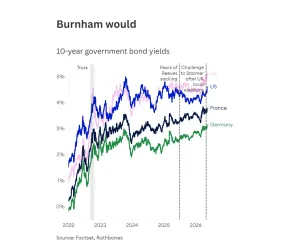
As speculation rises that a left-winger could replace Keir Starmer, UK gilt yields have risen to levels last seen before the financial crisis, bringing renewed focus to inflation, public finances and borrowing costs. Equity markets continue to be supported by earnings growth and AI investment, even as higher yields play a more visible role.

Article last updated 18 May 2026.
Turning market turmoil into planned action
Crises always hit when you don’t expect them. The most important thing is to have a detailed, continuously refreshed short-to-medium plan before it hits. Then you must stay calm, assess the situation and determine whether anything has changed that impacts your original investment plan. Only then, after a deep breath, should you act. Often, a crisis can accelerate the execution of this plan as violent lurches in market prices can create opportunities to both buy and sell.
Having a plan
We build our portfolios based on what mix of assets we think should perform best in terms of returns and the risk we’re willing to take over the next one to three years. This includes how many safer government bonds we hold, from which countries, through to how much equity to hold and which industries we want to invest in. We also have a sleeve of assets that diversifies us from both of these markets, and – with a bit of luck – reduces our portfolios’ volatility.
As for which specific stocks and bonds to buy, that comes down to relative valuation. For all our holdings, we have set valuation targets for when we would add to them on weakness or trim them on strength. Similarly, we have a bench of stocks we can swap in if they become more attractive than those in our portfolio. Again, we have targets at which we would make any changes, relative to how our portfolio companies are trading. This is extremely important to have in place well before any market fireworks, because it’s essentially a ready-made playbook.
It’s a rare week that we’re not pondering how our funds will hold up if stocks sell off, or if corporate defaults rise, or inflation changes course and central bankers threaten to raise rates, or if the oil price spikes, say, among countless other scenarios. These never arrive exactly as you would expect or play out in the way your theory books would tell you. Yet all this thinking and analysing isn’t wasted. It drives us to run scenarios and see how our portfolios would be expected to react. Doing that can flag areas where our diversification is less effective than we would like, giving us the chance to adjust our funds ahead of any actual crisis.
This iterative process of pessimism is never finished, but it puts you in good stead for when a sudden shock arrives. It means you’re quicker to spot the areas where things aren’t playing out as you would have expected – letting you home in on the areas that require your attention, rather than being overwhelmed by it all.
The day of turmoil
First thing in the morning – or over the weekend if a shock appears out of hours – my team get together to discuss what’s happening, the implications for GDP growth, inflation, central bank interest rates and all the asset prices that flow from those phenomena.
We compare this to what we expected to happen in such a scenario. Where stock prices and markets have diverged from the script, we drill down to determine if anything substantial has changed that undermines our reason for owning the asset. Where the investment rationale no longer makes sense, we sell immediately. Where we think the market is wrong, we buy, using the targets that we have already set.
We don’t make decisions because of upheaval like that caused by the Iran conflict. Instead, market gyrations give us the opportunity to trade as assets hit our targeted entry or exit points.
Trading during volatile periods is not for the faint-hearted. I’ve done this countless times over the 35 years I’ve been managing investments and it never seems to get easier. Self-doubt, fear, all of this is normal and never goes away. That’s why having a plan and a mechanical list of actions helps. You eliminate the emotion, trust in the process, and proceed, knowing that all things pass.
In the latest turmoil sparked by the Iran conflict, we determined that, when looking at the next three to six months, nothing fundamental had changed for our portfolios. Over the past year or so, we had bolstered our diversifiers by purchasing industrial metal exposure (particularly copper) to protect against a resurgence in inflation. We also carry three of the oil majors – Chevron, Total and Shell – as a standing hedge against oil price shocks. Renewable energy is a critical and growing fuel for global economies, but the world still runs on oil and gas.
Our bond exposure was already widely spread across many different governments. We did this because of increased concern about the path of public spending in the UK and US. Also, our bonds were of ‘low-duration’ overall, i.e. they mature sooner than normal, so the value is less sensitive to changes in prevailing yields/interest rates. We had positioned ourselves that way because of lingering concerns that inflation would not fall enough to deliver as many rate cuts as most investors expected (before the Middle East sent energy prices rising). That protected us somewhat from big sell-offs in bonds, but we’re reluctant to change this stance now that there’s a greater risk of rekindled inflation.
We had very little riskier fixed income, such as corporate bonds, emerging markets and private credit, as we felt their prices were too rich for the risks they offered. We will be keeping an eye out over the coming weeks to see if any prices are more attractive now in some of these areas. We added to our holding of private markets fund manager KKR, as we felt that its price had become more attractive. All this isn’t to say that the volatility hasn’t dented us. It has, albeit mitigated by protection we had in place before it all kicked off. But what’s more important is taking the opportunities that are offered and ensuring our portfolios are set up as well as possible for the months and years ahead.
The day after and the days and years after that
Our long-term plan is based on global dynamics that are bigger than any one economy or shock.
The world is ageing, and relatively fast. This is putting more strain on societies and governments that have to accommodate it. Meanwhile, more people are getting wealthier, which is an unmitigated good thing. Yet that increases the demand for virtually everything, particularly healthcare which is perhaps one of the hardest things to quickly increase supply at scale without sending costs spiralling higher. Wealthier, older people also boost demand for investments and pensions. This can sound esoteric, but besides creating opportunities for emerging market life assurers (one of which we own), it also affects the likely path of global interest rates. This is because it means more money flowing to global investments, which (all else equal) depresses yields and rates.
This flow of money, lower real rates and a real urgent need to do more with less are fertile ground for technological progress – in our view at least. And at the end of the day, it’s companies that deliver those technologies that help real people, which is why we’re optimistic about the future for stocks.
This, of course, brings us back to where we started: we set up our portfolios for the very long term. One thing that can drag you off course is ‘portfolio drift’ – where divergent performance leaves your portfolio with holdings in different proportions than you’ve planned for. That often means you start taking much bigger risks than you had intended.
This happens when a portfolio is unmonitored, left to drift without rebalancing by trimming winners and buying weaker performers. As a case in point, we’ve been trimming our oil stocks to keep them at the size we want, while adding to stocks that have been hit hardest (and most unfairly) recently. It’s important to do this regularly – monthly just doesn’t cut it, especially when markets move suddenly – to keep a portfolio on track and avoid taking on unexpected risks.
Investing in volatile times over the decades, I’ve realised that there are some things you can’t control, so you should focus on what you can influence. For me, that means having a plan ahead of time, following it even when it’s tough, and making loads of smaller uncomfortable decisions rather than one or two Hail Mary throws.
This is a financial promotion relating to a particular fund range. This information should not be taken as investment advice or a recommendation. When you invest your capital is at risk and you could lose some or all of your investment.