








  • Wealth management
  • Asset management
  • Asset management
  • Jersey
  • Guernsey
  • USA
  • MyRathbones login
  • Financial Planning login
  • Donor Advised Fund login
Home
  • Who we help
    Who we help

    We help a wide range of clients invest well so that they can focus on what matters.

    Who we help
    • Individuals and families

      Focusing on you and your individual goals.

    • Entrepreneurs and business owners

      Helping turn the success of your business into financial security for your family.

    • Financial advisers

      Working with you, for your clients.

    • Charities

      Helping charities invest in line with their mission and values.

    • Professional partners

      We work with lawyers, accountants and other professionals.

  • Our services
    Services

    See our wide range of services tailored for your needs.

    Our services
    • Investment Management

      Looking for someone to create an investment portfolio for you?

    • Wealth Management

      Our combined investment and planning service for a holistic approach to your finances.

    • Financial Planning

      Need help reorganising your finances and planning for the future?

    • Asset Management

      Looking to invest in a fund? See our full range.

    • Tax and Trust

      Helping you pass on your wealth, manage a trust or gift to charity.

    • Greenbank Sustainable Investing

      Looking for investments that align with your values? See our sustainable investment options.

    • Personal Injury and Court of Protection

      Rathbones’ dedicated personal injury (PI) and Court of Protection (COP) team.

    • Private Banking with Investec

      Private, corporate, and investment banking services through our partnership with Investec bank.

    • Awards

      Our awards and industry recognition reflects our commitment to exceptional wealth management.

  • About us
    About us

    A leading UK wealth manager with roots dating back to 1742.

    About us
    • Careers

      Learn more about what it’s like to work at Rathbones, and search our current vacancies.

    • Corporate governance

      Learn about our Executive Committee, Board, General Meetings and how we comply with the UK Corporate Governance Code.

    • Investor relations

      Find the Rathbones Group Plc financials, reports, investment case and key events.

    • Media centre

      Read the latest news from Rathbones Group.

    • Our purpose

      Our driving purpose is to help more people invest well, so they can live well.

    • Responsible business

      We believe in doing the right thing for our clients and for others too.

  • Insights
    Insights

    Read the latest news and market commentary from our specialists.

    Insights
    • Financial planning

      Explore a range of topics affecting your finances, from retirement planning to the latest legislative changes.

    • Investing

      Read about the key investment themes affecting global markets.

    • Podcasts

      Listen in to or watch our specialists in one of our podcasts.

    • Responsible investing

      Explore our articles, reports and events on investing responsibly.

    • Webinars

      Timely insights, real conversations. Watch live or catch up anytime.

  • Contacts
    Contacts

    Whether you have a question about our services, or need to talk someone specific, we can help.

    Contacts
    • Our offices

      Find your local Rathbones office. We have 21 across the UK and Channel Islands.

    • Our people

      Find the contact details for your Rathbones team by searching our people’s directory.

    • Let's talk

      Our team will be in touch to help you book a no obligation consultation with an adviser.

    • Our media contacts

      Access the contact details for our media team.

    • Other contacts

      Need to contact us about something else? Here you'll find all the options.

Let's talk

Autocomplete

Weekly Digest: A gilt-edged warning

19 May 2026

As speculation rises that a left-winger could replace Keir Starmer, UK gilt yields have risen to levels last seen before the financial crisis, bringing renewed focus to inflation, public finances and borrowing costs. Equity markets continue to be supported by earnings growth and AI investment, even as higher yields play a more visible role.


By John Wyn-Evans, Head of Market Analysis
  1. Home
  2. Knowledge and Insight
  3. Weekly Digest: A gilt-edged warning

Article last updated 19 May 2026.

Quick take

•    Higher gilt yields underline the challenges facing government finances and future policy decisions.
•    Strong corporate earnings have so far absorbed the impact of higher interest rates, helping markets look through short‑term pressures.
•    Patience and balance remain central to long‑term investment outcomes.


Even those with no great interest in investment matters will have noticed the headlines over the last week concerning the travails of the UK’s government bond market. You’ll likely be aware that bond yields have reached their highest level since 2008. And that the country’s finances are in a worse state than in the aftermath of 2022’s ‘mini-Budget’ during Liz Truss’s short premiership.

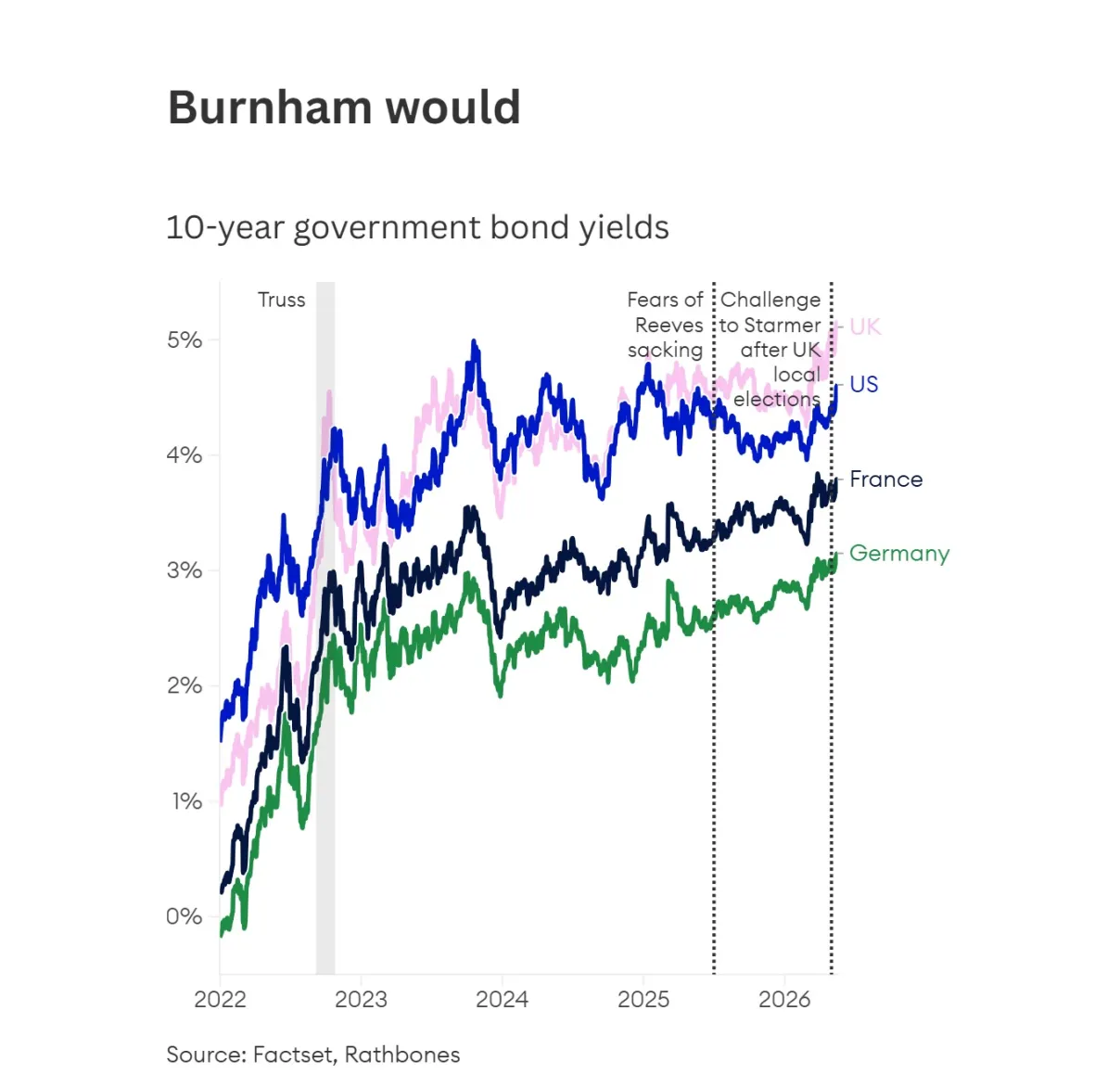
A gilt with a 30-year maturity currently trades with a redemption yield – the annual return if held till maturity – of 5.8%. The last time it did so was back in May 1998. The more commonly quoted 10-year gilt yield, currently 5.14%, was last this high in 2007, just before the Global Financial Crisis (GFC).
Since the GFC led to the first use of quantitative easing by the Bank of England to buy government bonds, you could say that we’ve completed a nineteen-year round-trip. That journey took us to a yield low point of 0.07% in August 2020, again thanks to central bank purchases and the fact that the bank base rate was 0.1%. To put that into context, a yield of 0.07% meant that it would take 1,420 years to earn back your capital through interest payments!

And the country’s finances relative to 2022? In some ways, not markedly different. The debt-to-GDP ratio is similar, at around 94%. However, higher interest payments on the outstanding debt will create an increasing burden as gilts issued in the last nineteen years mature and have to be refinanced at higher rates. At least the government is aware   this and has been at pains to rebuild some fiscal headroom by increasing taxes. But, of course, that has weighed on economic growth. 


A trend shift

Unlike today, bond yields were trending downwards in both 1998 and 2007. The 10-year yield had peaked at over 16% in 1980 and then again at close to 13% in 1990 in the face of high inflation. It’s difficult to overemphasize the positive influence of falling bond yields on the equity bull market that ran from 1980 to 2000. Bond yields constitute the discount rate used by investors to value future streams of earnings. The figure they come up with is called ‘net present value’. A lower yield leads, arithmetically, to a higher net present value for those earnings. That two-decade period saw balanced portfolio investors reap substantial gains from both equities and bonds, while inflation trended lower thanks to factors such as productivity growth and increasing globalisation. 

However, bond yields can get too low for comfort. Very low yields can also signal insufficient growth or the risk of tipping into Japan-style deflation. If prices are driven lower by innovation and productivity enhancements, this might be deemed ‘good’ deflation. But insufficient demand meeting oversupply is the bad sort. That was the world that threatened to develop after the technology bust at the turn of the century. It was later reinforced by the 2008 GFC, after which households and governments were more inclined to reduce their debts than to increase spending. 

The first two decades of the century didn’t turn out too badly for investors, especially on a risk-adjusted basis. Central banks’ quantitative easing supported financial assets, and the volatility of balanced portfolios was dampened by the fact that bonds’ and equities’ performance wasn’t positively correlated. To the contrary, when one went up, the other went down. 

That relationship has shifted again since the pandemic. Governments, bowing to populist forces, have been more willing to spend. That tendency has been reinforced by geopolitical events, including the war in Iran. Inflation has kicked into a higher gear. 

Although we endured a painful resetting of valuations in 2022, higher inflation hasn’t hindered equity markets – they hit new all-time highs again last week. So far, the tailwind of strong growth in corporate earnings has proved more powerful than the valuation headwind of a higher discount rate. To some degree, this has been enabled by the incredible level of investment in artificial intelligence (AI), which looks sustainable for the foreseeable future. But we have to consider the possibility that the bond market’s influence proves more potent. After all, the AI-related capex is inflationary in its own right. For example, the latest producer price data in the US showed a 27% year-on-year increase in the cost of electronic components. Much of this can be pinned on the burgeoning demand for memory chips as AI-related demand shifts from training the large language models to using them (a process known as inference). 


A crowded boat 

We could paint this situation more optimistically by saying that the rise in gilt yields isn’t a problem specific to the UK, but you can immediately see the flaw in that line of thought. If bond yields are rising everywhere, that leaves investors with fewer places to hide. And while the UK is paying more than any other G7 country for its debt, the interest bills are rising for the other six too. 

This year, the UK 10-year gilt yield’s climb from 4.47% to 5.14% amounts to an increase of 0.67 percentage points (pp). The average yield increase for the other six G7 members is 0.3pp. Since the Iran war began (and yields had been falling before that), the 10-year gilt yield has increased by 0.91pp against an average 0.60pp for the others (with a relatively tight range from 0.51 to 0.68pp).

So investors must see something in the UK they don’t like. Especially since the UK started with a higher yield, thanks to its history of higher structural inflation and the “moron premium” attached to it since the Truss affair. 

I think you need look no further than the Labour Party and its leadership contest. With betting markets favouring Andy Burnham as the likeliest winner, investors foresee a shift further to the left in policy that will lead to higher debt issuance. This fear could be exacerbated if, for example, increased defence spending is met outside the fiscal rules, an idea floated by Burnham in April (but it will still need to be paid for).

However, Burnham seemed to allay that fear in Monday comments, suggesting that he has been advised not to ignore the influence of the so-called ‘bond vigilantes’. This is the nickname given to investors in government bonds, who have the capacity to limit governments’ ability to resort to large fiscal deficits. That’s because governments know these bond investors will, in response, sell off bonds in fright, forcing up yields.


The balancing act

We’re almost always weighing opposing forces when constructing portfolios. Today, it feels as though those forces are more extreme than usual. There’s the massive potential reward of the buildout and adoption of AI on one side; there’s the threat of further disruption to energy supplies and inflation on the other.

Boring as it might seem not to bet the farm on one or the other extreme outcome, I’d portray that as responsibility amid uncertainty. Diversified portfolios still offer the best means of navigating the world. We certainly won’t be left behind if the AI boom wins out, but neither will we be left empty-handed if inflation and public finances turn out to be a bigger problem. 


UK bond yields have risen particularly fast, on fears that Andy Burnham or another left-wing figure could replace Keir Starmer as premier


 

Download a PDF of this article

Recent economic highlights

The UK flag

UK

GDP rose by 0.6% in the first quarter of the year against the last quarter of 2025. This was a strong performance taking into account that March followed the beginning of the war in Iran. One notable weak spot was travel agencies and tour operators as some trips were cancelled and bookings postponed, but other services held up remarkably well. It seems improbable that this will be sustained as inflation creeps higher again. A decent monthly increase in manufacturing output in March (+1.2%) also helped but could well have been the result of precautionary inventory-building ahead of possible future supply chain disruption. The other impediment to growth is the expectation of higher interest rates. Mortgage rates, driven by bond markets, are already on the rise again. Before the Middle East conflict began, futures markets were pricing in a couple of quarter-point base rate cuts this year. Now they project as many as three increases. The sharp weakening in the labour market in April (-100k PAYE employment) may help to restrain the recent rise in gilt yields by highlighting that, so far at least, the Iran war is prompting businesses to reduce headcounts rather than raise wage growth to compensate workers for higher inflation. The labour market is much slacker now than it was in 2022. 


The United States flag

US

Inflation is also in the pipeline in the US. March’s Producer Price Index for final demand increased by 6% against expectations of 4.8% and March’s 4.3% (itself revised up from 4%). Energy prices were +7.8%. Even stripping out food and energy, it was +5.2%. Notably within the core, electronic components prices are up 27% y/y , in part due to a shortage of DRAM memory chips, which are necessary for AI technology. Some of this is responsible for the increase in Hyperscaler capex – it’s higher costs, not more data centres. Consumer price rises were more moderate but still above expectations. Headline prices rose by 3.8% annually with core (ex-food and energy) +2.8%. As in the UK, expectations before the war were for the Federal Reserve to cut interest rates this year. While the market has been slower to price in increases than elsewhere, owing to the US’s greater energy independence, expectations for a rise are now creeping slowly higher here too. 


The European Union flag

Europe

GDP growth and employment in the eurozone slowed to a crawl on the eve of the energy price shock, while industry managed a small increase in output at the end of the quarter. As usual, it was a mixed bag by country. There was weakness in France, slowing growth in Italy and Spain, and easing momentum in Portugal and the Netherlands among the smaller economies. GDP growth in Germany accelerated slightly, while in Ireland it fell for a second consecutive quarter. Further weakness, which is distinctly possible, could create more political upset. In regional elections in Spain over the weekend, the right-wing populist party Vox secured enough votes in Andalusia to leave it in a position to negotiate its entry into a potential coalition government as the conservative People’s Party lost its majority. The far-right AfD party continues to rise in the polls in Germany, and the French presidential election is now less than a year away with no credible centrist candidate having yet emerged. 


The People's Republic of China flag

China

April’s activity failed to meet expectations. Industrial production (+4.1% year-on-year), fixed asset investment (-1.6%) and retail sales (+0.2%) were all weak and lower than in March. That was despite growth in high-tech sectors remaining strong across production, exports and investment. Sentiment was hit by the war with Iran as China is a big importer of oil. The property sector continues to act like a lead weight. Consumption indicators suggest discretionary spending weakened across both low and high-value segments last month. There was no sign of offsetting stimulus from government as fiscal deposits continued to climb robustly.
 

Download a PDF of this article

Additional recent analysis

Breakdown of different types of spending on health globally

2 mins

7 May 2026

Demographics: A healthy increase?

We’re living longer but healthy life expectancy isn’t keeping up

Demographics: A healthy increase?
Chart showing what older people spend more and less on

3 mins

7 May 2026

Demographics: Generation pet

An ageing society is reshaping the consumer staples sector

Demographics: Generation pet
graph comparing US vs emerging markets stock performance

5 mins

7 May 2026

Emerging markets: Mystifying misnomer

Emerging markets offer another way of investing in the AI theme

Emerging markets: Mystifying misnomer
Image of cat on lap

3 mins

7 May 2026

Investment Insights summary: May 2026

Our monthly look at what’s driving global markets

Investment Insights summary: May 2026
Open our hub of knowledge and insight

Let's talk

Ready to start a conversation? Please complete our enquiry form, and our distribution team will be in touch. 

Enquire
Rathbones Logo
  • Important information
    • Important information
    • Financial Services Compensation Scheme
    • Complaints and the Financial Ombudsman Service
    • Privacy policy
    • Accessibility
    • Investor relations centre
    • Cookies
    • Update cookie preferences
  • Important information 2
    • Fraud: Reporting and preventing it
    • Client help hub
    • Interest rates
    • Climate reporting
    • Corporate governance
    • Modern Slavery Statement
    • Sitemap
    • Status of our websites
Address

Rathbones Group Plc
30 Gresham Street
London
EC2V 7QN

© 2026 Rathbones Group Plc
Incorporated and registered in England and Wales.
Registered number 01000403

Follow us
  • Facebook
  • Instagram
  • LinkedIn
  • X
  • Youtube
Also of Interest
  • Benchmarks
  • Wealth Management E-Communications
  • Wealth and Investment Management Stories

The value of your investments and the income from them may go down as well as up, and you could get back less than you invested.