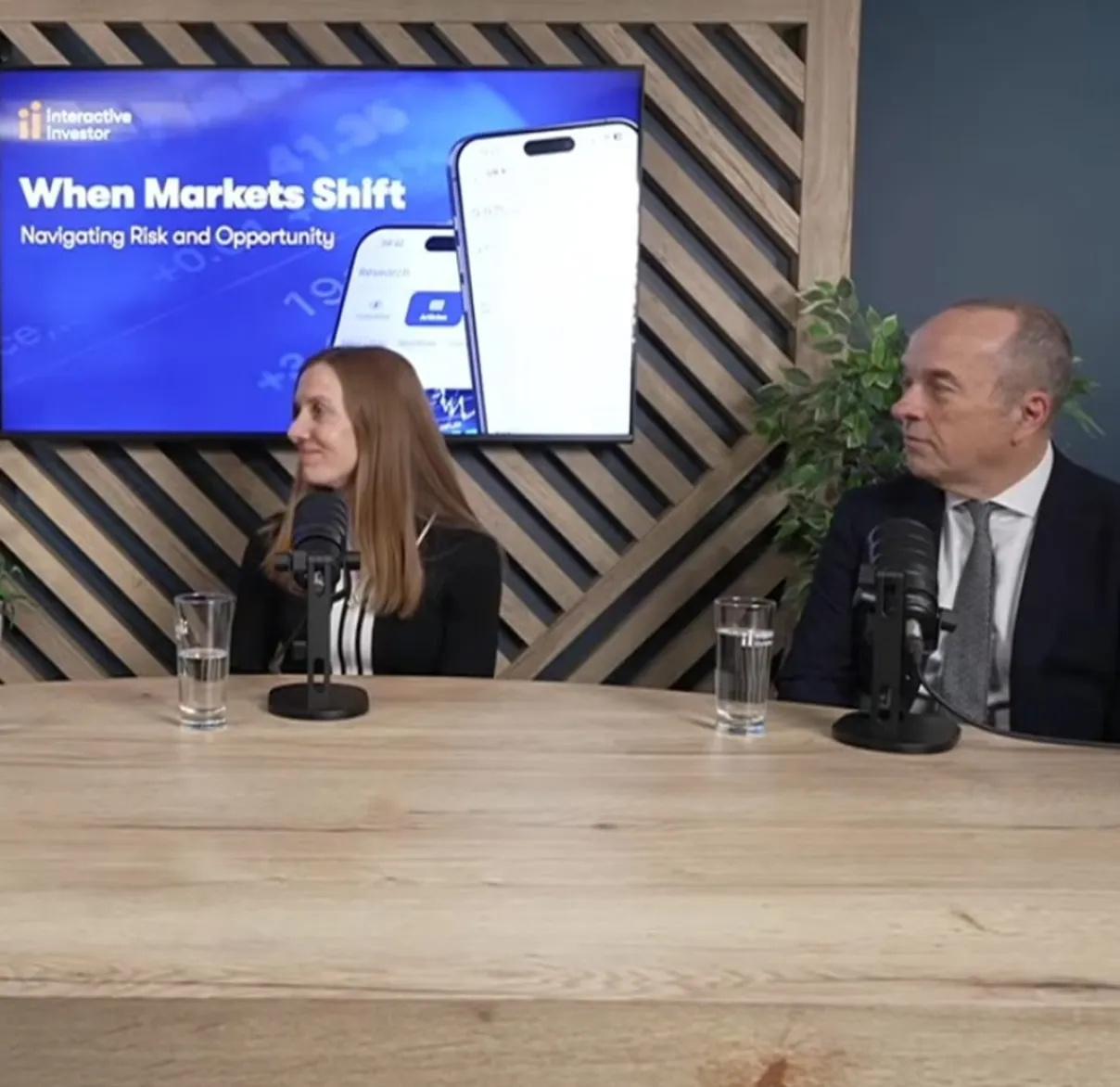
Victoria Scholar: Hello, and a very warm welcome to everyone joining us today. It’s great to have you with us. Thank you for joining us for this latest webinar.
My name is Victoria Scholar, Head of Investment at Interactive Investor, and I’ll be hosting today’s panel. We’re here to discuss When markets shift: navigating risks and opportunities.
We’re looking to get some expert perspective on what risk really means for investors, what some of the key risks are, and how to respond to them.
We’re aiming to run for about 35 to 40 minutes. We’ll start by introducing our guests, then move into a discussion, and finally open up to Q&A from you.
Before we get started, just a couple of housekeeping points. First, this webinar is for educational purposes only and does not constitute financial advice. Second, we’d love to hear from you.
We’ve already had some excellent questions through Slido, so thank you if you’ve submitted one. There’s still time to ask a question — head to Slido.com and use the code 2968604. You can add your questions there and they’ll come directly to me. The code can also be found under the YouTube webinar, and there should be a QR code on screen now.
If there’s a question you like, you can give it a thumbs up — that will push it higher up the list and make it more likely to be answered. Feel free to engage with existing questions as well.
I’m conscious of time, so let’s begin by introducing our panel.
We have David Coombs, Head of Multi-Asset Investment at Rathbones Asset Management, managing inflation-targeted funds for individual investors and charities.
We also have Tara Fitzpatrick, a multi-asset manager who co-manages Schroders’ global multi-asset portfolios on behalf of UK pension and wealth management clients.
Let’s kick off with some opening questions. Tara, I thought we’d start with a definition of risk. Managing risk is obviously central to investing — what is risk, and why is it so important for investors to understand?
Tara Fitzpatrick: Thank you, Victoria.
Risk is often distilled down to a number — a drawdown, a value-at-risk figure, or a volatility metric. But that really misses a lot of the point.
One of our fundamental beliefs is that risk is multifaceted. We need to think beyond just the number and consider what is actually posing risk. That can include both upside and downside risk.
We try to relate risk to the real world. What are the things we’re seeing that might impact asset values? When managing risk, we’re always asking how different asset classes or types of assets will react to different situations.
Ultimately, it’s about managing the path of returns — aiming for a smoother investment journey. It’s not just about risk metrics; it’s about understanding the real-world drivers and how to construct a portfolio that diversifies across different types of risk, not just numbers.
Victoria Scholar: That’s really helpful. I want to come back to diversification shortly, but David, one risk I’d like to start with is currency risk — something investors don’t always pay enough attention to.
If I’m a UK investor putting money into US equities, how should I think about movements in the dollar versus the pound and how that affects my investments?
David Coombs: It’s become increasingly important, particularly since Brexit. Both professional managers and private investors have been investing more globally.
Returns have generally been better overseas — especially in the US — and many investors have been lulled into a false sense of security because sterling has been relatively weak. That’s meant they’ve been rewarded for investing in overseas currencies for nearly a decade.
But last year, we saw a shift. Sterling strengthened by around 10% against the dollar. So even if the US market was up 10%, those gains were wiped out by currency moves.
That’s a real-world reminder of currency risk. You can do all the hard work picking investments, but if you ignore currency, those returns can disappear. One decision on currency can override dozens of good investment decisions.
Tara Fitzpatrick: Just to add to that, for sterling-based investors, owning the dollar has historically been quite helpful.
Sterling is a cyclical currency, so when equities fall, the dollar has often acted as a risk-off asset and cushioned portfolios. But as David said, we saw a change in that correlation last year, which is a really important reminder when thinking about risk.
Victoria Scholar: That’s a great point. Let’s move on to concentration risk.
When building a portfolio, we often see investors focus on individual stocks or funds without thinking about the overall picture. That can lead to too much exposure to a particular asset, region or sector.
Why is concentration risk something investors need to be mindful of, and why is diversification so important?
Tara Fitzpatrick: There are a few layers to this.
The first is obvious — you might think you’re diversified because you hold lots of investments, but actually you may still have a high concentration in a handful of companies. We’ve seen this with the S&P 500, which has become heavily concentrated in US tech.
The second layer is deeper. You need to think about what’s driving the risk.
You might hold equities and bonds and think you’re diversified, but it depends which equities and which bonds. For example, growth stocks — like tech — are very sensitive to interest rates. If your bonds are also sensitive to interest rates, both parts of your portfolio may react the same way.
So on paper, you look diversified, but in reality you’re exposed to the same underlying economic risk.
David Coombs: You see something similar with the AI trade. Investors talk about regional diversification — US, Asia, emerging markets — but in reality, the same AI-driven companies have been driving returns across regions.
So even geographic diversification isn’t always enough. You need to understand what we call factor risk — what is actually driving your portfolio.
If you’re overexposed to one theme, like AI, and it disappoints, diversification won’t help. You’ll have lots of holdings, but no real diversification.
Victoria Scholar: That’s interesting — especially given how dominant AI has been. But it’s difficult to avoid that exposure, isn’t it, given how heavily weighted passive indices are towards US tech?
David Coombs: Passive investing has accelerated this trend. It’s not an anti-passive argument, but it does create self-reinforcing behaviour.
Money flows into the largest companies, which pushes valuations higher, attracting more flows. The big get bigger.
That builds concentration risk over time. At some point, that trade reverses — and when it does, passive flows can amplify the downside because they become forced sellers.
Victoria Scholar: What types of risk do you think investors aren’t considering enough at the moment?
David Coombs: When markets are going up strongly, investors tend to forget about risk — and about patience.
There’s a fear of missing out, particularly with themes like AI. People stop wanting diversification because it might hold back returns.
But if everything in your portfolio is going up at the same time, it probably means you’re not diversified enough. It feels good, but it can be a warning sign.
Victoria Scholar: That leads nicely into behavioural risk. Tara, how do investors manage emotions — things like panic, greed or overconfidence — when making decisions?
Tara Fitzpatrick: The biggest test of your true risk tolerance is how you behave during a drawdown.
If you’re comfortable holding your investments through a downturn, you’ve probably got it right. If you become a forced seller, you haven’t.
The challenge is that you only discover this in hindsight. When markets are rising, everyone feels like they have a high risk tolerance. But that changes quickly when losses occur.
That’s why it’s critical to have a clear investment framework. It helps you stay objective and avoid reacting emotionally to short-term noise.
Geopolitical events are a good example. Markets react quickly, but the long-term impact often depends on how those events feed into the real economy — for example, through energy prices.
We use scenario analysis — a framework where we map out different economic outcomes and how they would affect growth and inflation. That allows us to respond more rationally as new information comes in.
Victoria Scholar: David, how are you thinking about geopolitical risks at the moment?
David Coombs: A lot.
The key is having a process and a plan. During periods like this, markets can create opportunities. Companies we’ve been watching for years can suddenly fall to attractive valuations.
Ideally, you want to be a buyer in these periods, not a forced seller.
We also maintain exposure to areas like oil as a structural hedge, because many crises are driven by energy prices. Even when it was unpopular, we held energy stocks for diversification reasons.
The key is discipline. You can’t predict events, but you can control how much risk you take and how you respond.
Victoria Scholar: Let’s talk about inflation. Tara, how does the current inflation risk compare with what we saw after COVID and the Russia-Ukraine conflict?
Tara Fitzpatrick: On the surface, it looks similar — geopolitical disruption affecting energy supply.
But the starting point is very different. In 2022, interest rates were extremely low, and labour markets were very tight. Today, rates are closer to neutral and labour markets are less stretched.
That means the environment is different, even if the initial shock looks similar. The key risk remains energy prices, but the magnitude and duration of inflation may differ.
Victoria Scholar: Let’s move to audience questions.
David, there’s been a lot of discussion around private credit and concerns about redemptions. Are you worried about systemic risks?
David Coombs: We’ve avoided private credit for some time. A lot of retail money flowed into it in search of higher yields, often without fully understanding the risks.
The issue is liquidity. Some investors expected to be able to exit quickly, but that was never realistic.
That said, I don’t see systemic risk. I see a potential opportunity. As money flows out, valuations may become more attractive, and better opportunities may emerge.
Victoria Scholar: Tara, a related question — what are the best defensive assets right now to hedge against equity market falls?
Tara Fitzpatrick: The key message is that there is no single reliable hedge.
You need to understand what risk you’re trying to hedge. If the risk is driven by energy prices, commodities may help. In other situations, currencies like the dollar may provide protection.
Different assets behave differently depending on the environment. There’s no one-size-fits-all solution.
David Coombs: I’d add that investors should also think about their time horizon.
If you’re constantly trying to hedge, it may suggest you’re too heavily invested or not holding enough cash for your needs. Investing should be long-term — ideally five years or more.
Trying to time markets or hedge every risk is extremely difficult, even for professionals.
Victoria Scholar: That links to another behavioural risk — trading too often. Is it important to hold your nerve in difficult times?
Tara Fitzpatrick: Absolutely. That comes back to risk tolerance.
If your portfolio is properly diversified, it gives you the ability to stay invested. Without that, you’re more likely to react emotionally.
Often, the most profitable decisions are the hardest ones — buying when markets are falling.
Victoria Scholar: We’ve had a question on commodities. Are they a good diversifier?
Tara Fitzpatrick: Commodities are not a single asset class — they behave very differently.
Gold is typically seen as a defensive asset, but it doesn’t always behave that way, especially when interest rates rise.
Industrial metals, like copper and aluminium, are more linked to economic growth and supply-demand dynamics. They can behave very differently from gold.
So again, it depends on the environment and what risk you’re trying to hedge.
David Coombs: I’d go further and say there’s no such thing as a true safe haven.
Gold can work in certain environments, particularly stagflation, but it’s not a consistent inflation hedge.
All commodities have different drivers. The key is matching the right asset to the right risk.
Victoria Scholar: One final question — can you be over-diversified?
David Coombs: Yes, particularly if you’re paying fees on multiple funds. You can end up duplicating holdings and creating inefficiencies.
Too much diversification can lead to hidden concentration and higher costs.
Victoria Scholar: That brings us to the end.
It’s been a fantastic discussion — thank you both for your insights. That was Tara Fitzpatrick and David Coombs.
Thank you very much, and goodbye.