




London Climate Action Week (LCAW) 2026 brought together an estimated 50,000 participants across 1,300 events under the theme Cooperation in a Fragmented World. Taking place against a backdrop of geopolitical tension, energy security concerns and strained public finances, the week offered a clear counterpoint to the idea that climate action is stalling. The tone was pragmatic: less about new commitments, and more about how climate goals can be delivered in the real economy.

Article last updated 25 June 2026.
The perception vs reality of data centre impact
AI dominates headlines – and with it, concerns about the energy and water demands of the data centres that power it. Yet while water stress and rising electricity demand are important issues that need addressing, zeroing in on AI companies is more than a little unfair, argues Rathbones Charity Growth & Income Fund Manager James Ayre – especially when you consider how much of our lives depends on cloud computing.
The rapid AI build-out is undeniably creating stress around power and water demand. But it’s often lost that data centres are nowhere near the largest user of either. US golf courses, for instance, use 30 times more water than US data centres. About one in seven Americans played golf at least once last year, according to the PGA. Yet virtually everyone uses data-centre-backed services daily. One is critical to our society’s standard of living, the other is a (much-loved) pastime for a few.
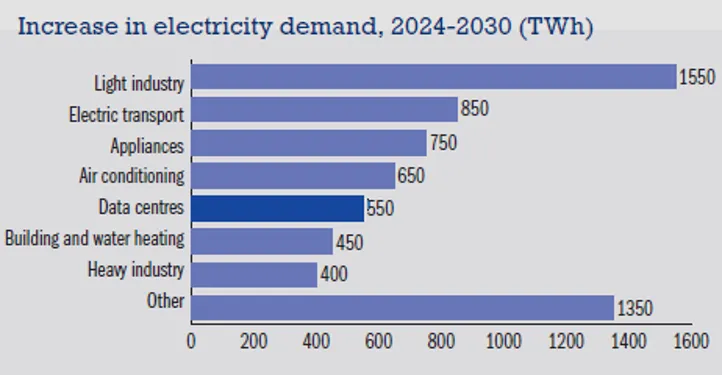
The same is true for global electricity consumption. As the chart below from the International Energy Agency’s Energy and AI report shows, the forecast increase in electricity demand from data centres to 2030 is dwarfed by, well, virtually everything else we use power for. AI itself accounts for only a fraction of data centre usage – roughly a fifth, by most estimates.
Why concerns are growing locally
So why do data centres attract such disproportionate scrutiny? Geography and the sheer speed of its growth. Data centres must be close to users to reduce latency, and close to each other for efficiency. This creates large clusters, often near population centres, where the effects on local power grids and water supplies are acutely felt. A new data centre campus in your neighbourhood is hard to ignore; a nationwide increase in industrial electricity demand is not.
The backlash is real. Data Center Watch estimates $162 billion of US data centre projects have been blocked or delayed since 2023, driven by community concerns over rising electricity bills, water consumption and quality of life. Acceptance is the first step.
Addressing the challenge and looking ahead
The AI hyperscalers – which make up 40-50% of the world’s data centres – are aware of this. Most have strategies in place to increase transparency, increase efficiency and mitigate their effects on communities.
Microsoft’s Community-First AI Infrastructure plan, launched in January, pledges to prevent local electricity bill increases, improve water-use intensity by 40% by 2030, create local jobs, pay full property taxes without special breaks, and invest in community AI training. Google has pledged to replenish more water than it consumes at its data centre sites by 2030, backed by 165 projects across 97 watersheds.
It’s not perfect, but the direction of travel is encouraging. We’re continuing to engage with companies in the tech sector on their energy and water use. The aim is to make data centre expansion something communities can support, not resist.
The concerns about power and water use are the right ones – significant improvements are needed to conserve our planet’s most precious resource and power our future at reasonable cost. But focusing on one industry minimises the issue. The largest user of global freshwater is agriculture, accounting for roughly 70% of the total. That’s roughly 5,000 times more water than data centres. And the largest polluter? Agriculture again, because of nutrient runoff, chemical leaching and intensive land use. Yet few think of farming as the biggest threat to water quality and the largest driver of water stress.