








New treatments and AI offer hope amid pricing and patent pressures.

Article last updated 10 November 2026.
Quick take
|
The results are in: the Democrats scored a resounding victory in the mid-term elections, wresting back control of both the Senate and the House of Representatives. This is what I wrote in a preview a couple of weeks ago:
“The key thing to look out for will be the magnitude of the shift in favour of the Democrats and what signals that might generate for the Presidential election in 2028. This might be one of those cases of ‘be careful what you wish for’. A more progressive President would probably be more in favour of regulating AI, which, although possibly right for humanity, might not suit the more near-sighted investment community.”
We didn’t have to wait till 2028 for investors to express their opinions, as companies exposed to spending on data centres sold off sharply. These included semiconductor manufacturers and memory providers, the companies that supply the kit to make the chips, and the highly indebted ‘neoclouds’, which rent out to customers the servers and chips on which AI computing takes place. The neoclouds’ future depends on increasing demand for computing power and the ability to fund the supply, largely with debt.
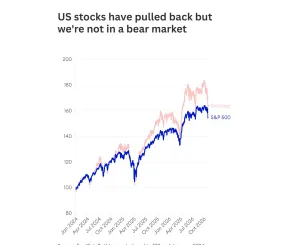
Selling was widespread on Thursday, pushing the S&P 500 Index down 4.4% and dragging global indices lower too. It was, in industry parlance, a classic ‘risk-off’ day, with only the defensive consumer staples sector eking out a 0.05% gain. By contrast, the technology sector fell almost 7%.
And yet, Wednesday had seen an initial burst of optimism. Getting past the election was viewed as a ‘clearing event’, allowing investors to focus on facts rather than speculation. The result also encouraged the belief that fears of re-escalation in the Middle East were overdone, especially with high-profile Republicans, including Vice President JD Vance, blaming the Iran War for their defeat. That led to sharp falls in the oil price, and hence hopes that interest rates might not have to rise much further, if at all. It turned out to be a bit of a ‘sucker’s rally’.
Our Head of Asset Allocation penned a piece on the day that looked at what the results might mean for domestic and foreign policy, and hence for financial markets.
AÏ (that’s French for ‘ouch’ – albeit with an 'e' on the end)
So much dust was thrown up last week that it’s going to take time for it to settle. Our Chief Investment Officer wrote a piece on Friday that put this drop into context, with a long-term frame of mind.
Let’s look at the threat to the AI trade. There had already been increasing scepticism about the sustainability of the AI-related capex boom, mainly owing to the increasingly prevalent view that it’s going to be a challenge to generate enough revenue across the industry to deliver a sufficiently high return on capital to justify the spending.
As a result, investors have demanded greater compensation in the form of higher yields on credit, while also putting a lower valuation on AI-exposed equities, especially those with higher leverage and/or a business model predicated on borrowing to build capacity. Last week’s events accelerated that trend.
Simply put, Democrat threats to delay or cancel data centre buildout and curtail development of frontier AI models weigh heavily on calculations of share price value, despite strong current conditions. Tighter regulation, reduced tax incentives, and fairer treatment for local residents, amongst other potential new burdens, add to the cost of development. Some projects might never break ground let alone break even. All of that points to a higher risk premium – investors will demand a higher earnings yield (or, to put it another way, a lower PE ratio), to hold the stocks.
One consequence is that a bird in the hand is deemed to be worth a lot more than any number of birds you can imagine in the bush. Hence the rotation into the leading hyperscalers – companies that operate computing infrastructure at a very large scale – with existing capacity. If capacity is constrained (and nobody is really disputing the rising demand for compute) then pricing power should be stronger. Furthermore, if capital spending (capex) estimates are going to be reduced, that improves free cash flow: the cash a company generates after accounting for cash outflows to support operations and maintain its capital assets. On that thesis, the credit default swap spreads of the biggest hyperscalers declined last week. A higher spread means a higher cost of insuring debt against default.
The other side of the trade that saw share price gains posted on the week by hyperscalers such as Amazon, Alphabet, and Microsoft (and a decline of less than 1% for Meta, which owns Facebook) was carnage in semiconductors, with the MSCI Global industry sub-sector index falling 13%. This has thrown up some extreme anomalies. For example, on current consensus earnings estimates as compiled by Bloomberg, leading chipmakers such as SK Hynix, Samsung, and Micron are on 2-year forward PE ratios (if we go a little far in the future, looking at forecast earnings for 2028) of 1.7x, 2.2x, and 3.3x respectively. Does that sound like a bubble? Nvidia, the leading chip designer amongst the mega-caps, is on 9x. Companies such as Cisco and Sun Microsystems were (in)famously on PEs of around 100x at the peak of the dotcom bubble!
Maybe the bubble is not in the valuations, but in the earnings themselves. There has been no hint of swingeing estimate cuts from analysts so far, although it would not be unreasonable to expect some trimming, at least. But it’s still very difficult to know by how much.
Crossed wires
US consumer staples companies overtook tech last week, year-to-date, but tech retook leadership this week
Pragmatic politics?
It’s not clear how soon the political answers will be provided. The next Congress will not be formed until 3 January . Also, it’s not the case that all of the Democrats’ wins were achieved by the more ‘progressive’ (in other words, left-wing) candidates. There’s a strong centrist representation and Congress will, in the optimistic case, try to find a balance between calming the AI-related concerns and maintaining economic momentum. Also, with an 80-odd seat majority in the House of Representatives, the Democrat leaders might be less beholden to the more extreme members.
Let’s hear it for diversification (again)!
As is often the case when markets make big moves, reports focused on the negatives, conveying a sense of doom. But balanced portfolios held up quite well (again) last week as sector and geographical diversification paid off. Whisper it quietly, but European equity markets were actually up on the week.
Government bonds also played their part, without necessarily blowing anyone’s socks off. After all, there are still those pesky fiscal deficits to consider. But prices went up (and yields went down). We’ve been more constructive on government bonds recently owing to the higher yields available. In the UK specifically, investors are also giving Andy Burnham’s government the benefit of the doubt when it comes to keeping the deficit under control (although that time bomb is ticking and needs defusing).
But there’s a lot left to unpick here, and we shouldn’t be impatient when it comes to expecting equities to resume their uptrend, which we believe they will. But neither do we see evidence to suggest a more aggressive sell-off – certainly no financial crisis (which seems to be on everyone’s worry list every time equity markets have the slightest wobble – stocks are inherently volatile). Hence the ‘amber light’. You may proceed, but exercise a little caution and look both ways!