A familiar conversation
A client in their late sixties or seventies comes in to review their will. Their pension and investments are largely untouched. They have followed some of the coverage around the April 2027 pension changes and want to understand whether anything needs to change.
You can explain the legislation.
What is often harder is the question that follows: “Am I doing the right things in the right order?”
It is not strictly a legal question, but it often lands with you - because your clients trust you, and because the way they use their assets in life now has a direct impact on what remains in their estate.
Until April 2027, that overlap was relatively contained. After it, it becomes much more central to planning.
What’s about to change
Pensions move into the IHT conversation
From 6 April 2027, most unused pension funds and pension death benefits will be included within the inheritance tax (IHT) calculation.
Around 10,500 additional estates are expected to become liable for IHT each year, with a further 38,500 likely to pay more than they otherwise would.
What remains outside scope
Some elements remain unchanged. Death-in-service lump sums and dependants’ scheme pensions stay outside scope. Transfers to a UK long-term-resident spouse, civil partner, or registered charity continue to be exempt.
The role of personal representatives
Responsibility for identifying pensions, obtaining valuations, calculating the IHT position, and settling liabilities will sit with personal representatives (PRs).
This includes:
- Obtaining valuations within 28 days of notification
- Managing potential withholding of benefits
- Using the Pensions Direct Payment Scheme where appropriate
Final HMRC guidance is expected shortly before implementation.
Why this distinction still matters
Pension wealth is being brought into the IHT calculation - not converted into a conventional estate asset.
That distinction matters. It introduces complexity around:
- Liquidity
- Administration
- The overall tax position
And it brings pensions firmly into the same planning conversation as wills and trusts.
Three numbers worth keeping in view
The effective rate
Up to 67%
In some scenarios - particularly post-75 deaths combined with additional-rate beneficiaries - the effective rate on pension wealth can be materially higher than many clients expect.
This is likely to reshape how sequencing decisions are approached.
The taper threshold
£2 million
Above this level, the residence nil-rate band begins to reduce, disappearing entirely at higher levels.
From April 2027, unused pension wealth will count towards this threshold. For some clients, this may introduce additional IHT exposure where none previously existed.
The valuation timeline
28 days
Pension scheme administrators must provide a valuation within this timeframe once notified.
For PRs, this introduces a new operational constraint into probate timelines.
These figures may not change how a will is drafted.
They do change the planning conversation beneath it.
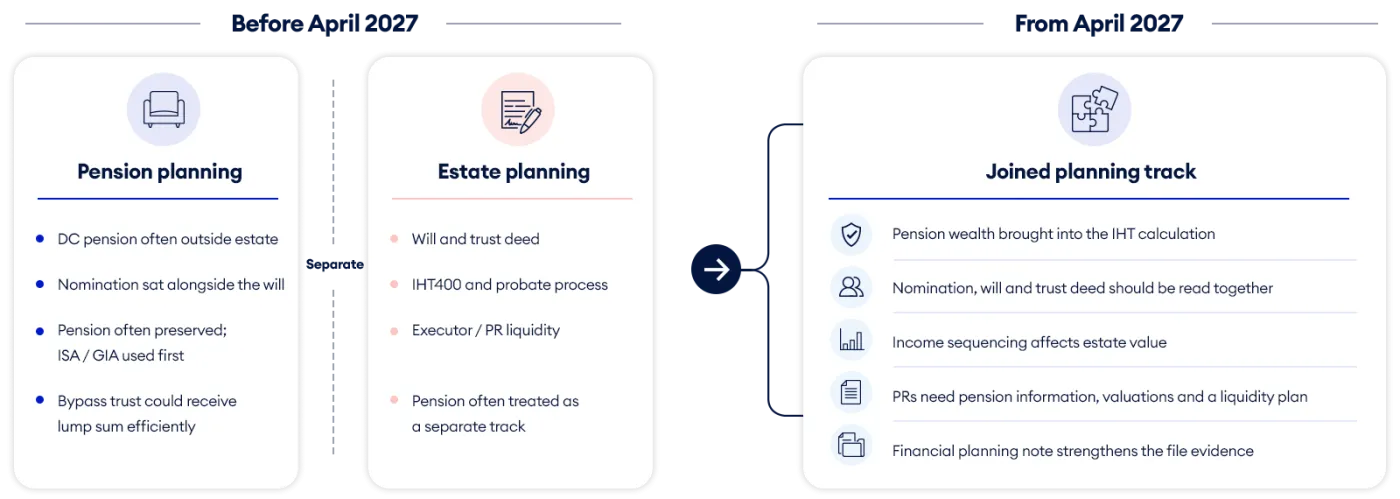
Before and after 2027
From parallel tracks to one estate-planning conversation

Key shift: the will may not change - but the planning conversation beneath it now has to.
Why this now sits in the will file
For many years, pensions and estate planning have operated on parallel tracks.
- Wills and trusts were drafted on one set of assumptions
- Pension nominations on another
From April 2027, those tracks converge.
Three practical implications tend to follow.
Spousal bypass trusts
These arrangements often relied on pension wealth remaining outside the estate for IHT purposes.
That assumption no longer consistently holds.
The structure may still be appropriate - particularly for control, protection, or succession reasons - but the tax position now requires more careful consideration.
Pension nominations
Pension nominations now form part of the wider planning framework.
While discretionary arrangements may remain in place, they no longer remove pension wealth from the IHT calculation.
Wills, trusts, and nominations should be viewed as a connected structure - with any differences clearly considered and recorded.
Life interest structures and second families
In second marriage scenarios, interactions between:
- Lifetime income needs
- Pension wealth
- Ultimate beneficiaries
become more sensitive.
The legal framework can accommodate different outcomes, but financial sequencing will determine how effectively those outcomes are delivered in practice.
Pensions are no longer a parallel planning track. They now sit alongside the will, the trust structure, and the IHT position as part of a single conversation.
The sequencing question
Historically, many clients drew from taxable investments first and left pensions untouched.
That approach was often logical when pensions sat outside the estate.
From April 2027, the position becomes more nuanced.
Drawing pension during lifetime
For some clients, using pension assets during life - within appropriate tax bands - may become a more effective way to manage overall exposure.
Surplus income gifting
Where conditions are met, gifting from surplus income can be a highly efficient tool:
- Immediately outside the estate
- No seven-year requirement
The challenge is evidencing the position clearly - which is where structured financial planning can support the legal file.
This is not a universal strategy
For some clients - particularly those with lower exposure, uncertain needs, or a preference for retaining pension assets - a different approach may remain entirely appropriate.
Sequencing remains a matter of judgement.
But it now benefits from being deliberate, documented, and aligned with the wider plan.
LPAs: a quieter consideration
A lasting power of attorney (LPA) for property and financial affairs may provide authority over pension-related decisions.
In practice, this means attorneys may influence:
- Drawdown
- Withdrawals
- Investment decisions
Historically, those decisions were primarily financial.
From April 2027, they also sit within the estate planning context.
This raises practical questions:
- Do attorneys understand the broader plan?
- Has the sequencing approach been clearly set out?
Often, a short planning note prepared in advance can provide useful clarity.
Three situations you may recognise
The pension-rich widows
The will is straightforward. The asset mix is not.
The planning question sits behind the legal structure - and benefits from being tested before changes are finalised.
The second marriage
Balancing income for a surviving spouse with provision for children requires careful alignment.
What was previously efficient by design may now need more explicit modelling.
The vulnerable beneficiary
Existing trust structures may still be appropriate.
However, the assumptions behind them - particularly around tax treatment - may need revisiting.
In these cases, planning insight often needs to come first, with drafting following.
Five prompts for a joined-up approach
- Is the pension nomination aligned with the will?
- Has affordability been considered before gifting discussions begin?
- Do legacy trust structures reflect the current tax position?
- Is there a clear plan for meeting any IHT liability?
- Is there likely to be unused pension wealth at death?
These questions do not change the role of legal advice. They help ensure it is working alongside the broader plan.
Where a Rathbones financial planner fits
The role is not to replace legal expertise.
It is to support it - by providing a clear view of how financial decisions interact with the legal framework.
The most useful output is often simple:
- How income will be funded
- What is likely to remain in the estate
- Where liquidity sits
- Whether the overall structure is aligned
This creates a practical bridge between advice and outcome.
A shared objective
For clients, the question is straightforward:
will this plan work for my family?
For advisers, it is equally important:
will it continue to work as circumstances evolve?
From April 2027, those questions increasingly point in the same direction - towards a more joined-up, considered approach to legal and financial planning. Get in touch if we can help you or your client.