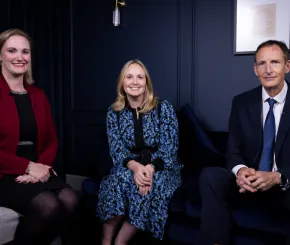




Join our experts as they explore planning, structuring, and investing for a changing world.
Article last updated 29 June 2026.
Saving for retirement is only half the story. How you turn that pot into a sustainable, flexible income, one that can flex with markets, longer lifespans, and the moments that matter, is just as important. In our recent webinar, Rathbones' Financial Planning Divisional Lead, Rebecca Williams, and Senior Investment Director, Jane Sydenham, joined host Myron Jobson to talk through what good retirement planning looks like today. Here are the key takeaways for anyone thinking about, or already in, retirement.
Retirement isn't a one-off decision
The shift from saving to spending is one of the biggest financial and emotional transitions of your life. For decades, you've built up a pot. Suddenly, the discipline reverses, and watching the balance go down rather than up can feel uncomfortable, even when it's entirely planned for.
That's why we treat retirement as an ongoing partnership rather than a single decision. Your financial planner and investment manager work side by side, talking regularly with you and with each other, adapting your plan as your circumstances evolve. The earlier those conversations begin, the smoother the handover from working life to retired life tends to be.
The transition is psychological as much as financial
Many people are surprised by how much they miss the structure of work, even when they've looked forward to retirement for years. A sense of purpose, identity, and routine can take time to rebuild. Phased retirement like part-time work, consultancy, or charity roles, can soften that cliff edge and give a sense of continuity while you find your feet.
For couples and civil partners, retirement is rarely a solo project. Plans should consider both partners' income, tax positions, and what happens if one passes away first, particularly given women, on average, live longer than men.
How much is "enough"? It depends on the life you want
There's no universal number. Your "enough" depends on the retirement you picture: a camping weekend in the UK, two weeks in the Med, or all-inclusive five-star travel will each call for very different budgets.
Cashflow modelling is the foundation we use to bring this to life. Think of it as a personal balance sheet that maps your current position, expected spending, larger one-off costs like gifts, and likely income streams over time. It isn't a crystal ball, but it gives you a realistic picture of the future and often reveals that clients can afford to relax and enjoy themselves a little more than they thought.
Plan for a longer retirement than your parents had
If you're 65 today, you have a meaningful chance of living into your 90s, and an 8% chance of reaching 100. That means retirement now spans 25 to 30 years for many people, not the 10 to 15 of previous generations. Layer in the likelihood of needing some form of care later in life, where care costs in London can reach £2,000 a week, and the case for a longer-term plan becomes clear.
This is one reason why "de-risking" too early can quietly become the biggest risk of all. Over a 20-year-plus horizon, not having enough exposure to the stock market makes it almost certain that your money will fall behind inflation. A measured, considered investment approach, rather than retreating wholesale into cash and bonds, tends to deliver better long-term outcomes.
A "fixed and flex" approach to income
The pension landscape today offers two broad routes: a guaranteed income for life via an annuity, or the flexibility of drawdown, where you take what you need, when you need it. Many of our clients find a blend of the two works well.
A common approach is to use an annuity to cover essential, non-negotiable spending like bills and food, giving certainty for life. Anything beyond that sits in flexible investments you can draw on for holidays, a new car, helping family, or later-life care. Inflation-linked annuities are well worth considering: with a pint of milk doubling in price over 20 years, the purchasing power of a flat income can quietly erode.
Total return and why dividends aren't the whole story
The old rule of "never touch the capital, only spend the income" doesn't always fit modern portfolios. Many of today's strongest-performing companies don't pay dividends at all. Instead, we take a total return approach: drawing a sustainable percentage from your portfolio, blending some capital and some income, so you benefit from the growth of every part of your investments.
The 4% rule is a useful starting point, but it isn't gospel. The right withdrawal rate for you depends on your assets, your goals, market conditions, interest rates, and inflation. A tailored plan will always beat a rule of thumb.
Managing sequencing risk, market noise, and short-term shocks
A market shock just as you start drawing down is one of the hardest scenarios to recover from, which is what we call sequencing risk. A good plan anticipates this. We typically hold around six months of expenditure in instant-access cash, plus around a year's worth of income in cash for those drawing down, so you're never forced to sell investments at the wrong moment.
When geopolitical headlines hit such as a conflict, a leadership contest, the Budget, markets often react sharply and then recover. The world economy is broad and growing, and the FTSE 100 derives nearly 80% of its earnings overseas, so even UK-based investors are far less exposed to domestic politics than the headlines suggest. Staying invested, and staying on course, almost always serves investors better than reacting to noise.
Property, tax, and the changes coming in April 2027
From April 2027, unused pension funds will fall within the scope of inheritance tax, a significant change after a decade of pensions being treated very differently. Our advice is simple: don't make knee-jerk decisions. There's time to plan thoughtfully between now and then.
A practical step is what's been called "dying tidy", which means consolidating multiple pension pots where it makes sense, keeping records organised, and making sure the people who will one day administer your estate know where everything is. It eases the burden on loved ones at a difficult time and reduces the risk of mistakes.
Property is increasingly part of retirement conversations too. The Financial Conduct Authority has acknowledged that, given how much wealth is held in homes, it can't be ignored. Whether you stay put, downsize, or release equity, your home is part of the wider picture and our report, Don't Bet the House, explores this in more detail.
Gifting now, with confidence
Many clients want to enjoy their legacy while they're still here, helping family or friends with school fees, a first home, or a meaningful experience together. That's a wonderful thing to be able to do, but it should follow, not precede, a clear view of your own long-term needs.
A robust cashflow plan shows what you can comfortably give without putting your own security at risk. In our experience, seeing the numbers clearly helps people find the right balance, whether that means feeling confident to give a little more, or recognising where it makes sense to hold back. Either way, it's about making informed decisions that work for you and the people you care about.
Talking about money with the next generation
Conversations about wealth and inheritance can feel awkward, but they don't have to be. Pick a calm moment, around the kitchen table rather than in passing. Do a little preparation: decide what you want to share, and what you'd like to come out of the conversation. Telling your own wealth story like how you built it, what shaped your approach to money, is often a natural way in. And regular, smaller conversations tend to work better than one big reveal.
Two things to take away
If you remember nothing else, take these two ideas with you.
- Think ahead. The more notice you give yourself, the smoother every transition will be, from working life into retirement, and through the chapters that follow.
- Make a plan. And if you're already in retirement without one, it's never too late to start. The peace of mind that comes from knowing your financial security is pinned down lets you focus on everything else: the family, the travel, the time, the life.
How Rathbones can help
A well-built retirement plan quietly evolves with you. It allows for the good years and the harder ones, the unexpected and the long-awaited. Whether you're approaching retirement, recently retired, or thinking about how to pass wealth on, our financial planners and investment managers work together to help you stay confident and in control.
If you're already a Rathbones client, please speak to your usual contact. If you're new to Rathbones, you can get in touch via the enquiry form below to start the conversation.
This article is for information only and does not consistute personal financial, investment or tax advice. You should seek professional advice based on your individual circumstances before making any financial decision. A note that any forward-looking views are based on current rules and may change.