Transcript
Speakers:
• Gemma Gooch – Head of Charities Distribution, Rathbones
• Matt Crossman – Stewardship Director, Rathbones
• Verity Harding – AI Specialist and Keynote Speaker
Introducing the AI keynote
Gemma: Our final session turns to AI and our keynote speaker. It would be hard to pick a more timely moment for this discussion.
In the last few weeks alone, some of the people behind the world’s most powerful AI systems have warned that development is moving too fast. Some have suggested there is a 10% chance it could destroy humanity. At the same time, President Trump has dismissed these concerns. Former presidents, presidential hopefuls and some of the biggest names in Silicon Valley have lined up on both sides of the argument.
What is striking, however, is that no one disagrees that AI and this technology are consequential. The disagreement is about how fast development should proceed and who should decide.
That is the backdrop against which charities are being asked to make their own choices about AI: how they fundraise, serve their beneficiaries, govern and, of course, invest.
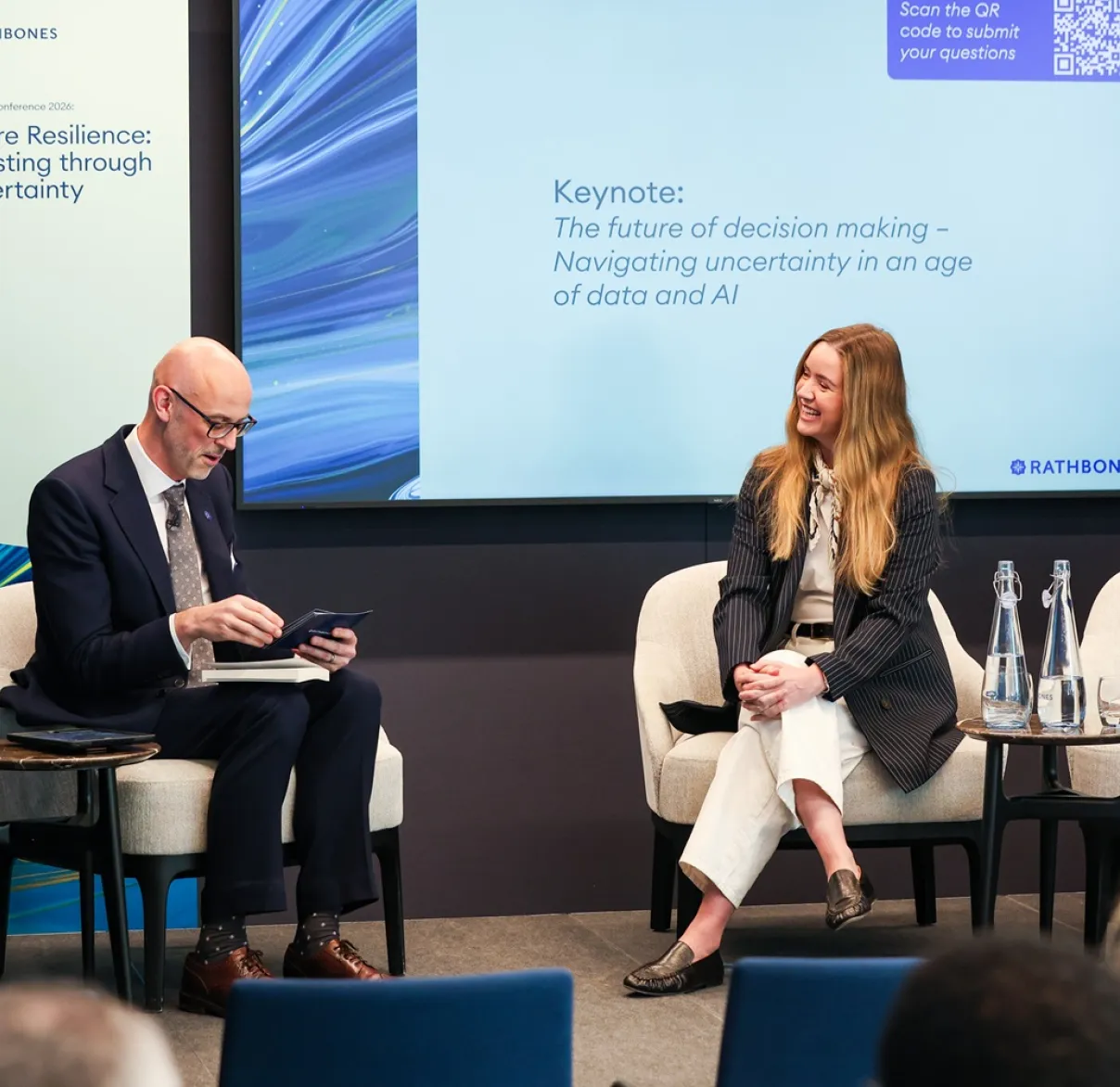
We are delighted to be joined by Verity Harding, a leading voice on AI and its wider implications. To introduce Verity and set the scene for the discussion, please welcome Matt Crossman once again.
Matt: Thank you, everyone. You have got me again, I’m afraid, as I am stepping in for David Cox, who sends his apologies.
We are going to give you a real opportunity to ask questions throughout this session, so please scan the QR code and contribute. I will leave plenty of time for open dialogue.
It is the final session and we are turning our attention to one of the forces creating both the greatest opportunity and the greatest uncertainty for organisations around the world: artificial intelligence.
For charities, this is not simply a technological discussion. AI is already beginning to influence how organisations understand need, allocate resources, communicate with supporters, deliver services and make decisions. It also raises important questions about accountability, trust and the continuing importance of human judgement.
Verity was named one of the TIME100 most influential people in AI. She is a leading expert in AI technology and public policy, the founder of Formation Advisory and Director of the AI and Geopolitics Project at the University of Cambridge.
Her debut book, AI Needs You, was published in 2024. Her career has been spent at the intersection of technology and democracy, including a decade at Alphabet and experience advising in government.
Distinguishing the signal from the noise
Matt: You have been engaging with these issues for more than a decade. AI captured most people’s imagination with ChatGPT, but we are now in a new phase in which the language is becoming increasingly dramatic.
Some people see AI as transformative, while others see considerable risk. For charity leaders who will never be full-time technology experts, how can we distinguish the signal from the noise? How concerned should we be, and how much should we be looking to embrace the technology?
Verity: Firstly, I should apologise on behalf of my industry for frightening everybody so much. More seriously, I understand the discombobulation and cognitive dissonance people experience when the industry says, on one day, that this technology is transformative and will do amazing things, before saying the next day that it might kill everyone.
It is understandable that people feel unsettled in that environment.
I have worked in AI policy for more than a decade. Before that, I worked in technology security policy and on national security and technology within government. We are living through a longer period of change involving digital technology, of which AI is the latest iteration.
People often describe AI as a new industrial revolution. I see it as part of the broader digital revolution we have experienced over several decades, including the early internet, personal computing, social media, major technology companies, smartphones and the app economy.
This digital revolution has created an enormous amount of data and content that the human brain can no longer navigate effectively. AI has therefore arrived as a way for us to process information, identify patterns, improve understanding and take advantage of what we have created over the past few decades.
Healthcare is a good example. A charity may have a large amount of data from which it wants to draw insights, and AI might enable it to do that. That is the promise, and it is exciting.
At the same time, all new technology brings challenges, fear and genuine problems. Social media did. Internet communications did. Digital banking brought benefits, but it also brought cybersecurity incidents.
I therefore see AI as precedented, rather than unprecedented. My concern is that the fear being created around it will make people less likely to realise the opportunities.
Putting AI risks into context
Verity: Some people believe AI poses an existential risk to humanity. I am not one of them.
I believe it poses risks, including serious cybersecurity risks, some of which already exist. These may be different in nature or more pronounced in certain areas. That should not be downplayed, but I do not believe AI presents an existential risk to humanity.
Technology is shaped by the political, societal and economic culture of its time. AI is currently acting as a mirror, reflecting who we are as a society.
Particularly in the West, there is division, polarisation, a lack of trust in institutions and uncertainty about major geopolitical and economic shifts. AI is viewed in that context and can easily become another item on a list of frightening developments.
My concern is that this prevents organisations from realising the opportunities. The aim should not be to downplay the risks, but to put them into context and bring some calm to the debate.
Credible opportunities for charities
Matt: Many charities are under pressure to deliver more with limited resources. At a headline level, much of what we hear about AI concerns efficiency and productivity. What do you see as the most credible opportunities for AI to help charities improve their effectiveness?
Verity: I recently read a report on AI and non-profits. It suggested that adoption in the non-profit sector was broadly similar to adoption in the for-profit sector, at around 90%.
However, when I looked more closely at how organisations were using it, the applications were fairly basic. People were generating first drafts or checking spelling and grammar. They were primarily using the chatbot element of AI.
The technology is moving beyond that towards productivity tools and what is sometimes called agentic AI. This is the idea that AI systems can work for you and carry out parts of the work that need to be done.
That is particularly important for the non-profit sector because, in the current environment, government funding is being cut and organisations are being asked to do more with less.
I do not see AI as being about removing people and replacing them with machines. That is not how it appears in the businesses I work with.
It is about removing some of the work that prevents people from concentrating on the things only they can do. Charity trustees may identify with that. There are things only they can do, but they may spend a relatively small percentage of their time doing them because they also have administration and other tasks to manage.
The opportunity is to retain your people while making them more productive, reaching more people or helping them reach existing audiences in a more targeted way.
AI will change how charities work, but it will also change the environment in which they operate. For example, if a charity’s work is affected by weather forecasting, improvements in AI forecasting could change how it supports people.
Starting with organisational strategy
Verity: There are several reasons why organisations currently use AI in a limited way.
One is expertise. People do not necessarily feel capable of building an AI agent and allowing it to undertake work. Another is general fear. People hear that AI is a productivity tool, but also hear claims that it might kill everyone. Understandably, they do not want to do anything harmful.
Strategy is another issue. Organisations need to understand why they are using AI.
When I speak to politicians and other leaders, I tell them not to begin by reacting to AI. They should first work out what sort of society and future they are trying to build. They can then consider how AI might help them get there, or how it might hinder them and need to be managed.
The same is true for any organisation. What is your strategy? What are you trying to achieve? How can AI help you? It may not be able to help with a particular objective, and that is fine too.
Governance and trustee oversight
Matt: As a trustee or board member, what should the governance response be to the potential opportunities and risks? Should organisations adopt broad principles or create detailed policies?
Verity: It is difficult to give generic advice because the answer is highly specific to the organisation and its context.
Principles have a place. If you are at an early stage, have nervous employees or want to take a consultative and collaborative approach, principles can be useful.
My caution is that principles can represent a snapshot in time. The technology is developing quickly, and an organisation with limited resources may put considerable effort into creating perfect principles that are not sufficiently agile as the technology changes.
If you want direct, AI-specific oversight, you might instead establish an ad hoc group that can convene when AI-related decisions need to be made. Most organisations will already have values through which they see the world. A smaller group from the board, executive leadership team or both can apply those values to particular decisions.
AI does not necessarily need to be a separate part of an organisation’s strategy. You can have an organisational strategy and then consider how AI might help deliver it.
Boards and trustees should provide challenge by asking whether the organisation is using AI enough and thinking ambitiously enough about how technology might improve its work. They should also provide caution where required.
An organisation would have to be relatively large before I would recommend establishing extensive AI principles, an AI ethics committee and a separate governance structure. Such approaches can work, but increasingly I encourage resource-constrained organisations to take a more agile approach.
Lessons from previous technological change
Matt: Your book uses the space race, IVF and the development of the internet as examples. What does history teach us about managing transformative technologies?
Verity: The bulk of the book is a political history of technology. It examines the space race, early biotechnology, particularly IVF and human embryology research, and the internet.
We have experienced transformative technologies before. AI may be new, but invention and progress are not.
People often reach for nuclear weapons as a historical analogy for AI. I do not believe AI resembles nuclear weapons in many important ways, so I do not find that framing helpful.
The overarching lesson from my research is that it is incorrect to think of technology as something that simply arrives and changes society. The reverse is also true. The culture and values of the time profoundly influence the science and technology we develop.
People built electric vehicles decades ago, for example, but they did not receive the funding required to take off. At that point, people were not sufficiently concerned about climate change to invest in them.
Funding, regulation and public popularity are all influenced by the political and cultural climate.
Technology as a human choice
Verity: The internet we have today did not have to look this way. People worked hard to keep it relatively open and free.
Technology is very human. It is not inevitable or something that simply arrives and must be accepted as it is. Human beings shape it.
Matt: In the space-race example, you discuss President Kennedy’s role in shaping a global-commons approach to space.
Verity: Yes. When astronauts left a plaque on the Moon bearing the words “We came in peace for all mankind”, it was not simply a pleasant phrase.
It reflected a global treaty agreed through the United Nations two years before anyone stepped on the Moon. The world agreed that space would be used peacefully and for the benefit of humanity.
It did not have to be that way. We do not have nuclear weapons orbiting above us because of that treaty and because people came together to negotiate and make decisions.
Leadership is important, but advocacy also matters. The way people use technology and what they use it for help shape the eventual outcome.
Creating effective public dialogue
Matt: Do we have an opportunity for that sort of societal intervention around AI?
Verity: I have been involved in many international discussions about AI, including G7 discussions in 2018. Those discussions led to agreement that an international body was required. A body was established, but it did not achieve what it needed to achieve, partly because some larger countries did not use it as effectively as they could have done.
Regulation is both top down and bottom up. More people are now educated about AI, and protests concerning data centres are shaping how politicians respond.
I feel positive because many people want to discuss AI, although there can be a leadership vacuum. It is encouraging when non-traditional leaders create space for people to come together and have a dialogue.
There is a moment now in which things have opened up, but the atmosphere is febrile. The Warnock Commission, which considered the regulation of early biotechnology, demonstrates the value of deliberative, interdisciplinary and multilateral processes.
These inflection points are rare. When they happen, the cards are in the air and can fall in different places. That can feel unnerving, but it is also an opportunity to influence where they land.
Building practical AI knowledge
Matt: With technology developing so quickly, what advice would you give people about keeping up to date with the latest tools and opportunities?
Verity: Many large AI and technology companies offer discounted tools or free training for non-profits. One approach is to take advantage of those offers while remembering that the companies are also trying to sell something.
At the very least, the training can be an effective way to develop skills.
The best way to understand the technology is to use it. Try building something using the tools available to you. That gives you a stronger sense of what the technology can do.
It will also help you ask better questions. You may find yourself saying, “I know this is possible, so why are we not considering it?”
You may not be an AI expert, but you are an expert in your own area. If you work with young people, for example, you already know that their safety must be a priority. Anything you do with AI should be considered in that context.
People should not forget their own expertise. AI can feel intimidating and gatekept, but subject expertise is highly relevant because the technology is so pervasive. AI needs you.
AI, young people and the future of work
Matt: What is your view on youth employment and the future of work in the context of AI?
Verity: This is one reason I am frustrated by how much of the conversation has become frightening. I think it is irresponsible for companies to frighten people, particularly young people who have already experienced disruption from the pandemic.
New technologies undoubtedly change work, but there is no historical evidence of technology causing mass unemployment across an economy. Pandemics and wars have caused major spikes in unemployment, but technology has not.
Technology has affected particular roles, and some people’s work will change. That should not be dismissed. However, the data does not currently demonstrate that we will experience the huge wave of unemployment some people predict.
There are signs of problems with youth unemployment, but it is not clear that these are directly related to AI. AI may play a role, but factors such as the wider economy, employer National Insurance contributions and nervousness about recruitment may also be relevant.
This is an example of a discussion that begins with AI but is really about a broader set of economic issues. An AI strategy cannot be isolated from an organisation’s or country’s wider growth strategy.
Environmental impacts and data centres
Matt: How should environmental charities approach investing in and using AI while remaining true to their environmental objectives?
Verity: There is a school of thought that AI is particularly harmful to the environment. This usually appears in discussions about data centres, their energy requirements, emissions and water use.
I have tried to examine the underlying data and evidence. I have not yet been convinced that AI is intrinsically worse than our existing use of digital technology and electricity.
People may say that using ChatGPT for a task consumes a particular amount of water, but conventional internet searches and other digital activities also consume resources.
Environmental charities should look carefully at the data and reach their own conclusions. I would not want them to exclude themselves from the benefits of the technology because of assumptions that may not be supported by the evidence.
AI is likely to be transformative in many positive ways, and non-profits are among the organisations that could benefit substantially.
Matt: This is a trend we are following at Rathbones. Our Centre of Excellence team is engaging on the environmental impact of data centres, and investors are increasingly scrutinising the issue.
We have already seen progress in data-centre design and water use. It is still early, and the infrastructure is likely to become more efficient.
Access, affordability and inequality
Matt: Can AI help address technological inequality, or will it make inequality worse? What happens to organisations that cannot afford access?
Verity: Better-resourced non-profits are more able to use AI, and the same is true in the private sector. Organisations that can afford technical expertise or consultants are likely to have an advantage.
The potential silver lining is that AI tools may reduce workloads and widen access to services that organisations could not previously afford.
Advanced data processing, pattern recognition and some types of financial, legal or tax support might become more affordable. There is therefore some potential for equalisation, but I would not want to give an excessively positive answer.
The tools can be expensive and there will be losers, although we do not yet know precisely where they will be. The industry has not settled. Open-source models may become more popular because they are cheaper and more customisable.
Some large companies are also questioning whether they are receiving sufficient returns from their AI spending. It has not yet become clear where the market will settle.
Advice for leaders
Matt: If you had a minute with Andy Burnham tomorrow, what would you say to him about AI investment, adoption and the economy?
Verity: I would tell him to know his own mind and listen to a wide range of people, not only the technology industry.
The industry should have a seat at the table. Its leaders can be helpful thought partners, but they often come from a relatively narrow perspective.
Leaders should also speak to business leaders, non-profit leaders and people working on the ground. Often, the people with the most direct experience of AI are workers whose jobs already involve it.
Rather than deciding from the top that AI will be used in the NHS, leaders should speak to the people already using it and understand what is happening.
I would also encourage him to look beyond the headlines and the narrow group of recognised AI experts. AI is about everyone, and people should not feel excluded from the discussion.
If the UK wants to be a world leader in science and technology, it cannot have only an AI strategy. It must create an environment in which people want to conduct science, establish companies, grow start-ups and employ people.
The same principle applies to the organisations in this room. Do not begin with, “We have to use AI, so where can we put it?” At its best, AI should be a tool that helps you achieve what you are already trying to accomplish.
Trust your expertise and your judgement.
Key messages from the discussion
Matt: That is excellent advice for Andy Burnham and everyone in the room.
Verity, thank you for joining us for such a thought-provoking and fascinating discussion. Copies of the book are available for every delegate.
The clearest message is that AI is not a distant technological conversation. It is something in which we should all take an interest and to which we should bring our voices and curiosity.
It is also a leadership and governance question that asks organisations to think carefully about their values and purpose.
The Charity Commission has resisted issuing specific AI guidance and has instead encouraged charities to consider it through the existing framework of trustee duties.
Building future resilience
Gemma: Thank you very much, Verity and Matt. That was a fascinating and thought-provoking conversation.
We have covered four distinct topics today, but they point towards the same conclusion: resilience is not something charities find. It is something they build deliberately over time.
First, choosing not to invest is itself a decision, and it carries risk. The Charity Commission has identified financial resilience as the sector’s biggest systemic risk.
Around two in five charities are spending more than they receive, yet more than half of charities with income above £500,000 hold no long-term investments. This leaves an estimated £30 billion in cash losing value in real terms each year.
For many charity portfolios, the greatest threat is not a bad investment decision. It is making no decision at all.
Second, resilience starts with governance. We cannot control markets, geopolitics or economic shocks, but we can control the quality of our decision-making and ensure we have the right skills and people involved.
Clear objectives, strong governance and regular challenge create organisations that are better prepared for uncertainty. The boards that navigate crises most effectively are usually those that did the hard work before the crisis arrived.
Third, your capital carries influence. Stewardship is not a soft extra. It is one of the most powerful tools available to align investments with your mission and values, and to help drive positive societal change.
Fourth, technology is human and human beings shape technology.
What future resilience means to charities
Delegate montage: Future resilience means investing in scientific research and applying that research in the real world to ensure it has the greatest possible impact.
It means investing in firms that are working to reduce their biodiversity and climate footprints.
Resilience means building systems that not only reduce waste but also help regenerate and replenish nature.
For infrastructure charities, resilience means secure funding. Many organisations are stretched and struggling to stay afloat in the current funding climate.
It means enabling people and communities to thrive. For membership organisations, resilience also means maintaining engagement with members and the people they support.
Closing remarks
Gemma: I would like to thank all our speakers, chairs and panellists for sharing their expertise so generously. I am sure the discussions have given you plenty to take back to your organisations.
Rathbones is proud to partner with the charity sector and the people who lead it. We look forward to continuing our conversations and working with you in the months ahead.
Our speakers and many members of the Rathbones team are here for the drinks and networking reception, so please take the opportunity to continue the discussion.
Thank you for joining us, for your engagement and questions throughout the day, and for everything you do for your organisations, causes,







_0.jpg?changed=1790591353)
.jpg?changed=1790581581)